Pol-Grappein bivouac, from the Valnontey car park

Edited by:
Gian Mario Navillod
Updated at: 07/06/2026
Access
Road Navigation
At the motorway junction of Aosta West, enter the roundabout and take the second exit following the signs for / Cogne / Aymavilles. Continue on for 20.0km (20.0km) to the roundabout at the entrance to Cogne, where take the first exit onto Avenue G.F. Cavagnet (350m, 20.35km). Continue on Via Bourgeois (120m, 20.5km), then turn right onto Rue Grand Paradis. Follow Rue Grand Paradis for 2.4km (22.9km), continue on Frazione Valnontey for 210m (23.1km) and turn right to reach the car park.
Parking
At the end of the road is the 🅿️ car park in Valnontey, the access point to the Gran Paradiso National Park. Check on site for access conditions and any seasonal restrictions imposed by the park authority.
Access by public transport
The Valnontey car park can be reached by the Cogne urban circular line run by SVAP. The reference stop is Cogne Valnontey. The winter service runs every weekday and on public holidays, except 25 December and the summer period; the runs serving the Valnontey stop depart from Cogne Revettaz at 09:00, 10:05, 11:10, 12:40 and 15:00, arriving in Valnontey at 09:25, 10:30, 11:35, 13:05 and 15:25 respectively. For updated timetables please consult the timetable SVAP - Cogne Urban Line.
Distance and travel time
🕒Travel time: 35 minutes
📏 Distance: 23.5km
GPS navigation
Information note
The information provided has been verified as of the date of the survey of the itinerary. Before departure, it is recommended to check possible changes in the route or road conditions. Please consult Google Maps or Apple Maps for the latest information.
.Introduction
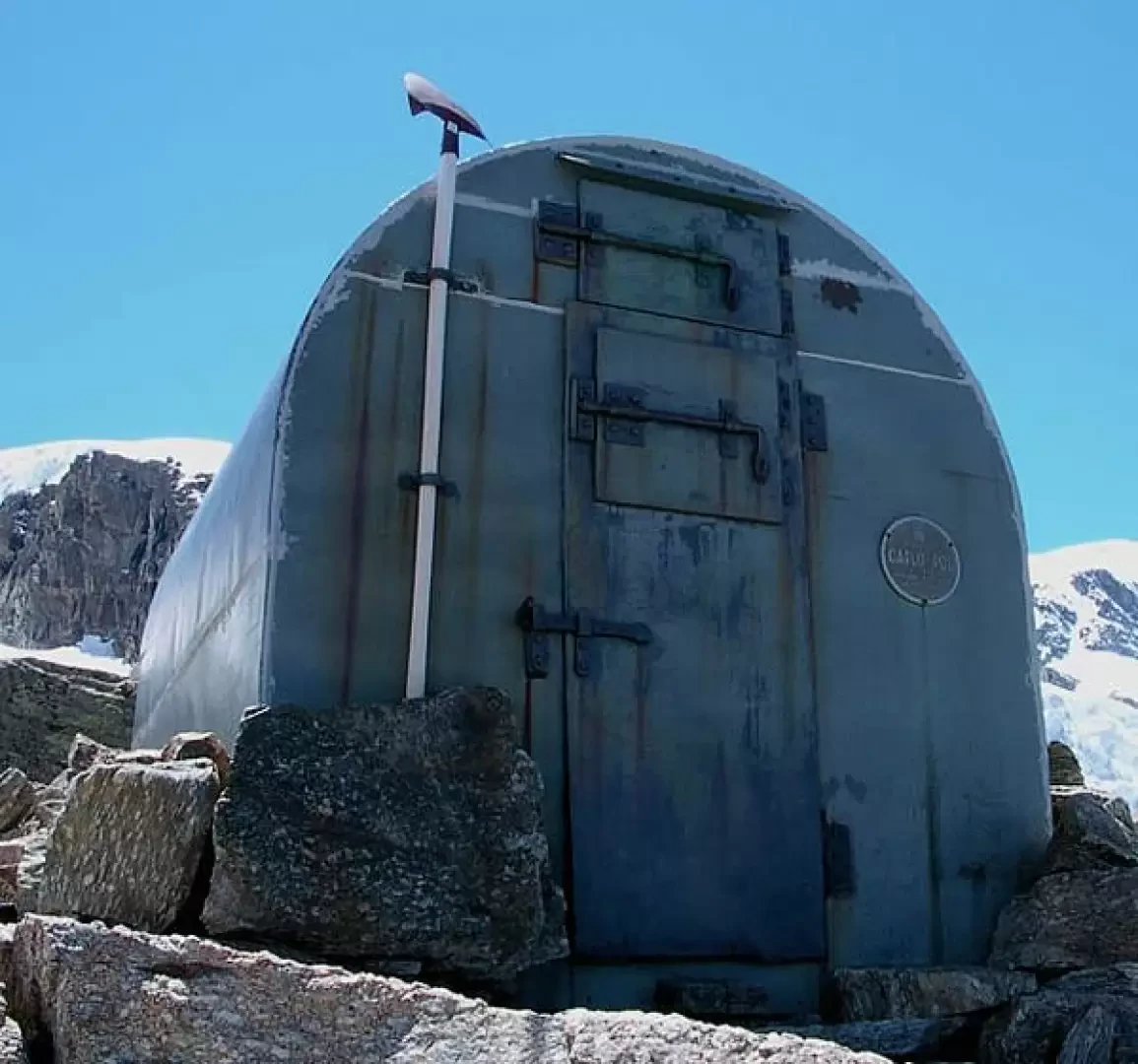
The Pol bivouac is built in one of the most beautiful places in the entire Aosta Valley. It is located in the heart of the Gran Paradiso National Park, surrounded by the Tribolazione glacier and suspended over Valnontey. From the rocky terrace in front, the Matterhorn and Monte Rosa can be seen on the horizon, with the Money glacier in the foreground. Behind, the dazzling splendour of the Tribolazione glacier and the Gran Paradiso massif. Access to this splendid place is reserved for mountaineers: the access route is poorly signposted, and there are numerous exposed sections prone to landslides or rock falls. Some chains help in the progression but in bad weather the risk of fatal accidents is high.
Description
Following the hiking signposts, we set off along the dirt road that runs along the bottom of the valley, on the right the Valnontey stream rushes through the banks. On the left, the small buildings of the Gran Paradiso campsite, the last in the valley, can be glimpsed among the tents. At dusk and early in the morning, foxes roam these places. With a little luck, it is possible to see these beautiful animals up close, which elsewhere hunting has made wary. A little further on, the path for Plan de Tournetta branches off to the left, just opposite the bridge to Leuttaz. We continue along the dirt track that crosses some coniferous thickets until we arrive at David, a beautiful, carefully restored mountain house. Behind it we can see a rascard: the rural building built with larch trunks that was once used as a barn, haystack and for threshing grain. In the Cogne dialect, this small nucleus of buildings was called lo mayen de Davit, David's hut, and is mentioned in Celestino Guichardaz and Andrea Fassò's volume on the Franco-Provençal dialect of Cogne, a very interesting study on the daily life of this community caught in the transition between peasant and post-industrial civilisation. A little further on, we cross a scrub of larch trees grown among the large boulders of an ancient landslide where chamois occasionally come down to ruminate. A small straight stretch leads to the beginning of the village of Vermiana: a handful of houses, less than a dozen, clustered around the dirt road that runs along the valley floor. Some of them have been restored but most are still abandoned, having lost their function of supporting self-sufficient agriculture, which was practised in Valle d'Aosta until the mid-20th century. Each family made a living from raising a few cows, a few sheep and, in the wealthier ones, pigs, which were slaughtered in the autumn when the first cold weather arrived. The kitchen garden provided the vegetables and cereals and potatoes were grown in the fields. Therefore, in each village there were stables and barns for storing fodder and cereal ears before threshing, the barn area for threshing grain, the cellar for storing foodstuffs, the milk room, and the few rooms used by family members. From Vermianaz, continue along the dirt road until you find the start of path no. 22 on the left for the bivouacs of the upper Valnontey. (A little further on, the road stops near the ford on the Valnontey stream). Take the path, which is quite narrow at first but then widens out to the majestic width of the royal hunting roads. One walks among patches of conifers, numerous larches and a few spruces. In the undergrowth, the red flowers of the rhododendrons stand out in early summer. After leaving the fork to the left, from which the path to the Money bivouac branches off, we cross a flat section completely uncovered. High against the sky, one can see the Testa di Valnontey (3562 m) framed by the steep flanks of the valley. Underneath it, almost like a necklace, is a forest of larch trees. We cross the long wooden bridge over the Valnontey stream, the riverbed is wide and strewn with stones dragged by floods. On the other side of the valley, the path climbs with a few sharp bends over terrain strewn with alluvial deposits. We pass at the foot of an enormous boulder that fell after the last glacial retreat and then move onto the side of the valley, far from the torrent and its disastrous floods. One proceeds on a false level, crossing several landslides, the last of which has considerably narrowed the path. After crossing a couple of bridges that are partially dismantled in winter to protect them from avalanches, we arrive at the rock carving of 1866. It is marked at an altitude of almost 2000 metres: on a glacier-smoothed wall, an arrow pointing southwards is engraved with the inscription Glacier 1866. Below it, two names separated by a hyphen: E. D'Albertis - J. P. Carrel. At the next crossroads, leave the path for the Leonessa bivouac and turn left, following the signs for the Borghi, Martinotti and Pol bivouacs. After an initial flat section, the path begins to climb among the boulders of the moraine, which have been moved by avalanches and floods of the torrent. It climbs gently among the last broadleaves and clumps of fragrant flowers growing among the stones. You arrive at a fork in the road, from which the path to the Borghi and Martinotti bivouacs branches off to the left. Follow the signs and turn right towards the Pol and Grappein bivouacs. Climb up on the orographic left of the Valnontey stream, which descends from the Tribolazione glacier, until you come to the bridge that allows you to cross to the other bank. Before it, at an altitude of around 2200 metres, you come across a section of the royal hunting road completely destroyed by avalanches. Amidst the stones brought down by the avalanches, the alpine flora fills the eyes with a riot of colours. After crossing the bridge, head southwards almost level, following the cairns, until reaching the ford on a tributary of the Valnontey stream. You follow the back of a moraine cordon for a stretch, then the path becomes steeper and climbs along the sharp ridge of stones and silt that separated the Tribulation glacier from the Grand Croux glacier. At an altitude of just over 2,450 metres, the mountaineering part of this excursion begins: the path stops at the foot of a modest rock jump, which is overcome with the aid of three metal steps and about ten metres of chain. The path continues to climb along the back of the moraine until it reaches the foot of some large rocks where it bends to the left. You cross a meadow suspended over the abyss below and dotted with the rich bloom of the pink rhodiola. The lower edge of the meadow is gradually eroded by some landslides that fall into the scree below. At about 2650 metres, one passes a barma, a hollow in the rock that can offer shelter in bad weather. On the rock face to the side is the first signpost for the Pol bivouac marked in red paint. Enter a small gully with a bottom covered by a scree, go uphill for about twenty metres and then exit to the right with the help of two sections of chain about five metres long. Suddenly, the lower tongue of Tribolazione ice appears before your eyes, broken by seracs and almost suspended between the sky, which at this altitude appears almost blue, and the rocks that have just been abandoned by the glacial blanket. The rocks are still a barren grey colour and only in places are they tinged brick red by iron oxides. It will be a few years before they are colonised by lichens, those plants resulting from the symbiosis between a fungus and an alga that give them those black, yellow or red hues typical of mountain rocks. Heading to the left, we pass at the foot of a rocky wall until we reach the most dangerous passage of the ascent. It is an exposed and delicate section covered by a roof of broken rocks. The chain that made it easier to climb over it was sheared off by a hail of stones. Hoping that the unstable rocks do not choose the few minutes it takes to cross this dangerous area to precipitate a deadly discharge, we hastily cross the danger zone by taking a breath a little further on. We head to the right, almost level, cross an area of boulders precariously balanced by some twenty metres of chains, then descend slightly, crossing the base of a snowfield. High up, suspended against the sky, a piece of the glacial tongue can be seen. Cross a small stream and climb up the other side of the gorge following the yellow markers. The first section is on trail tracks, then climbs up between split rocks and clumps of grass until you reach the splendid plateau surrounded by ice where the bivouac dedicated to Carlo Pol is located. From the Pol bivouac, a barrel-shaped building with four beds, you can see three peaks to the north that exceed four thousand metres in altitude: the Grand Combin, Mount Cervin, which is exactly on the extension of Valnontey, and to its right the entire Monte Rosa massif. On the other side of the valley you can see, barely perceptible to the naked eye, the little yellow dot of the Money bivouac. It is located on the vertical of a moraine cordon, clearly visible to the naked eye. Continuing in a clockwise direction, the Coupé de Money glacier, the Money glacier and the Grand Croux glacier can be seen, at the foot of which stands the red Martinotti bivouac, clearly visible at the head of Valnontey. Behind it is a glacial lake that is not yet marked on the maps. It has the characteristic glaucous colour of lakes born of ice: a greyish green due to the presence of silt. On the right, on the other side of the horseshoe that surrounds the valley at the top, you can see the Grappein bivouac shining in the sun. It is a barrel-shaped construction only fifty metres away, and inside there are nine beds with blankets and pillows. A few stools and some pots and pans complete the furnishings. It is dedicated to the memory of Marcello Gérard, who perished climbing the Lavina Tower on 18 January 1976, and Ettore Grappein, who fell from the summit of the eastern Lyskamm while completing his course as an aspiring mountain guide on 19 September 1985. Behind him can be seen the Testa di Valnontey and Testa della Tribolazione. Isolated by a blanket of ice, in the distance, the Punta di Ceresole also known as Pointe de la Lune. Where the Tribolazione glacier that surrounds the two bivouacs ends, the Gran Paradiso massif begins, on the right, detached from the other peaks, is the Becca di Montandayné.
Objective hazard: High (numerous exposed sections subject to landslides or rockfalls)
.
Comments (0)
Sign in to leave a comment