Uja of Ciamarella

Edited by:
Massimo Martini
Access
Introduction
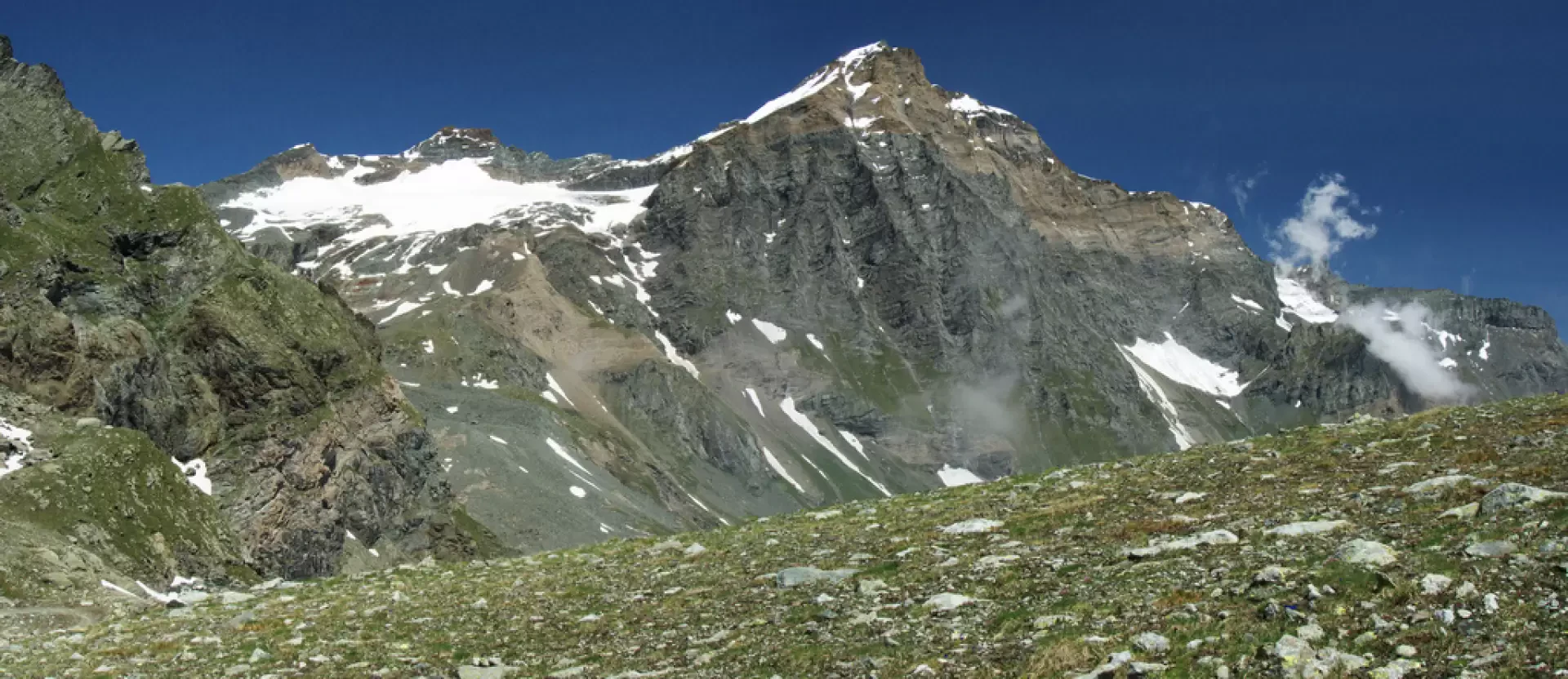
The Uja di Ciamarella, at 3676 metres, is the highest peak in the Lanzo Valleys, located on the border between Piedmont (Italy) and the Haute Maurienne (France), in the southern Graian Alps. Its imposing mass dominates highly evocative landscapes, offering a privileged vantage point over numerous Alpine peaks, from Gran Paradiso to Monte Rosa, distinguished by a mighty glacial profile, particularly marked on the northern slope. Known to be a mountain frequented by mountaineers, the Ciamarella owes part of its fascination to both its exceptional geological richness and the presence of extensive glaciers and high-altitude grazing areas, with environments that rapidly change from alpine meadows to mineral kingdoms of rock and ice.
Description
The exploratory history of the summit is intertwined with the first topographic survey activities in the Piedmont Alps. In fact, the first documented ascent dates back to 31 July 1857 by engineer Antonio Tonini and his assistant Ambrosini, who were commissioned to carry out cartographic surveys. The purely 'mountaineering' character of the conquest became apparent ten years later, on 17 August 1867, when Count Paolo Ballada of Saint Robert, with G.B. Abbà, D. Aimo and the guide Antonio Castagneri di Balme, reached the summit along the south-western slope. At the end of the 19th century, the summit was the scene of the first women's exploits in the Western Alps and of spectacular winter traverses: the first winter ascent was made by Adolfo Kind, G.B. and R. Vaccarone, Paolo and Guido Rey and J. and S. Rey on 21 March 1896.
The Ciamarella's slopes tell a complex geography: the southern one, relatively accessible, welcomes the Italian normal route across the vast glacial basin of Pian Gias, today much reduced due to the retreat of the ice. The northern slope, on the other hand, is marked by spectacular moraines and the remains of the Tonini and Ciamarella glaciers. The geological substratum consists of gneisses and mica schist, typical of the Graian Alps, and the ecosystem is home to a varied alpine fauna, including chamois, ibexes and numerous species of birds of prey. The climate is typical of high sub-Alpine altitudes, with the best periods for climbing from June to September: attention should be paid to the residual snow conditions at the beginning of the season and the typical fog that can persist on the crests.
The place name 'Ciamarella' recalls the local dialect and derives from the name of an alpine pasture located near the mountain; the root 'cià' or 'tcha' often refers to grazing places or buildings linked to sheep farming, while the suffix 'marella' seems to reflect an estate or an ancient family reference. The role of the mountain in local culture is underlined by legends and traditions linked to pastoralism, as well as its importance for the identity of the communities of Balme and the Savoy side. The Ciamarella also appears in Piedmontese mountaineering literature and iconography as a symbol of a natural frontier and a meeting ground between Italian and French culture.
Aclimbing to the Ciamarella is nowadays possible mainly by the normal route from Pian della Mussa, classified F (Easy) according to the mountaineering scale, with departure from the wide basin and a recommended overnight stay at the Bartolomeo Gastaldi Refuge (2659 m). The itinerary follows the path to Pian dei Morti and then to Pian Gias, and finally ascends the moraine and the glacier, where attention must be paid to exposed sections and possible snowy ledges, especially at the beginning of the season. There are also numerous more demanding mountaineering routes on ridges and walls, including the route to the north ridge and various itineraries on the north-east face, with considerable difficulties (PD-AD/AD+), in addition to the traverses to Punta d'Arnas and Monte Bessanetto.
On the Italian side, the main support points are the Rifugio Gastaldi (2659 m), an ideal starting point for the normal route and a reference mountaineering base for more technical ascents. The recommended period for the ascent is from mid-June to mid-September. In summer, the area is subject to crowding at weekends.
Information
Quota: 3676m
Alternative name: -
Mountain group: Ciamarella-Mondrone group
First ascent: 31 July 1857
First ascentionists: Antonio Tonini and Ambrosini
First winter ascent: 23/01/1877
First ascenders in winter: Luigi Vaccarone, Antonio Boggiatto, Costantino Nigra, Antonio Castagneri