Shrine of Notre-Dame-de-la-Garde (Perloz)

Edited by:
Massimo Martini
Access
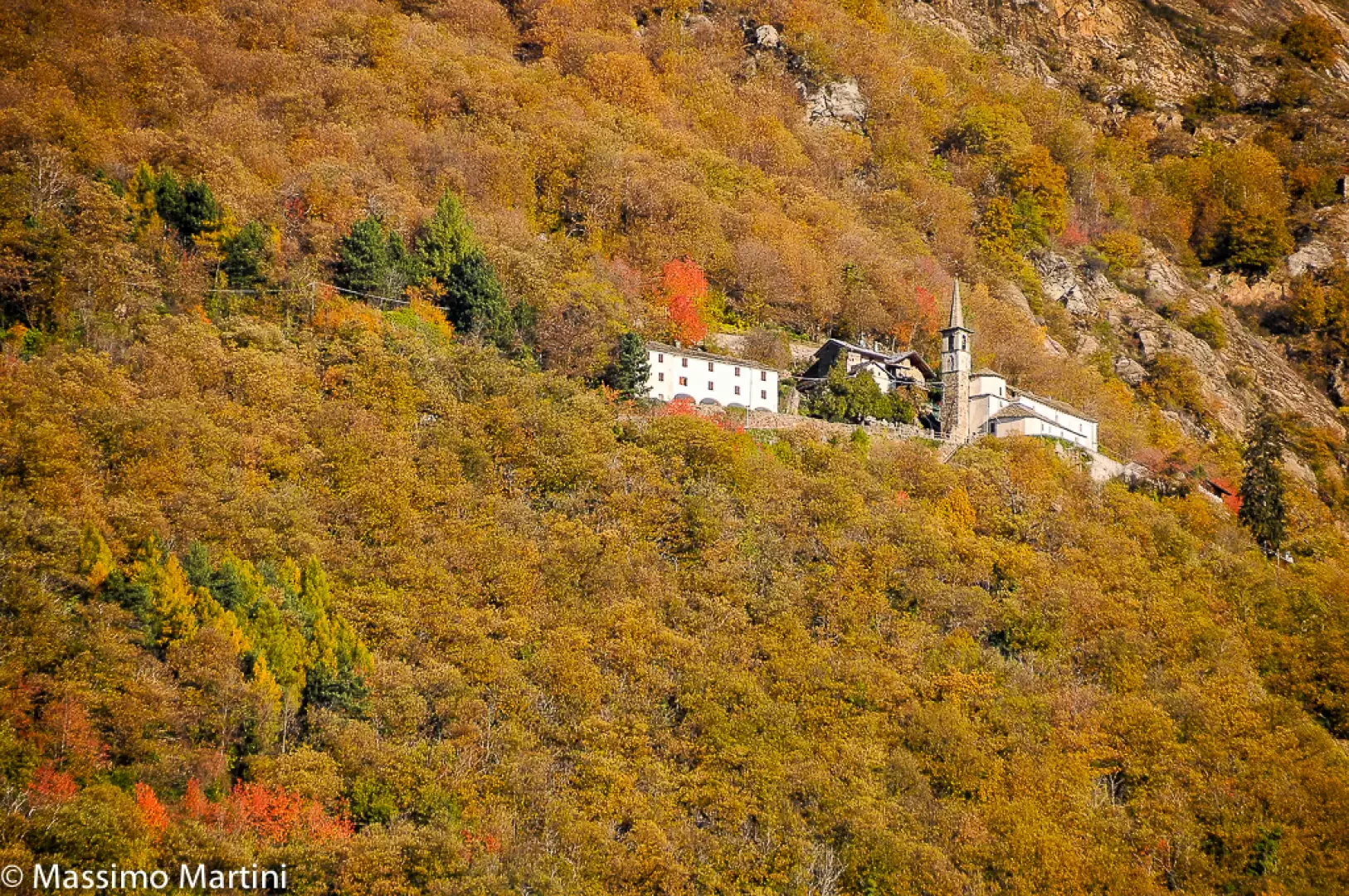
The Sanctuary of Notre-Dame-de-la-Garde is located in the municipality of Perloz, in the Aosta Valley, a short distance from the village centre, on a slope overlooking Pont-Saint-Martin at the entrance to the Lys Valley. By car, it is reached by exiting at the Pont-Saint-Martin toll gate on the motorway (Turin–Aosta) and following signs for Perloz along the regional road. Parking is available near the sanctuary; 🅿️ from the forecourt, two ramps provide pedestrian access, also suitable for people with reduced mobility. The nearest railway station is Pont-Saint-Martin, on the Turin–Aosta line, approximately 5km away.
On foot:
from Piazza IV Novembre (Pont-Saint-Martin), trail
Introduction
The Sanctuary of Notre-Dame-de-la-Garde, also known as the Sanctuary of Our Lady of the Guard, is a Marian place of worship located in the municipality of Perloz, in the Aosta Valley, at approximately 690m above sea level, on a steep slope dominating Pont-Saint-Martin and the entrance to the Lys Valley. It is the principal centre of Marian devotion in the lower Aosta Valley. The complex includes the sanctuary itself, the chapels of the Mysteries of the Rosary and the historic Palazzo dei Pellegrini, and is surrounded by chestnut woods. The origin of the site is linked, according to tradition, to the discovery of a wooden statuette of the Virgin and Child, whose existence is documented from 1252.
Description
Local tradition holds that at an unspecified time in the past, men engaged in construction work found a statuette of the Virgin and Child and brought it to the church of Perloz. The following morning the statuette was found back at its original location, a circumstance interpreted as the Virgin's wish to remain at that site. A small shrine was built on the spot, later converted into a chapel. The first documentary record dates to 1252. The current building was constructed in the sixteenth century over the earlier chapel and subsequently enlarged during the eighteenth century to accommodate the growing number of pilgrims.
The complex consists of several architectural elements accumulated over the centuries. The façade is preceded by a portico supported by four stone columns sheltering the entrance portal; in the square in front of the church stand a column fountain and a stone basin carved from a single block, dated 1736. An external grotesque mask is dated 1642. At the rear is a hospice for pilgrims. The bell tower is Romanesque in character.
The interior has a single nave divided into three bays with sail vaults; the dome is octagonal. The walls and vaults are entirely frescoed by Vittorio Avondo and his brother, Valsesian painters, in 1831, with subjects drawn from Old and New Testament iconography; the dome depicts the four evangelists and the Marian mysteries. The high altar, decorated in 1845 by Joseph Vinea and Denys Fusotto, bears at its centre the fourteenth-century statue of the Virgin enthroned with the Child, flanked by statues of Saint Jucundus and Saint Gratus. The two gilded wooden side altars date from 1731. At the entrance stands a stone alms box bearing the carved coat of arms of the Vallaise family and the Christogram IHS. The walls preserve a substantial number of ex-votos. The adjacent Chapel of Our Lady of Mount Carmel houses a relief from the early seventeenth century depicting the Virgin of Carmel with saints and souls in Purgatory. A seventeenth-century organ is also present.
The patronal feast takes place on 8 September with a procession to the sanctuary; the feast of the Assumption on 15 August is a further significant occasion of communal gathering.
Information
Visiting conditions
opening: Sundays from May to late September, 2.30–5.00 pm
mass: every Sunday in July and August, 9.00 am
recitation of the rosary: every Sunday, 3.30 pm
patronal feast: 8 September
feast of the Assumption: 15 August
Contacts
diocese of Aosta – official website: www.diocesiaosta.it