Belluno Dolomites Park

Edited by:
Massimo Martini
Access
The Dolomiti Bellunesi National Park has two main gates: Belluno to the north and Feltre to the south. Belluno can be reached from Venice and Mestre by taking the Venezia-Pian di Vedòia motorway, then the trunk road to Ponte nelle Alpi and then the trunk road towards Belluno; coming from Padua, the route is on the Milano-Venezia motorway to Mestre and then the . Feltre can be reached from Vicenza by taking the Val d'Astico motorway and exiting at Dueville, continuing along the Valsugana highway as far as Primolano and then along the towards Feltre; from Trento follow the Valsugana highway. From Friuli and the Slovenian border, take the then the to Belluno; from Cortina d'Ampezzo and Austria take the to Belluno. The headquarters of the Park Authority are in Feltre (BL), in Piazzale Zancanaro 1. There are three main visitor centres: in Pedavena ("Il sasso nello stagno"), in Valle Imperina (museum of geology and mining activities), and the Vincheto di Cellarda Nature Reserve. The Ethnographic Museum of the Province of Belluno and the Park is located in Serravella di Cesiomaggiore. The main access valleys within the park are the Valle del Mis (crossed by provincial road no. 2), Val Canzoi, Valle dell'Ardo and Val Prampèr; the state road Agordina goes up the lower Cordevole towards Agordo. Feltre and Belluno are served by the Padova-Montebelluna-Feltre-Belluno-Calalzo railway line operated by Trenitalia (TI), which also allows for the transport of bicycles. The municipalities in the park are linked by the Dolomitibus bus network.
Introduction
The Belluno Dolomites National Park extends in the central-southern sector of the province of Belluno, in the Veneto region, between the valley furrow of the Cismon torrent to the west and that of the Piave river to the east, with offshoots towards the Maè basin to the north and the lower Agordino area to the south. Established by the Ministerial Decree of 20 April 1990 - published in the Official Gazette on 2 June 1990 - and enlarged with the new perimeter of the Presidential Decree of 9 January 2008, it covers an area of 315.12 km² entirely within the province of Belluno, distributed over fifteen municipalities. The park is located on the southern edge of the Dolomite area and since 2009 has been included in the "Pale di San Martino - San Lucano - Dolomiti Bellunesi - Vette Feltrine" section of the Dolomites serial site, recognised as a UNESCO World Heritage Site. It stretches between the minimum altitude of 412m and the Schiara at 2,565m, with a variety of environments ranging from the riparian areas at the bottom of the valley to the Dolomite cliffs at high altitudes, through broadleaf forests, coniferous forests, sub-alpine heaths and maceretos. The symbol of the park is the Campanula morettiana, a bellflower endemic to the Dolomites.
Description
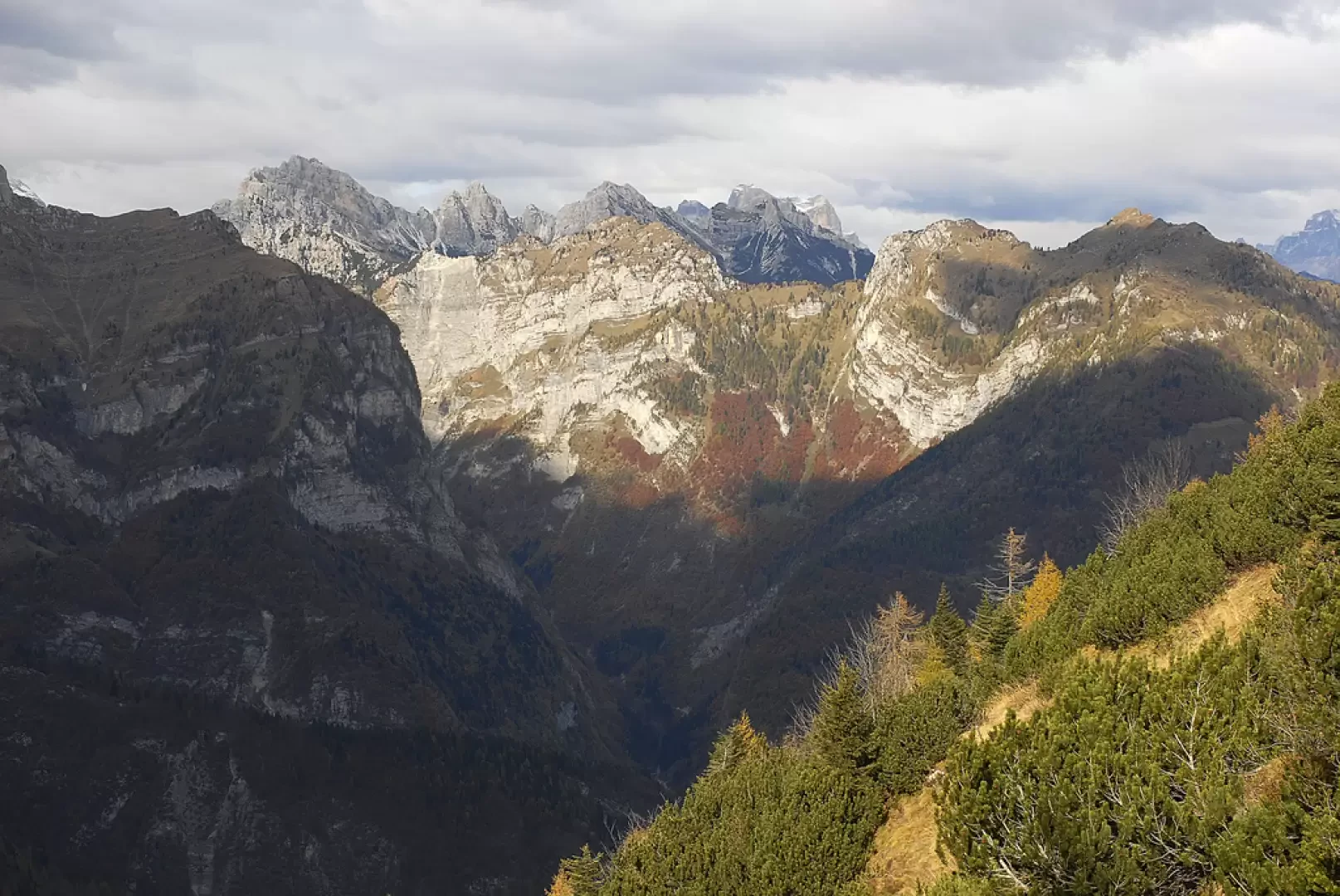
The mountain groups included in the park develop from north-west to south-east according to the typical structure of the southern Dolomites: the Feltre Alps with the Vette di Feltre, the Cimonega, the Pizzocco, the Brendol and the Agnelezze; the Monti del Sole and the Feruch; the Schiara (2,565m, maximum altitude) and the Talvéna (2,542m); the Prampèr and the Spiz di Mezzodì. The peaks are characterised by overhanging dolomite towers and spires alternating with grassy slopes, glacial cirques and karstic plateaus, of which the Piani Eterni in the Cimonega group are among the most spectacular examples of high-altitude karst in the Dolomites. From a geological point of view, the territory is prevalently set on carbonate sedimentary rocks of the Mesozoic - Triassic dolomites and Jurassic and Cretaceous limestones - with significant exceptions in the upper Valle del Mis and in Valle Imperina, where the Valsugana Line - an important fault that constitutes the geological boundary of the Dolomites - brings very ancient metamorphic rocks to the surface. Water resources are abundant: springs, perennial streams and alpine lakes are distributed throughout the territory. The main tributaries are the Cordevole, the Mis, the Caorame, the Stién, the Falcina, the Ardo, the Vescovà and the Prampèra; in Val Canzoi, the La Stua reservoir is the park's main body of water. The Soffia waterfalls and the Cadini del Brenton in the Valle del Mis, and the gorges of the Ardo torrent are among the most spectacular river environments.
The flora is one of the main scientific reasons behind the creation of the park: with over 1,500 vascular species, it presents one of the richest floral species in the Dolomites, with endemisms and rarities of exceptional biogeographical interest. The geographical position is decisive: the southern edge of the Dolomites remained largely free of ice during the last Quaternary glaciations, allowing the survival of relict species and localised endemisms. The Campanula morettiana - endemic to the Dolomites and symbol of the park, with violet-coloured blooms after mid-July among the damp cliffs at altitudes above 1,000-1,200m - is the most representative species. Other endemisms and rarities include the alpine spurge (Delphinium dubium), Mattioli's cortusa (Primula matthioli), the alpine tiarellis (Rhizobotrya alpina), the alpine cochlear (Cochlearia pyrenaica) and the'alyssum of the Obir (Alyssum ovirense). Four species were first described by science in this area: Thlaspi minimum, Minuartia graminifolia, Rhizobotrya alpina and Alchemilla lasenii. The area's botanical tradition is already documented in the Codex Bellunensis, a precious illustrated herbarium from the early 1400s preserved in the British Library in London, which illustrates plants gathered in the Belluno mountains; the edelweiss (Leontopodium nivale) appears there in what is considered the oldest known depiction. The forests range from beech woods (Fagus sylvatica) between 600 and 1,600m to forests of silver fir (Abies alba) and spruce (Picea abies), with stations of mixed forest of silver fir and noble broadleaf trees in the Val del Grisol considered unique in Europe.
The fauna is representative of high-altitude Alpine environments. The ungulates include more than 3,000 chamois (Rupicapra rupicapra), more than 2,000 roe deer, a growing population of red deer and several mouflons. Among carnivores, there is the recent spontaneous return of the lynx (Lynx lynx), the brown bear (Ursus arctos) and the golden jackal (Canis aureus), as well as the stable presence of the fox, marten, stone marten and ermine. L'avifauna counts 115 nesting species, with the presence of the golden eagle (Aquila chrysaetos), eagle owl (Bubo bubo), little owl (Glaucidium passerinum) and redstart (Aegolius funereus), goshawk (Accipiter gentilis), capercaillie (Tetrao urogallus), black grouse (Lyrurus tetrix), black grouse (Bonasa bonasia) - an endangered species - and ptarmigan (Lagopus muta). The wallcreeper (Tichodroma muraria) and alpine finch (Montifringilla nivalis) frequent rock faces. Reptiles include the horned viper (Vipera ammodytes); amphibians include the Alpine black salamander (Salamandra atra), the Alpine newt and the yellow-bellied toad (Bombina variegata). The invertebrate fauna is rich in endemisms, with at least 100 species of diurnal butterflies and around 50 species of carabid beetles.
The park was established at the instigation of local environmental associations in the 1980s, with formal establishment in 1990 by Ministerial Decree and activation of the Park Authority in 1993. The original perimeter of 15,000 ha was extended to 31,512 ha by the Presidential Decree of 9 January 2008. At the time of its establishment, 16,000 hectares of the park were already made up of eight Nature Reserves belonging to the Council of Europe's network of biogenetic reserves. Sites of historical interest include the Vedana Charterhouse near Lake Vedana (municipality of Sospirolo), a monastery complex of great architectural value, and the Valle Imperina Mines - a mining village with over five centuries of copper and pyrite mining history. The Piazza del Diavolo and the Gusèla del Vescovà are emblematic rock formations of the park, the latter a limestone obelisk also visible from Belluno. The Belluno-born writer and painter Dino Buzzati, who is closely linked to the mountains in the park, described them in one of his writings as "enigmatic, intimate, secret [...] moving because of the stories they tell, the air of other centuries, the solitude comparable to that of deserts".
The park's trail network stretches for hundreds of kilometres, with hiking and mountain biking routes through the valleys and mountain groups. The main excursion areas are the alpine pastures of Vette Grandi and Monsampiano, Piazza del Diavolo, Val Canzoi with Lago della Stua, Valle del Mis with the Cadini del Brenton and Bus de le Nèole, Val di Piero, Val Vescovà, Foresta di Cajada and Val Prampèr.
.Information
General Data
Typology: National Park; UNESCO World Heritage Site (from 2009, as part of the "Dolomites" serial site)
Year of establishment: 1990 (Ministerial Decree 20 April 1990; Official Gazette no. 127 of 2 June 1990); park authority: Presidential Decree 12 July 1993; new perimeter: Presidential Decree 9 January 2008; Dolomites UNESCO Heritage: 2009
Managing body: Ente Parco Nazionale Dolomiti Bellunesi
Reference body: Ministero dell'Ambiente e della Sicurezza Energetica
Area: 315,12 km²
Minimum altitude: 412m
Maximum altitude: 2.565m
Maximum elevation: 2.565m - Schiara (Sospirolo / Belluno, BL)
Region(s): Veneto
Province(s): Belluno
Municipalities involved: Belluno - Cesiomaggiore - Feltre - Gosaldo - La Valle Agordina - Longarone - Pedavena - Ponte nelle Alpi - Rivamonte Agordino - San Gregorio nelle Alpi - Santa Giustina - Sedico - Sospirolo - Sovramonte - Val di Zoldo
Official website: https://www.dolomitipark.en