Circeo Park

Edited by:
Massimo Martini
Access
The Circeo National Park is located about 100 km south of Rome, in the province of Latina, and is not directly served by motorway. The main access is from the Milan-Naples motorway, exiting at Frosinone, then continuing on the Monti Lepini highway towards Latina until the junction for Priverno, from where it is possible to reach Sabaudia - the park authority headquarters - via the Marittima provincial road and the Pontina highway. From Rome, follow the state road Via Pontina directly towards Latina and Sabaudia, with a diversion onto the provincial road towards Sabaudia. From Naples, follow the state road Appia to Formia and Gaeta, then the Via Flacca towards Terracina and finally the state road Mediana to the junction for Sabaudia. The Park Authority headquarters and Visitor Centre are located in Sabaudia, at Via Carlo Alberto 188; the park's Natural History Museum is accessible free of charge. The nearest railway connection is the Priverno-Fossanova station, on the Trenitalia (TI) Rome-Naples line via Formia, from which Cotral buses depart for Sabaudia. From Rome it is possible to reach Sabaudia directly by Cotral bus from the EUR Fermi terminal (Metro line B). For the island of Zannone - part of the park in the Ponzian Archipelago - the embarkation point is the port of Ponza, which in turn can be reached by ferries from Anzio, Formia and Terracina. Access to the park is free of charge; some areas of the integral reserve are forbidden or only accessible by guided tour. The bicycle is the most suitable means of transport for getting around the different areas of the park, which is almost entirely flat.
Introduction
The Circeo National Park extends along the Tyrrhenian coast of southern Lazio, in the province of Latina, in the municipalities of Latina, Sabaudia, San Felice Circeo and Ponza, covering an area of 89.17 km². Established by Royal Decree-Law 285 of 25 January 1934, it is one of Italy's five historic national parks and the first protected area established in Lazio. Its establishment, which occurred during the radical reclamation of the Agro Pontino, saved the last strip of Selva di Terracina, the four coastal lakes and the Circeo Promontory from agricultural conversion. The park protects five distinct and contiguous environments - the lowland forest, the coastal dune system, the brackish lakes, the limestone promontory and the island of Zannone - which constitute one of the most intact coastal ecological mosaics in peninsular Italy. The Selva del Circeo has been a UNESCO MAB Biosphere Reserve since 1977; the four coastal lakes have been Wetlands of International Importance under the Ramsar Convention since 1976.
Description
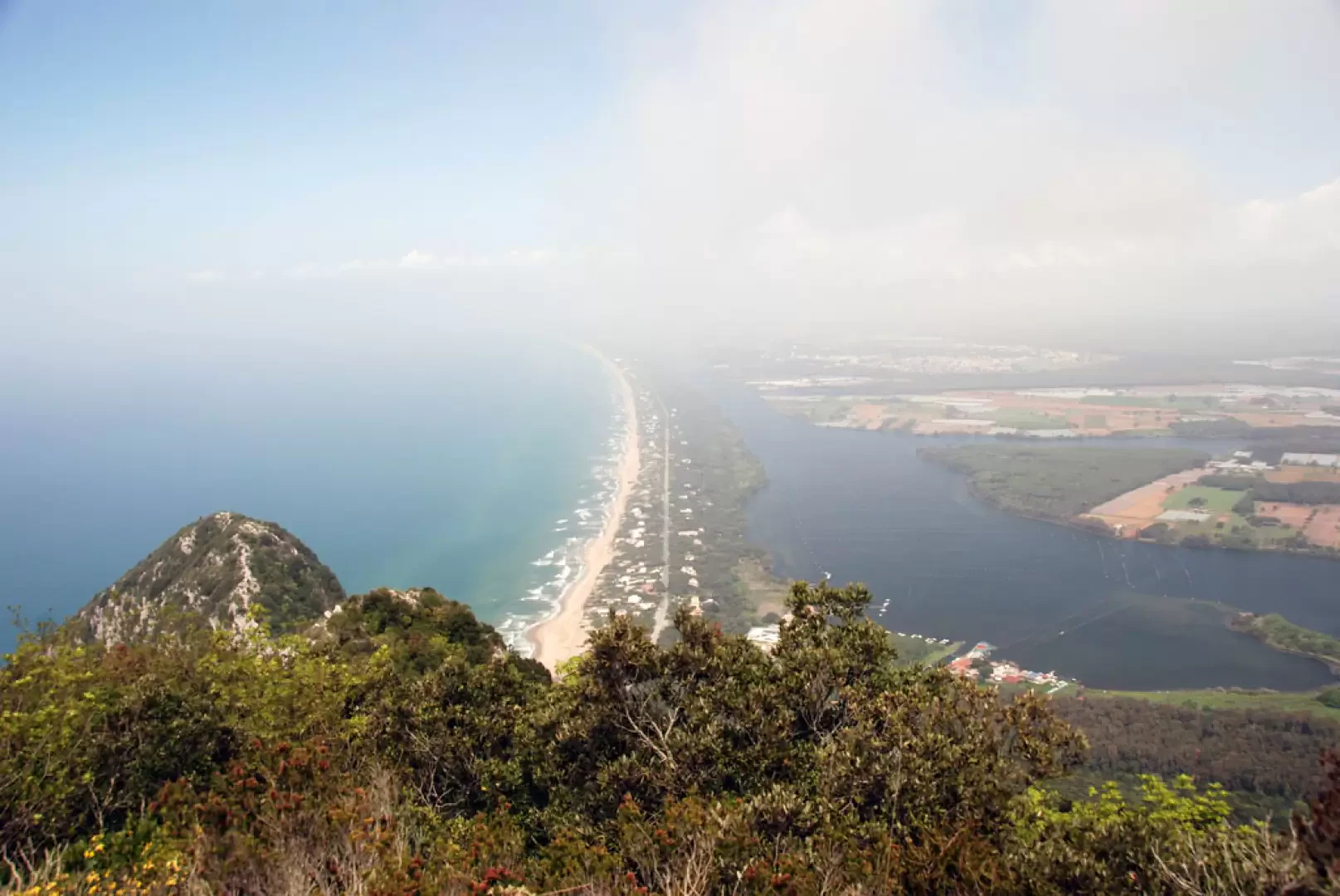
The park territory is organised around five distinct environmental systems, arranged in sequence from the coast towards the interior. The dune system stretches for about 25 km from the Circeo Promontory northwards to Capo Portiere, with a cordon that reaches heights of 27 m and is characteristically crescent-shaped; the vegetation here is dominated by psammophilous and halophilous flora, with sea lilies (Pancratium maritimum) in the foreshore area, the prickly juniper (Juniperus oxycedrus subsp. macrocarpa) in the backdune and holm oak scrub towards the interior. The lagoon system consists of four coastal lakes separated from the sea by the dune cordon: Lake Sabaudia or Lake Paola (400 ha), Lake Caprolace (229 ha), Lake dei Monaci (94 ha) and Lake Fogliano (395 ha), classified as Wetlands of International Importance (Ramsar) since 1976. The brackish waters of the lakes are home to fish communities managed with traditional conservation-compatible fishing; the marshy shores are inhabited by semi-wild buffalos among which herons, egrets, cranes, geese and lapwings nest. The Selva di Circe is the most unique ecological element: a lowland forest of about 3,300 hectares, the only remnant of what before the reclamation of the 1930s extended over 11,000 hectares as the Selva di Terracina. The forest is home to species with a continental climate - turkey oak (Quercus cerris), ash (Fraxinus oxycarpa) English oak (Quercus robur) - and Mediterranean species - holm oak (Quercus ilex), laurel (Laurus nobilis), cork (Quercus suber) - a cross between phytoclimatic origins that is very rare in Italy. The depressed areas of the clay soil form the Piscine, natural marshy environments where water stagnation maintains populations of ash (Fraxinus angustifolia) and a unique aquatic biodiversity; fallow deer (Dama dama), introduced in 1953 and then escaped from the enclosure, have colonised the entire forest with negative effects on forest renewal due to the absence of predators.
The Circeo Promontory is a Mesozoic limestone-dolomitic massif, geologically separate from the Apennines: originating elsewhere and sliding for about 200 km along overlapping strata on flysch substrates, it occupies its present isolated position on the Pontine plain as a geomorphological anomaly. The Peak of Circe - the highest peak at 541m - dominates the landscape of the Pontine Plain and is visible from tens of kilometres away. The promontory's asymmetrical profile determines two slopes with opposing ecological vocations: the northern "Quarto Freddo" shady, is home to a thermophilous forest with almost Apennine elements such as beech and downy oak; the southern "Quarto Caldo" exposed to the sun and saltiness, is covered by xerophilous scrub with wild olive, mastic, strawberry tree, cistus and rosemary. About forty caves open up on the surface of the promontory, some coastal and some accessible only by sea and others accessible from land. The Guattari Cave, discovered on 24 February 1939 during construction work, is the most scientifically significant prehistoric site: a skull of Homo neanderthalensis in an exceptionally well-preserved state, dating from around 55,000 years ago, was found inside, ritually positioned in the centre of a crown of stones and with a hole drilled at the skull base. The artefacts found in the deeper layers of the cave document the presence of hyenas as primary occupants, bearing traces of Pleistocene fauna including deer, roe deer, fallow deer and primeval oxen. The Grotta del Fossellone, the largest of the complex, has yielded a fragment of a Neanderthal jawbone and faunal and botanical finds from the Palaeolithic period.
The island of Zannone, which became part of the park in 1979, is part of the Ponzian Archipelago and is the only one of the Ponzian islands to have preserved its vegetation cover intact. Of mixed geological origin - volcanic, metamorphic and sedimentary rocks dating back up to 200 million years - it is uninhabited and covered with holm oak, oak and Mediterranean maquis forests with spectacular heather blossoms in autumn; the mouflon (Ovis aries musimon), introduced in the 1920s, lives there in the wild. The island is a fundamental stopping point for thousands of migratory birds and a nesting site for marine species including the greater shearwater.
The park was established in 1934 at the behest of the Forestry Administration, during the great Pontine reclamation initiated by the Fascist regime: this hydraulic engineering operation radically transformed the Pontine Plain, reclaiming some 100,000 hectares of malarial marshes, founding new towns including Latina and Sabaudia, but almost entirely destroying the original ecosystem. The establishment of the park saved the remaining nucleus of the ancient Selva and the lakes. The site of Domitian's villa (1st century AD), on the eastern shore of Lake Sabaudia, is the largest Roman monumental complex in the entire area. The Circeii Cyclopean Walls, the remains of the acropolis of the ancient Latin city on the promontory, date back to the 4th century BC and represent one of the best-preserved polygonal wall systems in Lazio.
The network of footpaths includes the Picco di Circe route (classified EE due to its irregular limestone terrain), the Lago di Caprolace circuit (23.5km), the Selva flat route (14.7km) and the Coastal Dune route (25km), accessible on foot and by bicycle. The Nature Museum at the Visitors Centre in Sabaudia illustrates the park's ecosystems with three-dimensional exhibits, dioramas and an aquarium.
Information
General Data
Typology: National Park; UNESCO MAB Biosphere Reserve - Circeo Forest (since 1977); Ramsar Wetlands - Coastal Lakes (since 1976)
Year of Establishment: 1934 (Law 285 of 25 January 1934); extension 1975 (Presidential Decree 2 July 1975); Zannone Island: 1979; Park Authority: Presidential Decree 4 April 2005; MAB Biosphere Reserve: 1977; Ramsar Wetland: 1976
Managing body: Ente Parco Nazionale del Circeo
Reference body: Ministero dell'Ambiente e della Sicurezza Energetica
Area: 89.17 km²
Minimum elevation: 0m (sea level)
Maximum elevation: 541m
Maximum elevation: 541m - Picco di Circeo (San Felice Circeo, LT)
Region(s): Lazio
Province(s): Latina
Municipalities concerned: Latina - Ponza - Sabaudia - San Felice Circeo
Official website: https://www.parcocirceo.it