Casentino Forest Park

Edited by:
Massimo Martini
Access
The Foreste Casentinesi, Monte Falterona and Campigna National Park can be reached from both sides of the Apennines. From the Romagna side (Emilia-Romagna) it can be reached via the Bologna-Rimini motorway with exits at Faenza, Forlì or Cesena, continuing towards the inland valleys along the state road and the provincial roads towards Bagno di Romagna, Santa Sofia, Premilcuore and Tredozio. The Tuscan side of the valley can be reached via the Milan-Rome [A1] motorway, exiting at Barberino del Mugello and passing through the municipalities of Londa and San Godenzo along the Futa Pass State Road , or exiting at Florence and continuing along the towards Mugello; the Arezzo exit serves Casentino, from which one can reach Bibbiena, Poppi, Pratovecchio Stia and Chiusi della Verna along the Umbria State Road . The headquarters of the Park Authority are located in Pratovecchio (AR), in Palazzo Vigiani via Guido Brocchi 7. The Park Authority runs eleven visitor centres on both sides of the valley; on the Romagna side, the main ones are located in Bagno di Romagna, Santa Sofia, Premilcuore, Tredozio and Corniolo; on the Tuscan side, in Camaldoli, Poppi and Chiusi della Verna. The Tuscan side is served by the Trenitalia (TI) railway on the Arezzo-Pratovecchio-Stia line, with stations at Bibbiena, Poppi, Pratovecchio and Stia. The park's trail network extends over 600 km, which can be travelled on foot, by mountain bike, on horseback and, in winter, with snowshoes.
Introduction
The National Park of the Casentinesi Forests, Mount Falterona and Campigna extends along the Tuscan-Romagna Apennine ridge, on the border between Tuscany and Emilia-Romagna, in the provinces of Arezzo, Florence and Forlì-Cesena, covering an area of 364.26 km². Established by Decree of the President of the Republic on 12 July 1993 and active in its definitive configuration since 1993, it is the national park with the highest percentage of forest cover in Italy, with about 85% of the surface area covered by woods. It includes the Casentino State Forests, the Sasso Fratino Integral Nature Reserve - the first integral reserve established in Italy in 1959 - and five biogenetic nature reserves. Since 7 July 2017, the Sasso Fratino Reserve and the park's ancient beech forests have been included in the UNESCO World Heritage List as part of the transnational site "Primary and Ancient Beech Forests of the Carpathians and Other Regions of Europe". Since 2015, the park has been awarded the Wilderness Diploma of the European Wilderness Society and has been included in the IUCN Green List since April 2021.
.Description
The park territory stretches along about 20 km of Apennine ridge, with markedly asymmetrical morphological features between the two slopes. The Romagna side is steep and furrowed by narrow, parallel valleys - the valleys of the Bidente, Rabbi and their tributaries - that descend abruptly towards the Po Valley; the Tuscan side is gentler and more articulated, with the valleys of the Arno's tributaries - the Casentino, the upper valley of the Arno, and the Mugello - that descend towards wide, densely populated valley floors. The altitudes range from about 400 metres in the valley bottoms to the 1,658 metres of Monte Falco, the highest peak in the park, on the border between Tuscany and Emilia-Romagna. The prevailing rocks are sandstones and marls of the Macigno Formation and Flysch of the Ligurian type, characteristic of the northern Apennines; the limestone exceptions are significant in the southern sector, where Monte Penna - on which the Verna Sanctuary stands - is a limestone massif with a morphology quite different from the rest of the park.
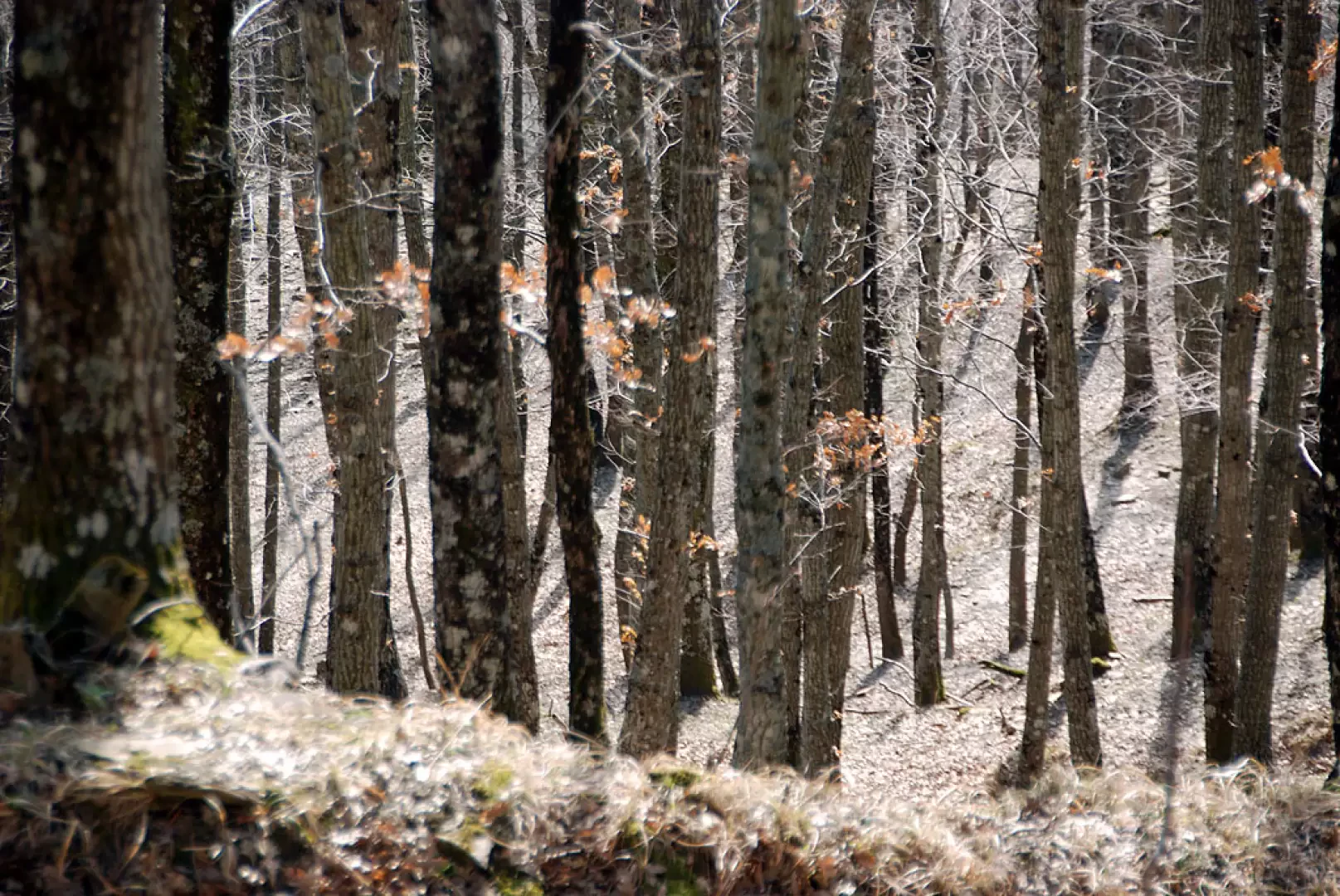
The forest cover is the dominant and identifying feature of the park. The beech forest (Fagus sylvatica) is the most extensive formation, present from the Romagna side - where it descends to relatively low altitudes - to the Tuscan summits, often mixed with mountain maple (Acer pseudoplatanus) and ash (Fraxinus excelsior). The forests of silver fir (Abies alba) and Norway spruce (Picea abies) characterise the State Forests of Campigna and Lama, which remained intact for centuries under the management first of the Camaldolese monks and then of the Grand Ducal forest administrations; the trunks of these firs provided the most valuable timber for the ships of the Maritime Republics and for the building sites of the great Tuscan architectural works, including the Opera del Duomo in Florence. In the warmer areas of the Tuscan slope, mixed deciduous woods with downy oak (Quercus pubescens), turkey oak (Quercus cerris), black hornbeam (Ostrya carpinifolia) and chestnut (Castanea sativa) appear, with extensive traditional chestnut groves. The Sasso Fratino Integral Nature Reserve - 764 hectares of ancient forest on slopes up to the vertical - is strictly closed to access: 554 species of higher fungi, 102 species of lichens, 66 species of mosses and 27 species of ferns have been counted here, with long-lived beech trees over 500 years old among the oldest in Europe. The surrounding area of around 6,942 ha, which is also included in the UNESCO recognition, is accessible by footpaths. The overall vascular flora of the park has more than 1,000 herbaceous species and 48 tree and shrub species, with spectacular spring blooms of cardamine, snowdrops, scilla and coridals in the undergrowth of the beech forests before the foliage unfolds.
The fauna is exceptionally rich and varied. The Apennine wolf population (Canis lupus italicus) - distributed in around 9 packs with an estimated total of around 100 - is the most important in the northern Apennines. The red deer (Cervus elaphus) numbers more than 2,000, counted annually at the roaring in September; fallow deer (Dama dama), roe deer (Capreolus capreolus), wild boar (Sus scrofa) and mouflon complete the picture of ungulates. The wild cat (Felis silvestris) is present in the most intact areas. The birdlife includes around a hundred nesting species: the black woodpecker (Dryocopus martius), which was absent before the park was established, has colonised the area since 2000; the golden eagle (Aquila chrysaetos) flies over the entire area; the corncrake (Crex crex), a species of Community interest that is in sharp decline, nests in the high-altitude meadows. The spotted salamander (Salamandra salamandra) and the crayfish (Austropotamobius pallipes) - a protected species strongly indicative of water quality - inhabit the wet woods and streams of the park respectively.
The area bears the traces of thousands of years of human and spiritual habitation. The Casentino Forests were already known in antiquity: the Celts and then the Etruscans left traces here, including the Lago degli Idoli (Lake of Idols) at the foot of Mount Falterona, which was the most important Etruscan cult site in the Tuscan-Romagna Apennines, with thousands of votive offerings recovered. The Hermitage of Camaldoli, founded in 1012 by St. Romuald of Ravenna - who established the foundations of the Order of Camaldolese Monks there - and its monastery remained the custodians and managers of these forests for centuries, guaranteeing their survival until modern times; the monastery's ancient pharmacy still has still retains stills stills, mortars and texts from the monks's galenical laboratory. The Sanctuary of La Verna, on Monte Penna (1,283m), was donated by Orlando Cattani da Chiusi to St Francis of Assisi in 1213 as a place of hermitage: the miracle of the stigmata, recalled by Dante in Paradise, took place here in September 1224; the sanctuary is still the destination of an uninterrupted pilgrimage. The Waterfall of Acquacheta, in the municipality of San Benedetto in Alpe, with a drop of about 70 metres, was described by Dante in the 16th canto of the Inferno - "come quel fiume c'ha proprio cammino / prima dal Monte Viso inver' levante / [...] rimbomba là sovra San Benedetto / de l'Alpe" - and is the most famous reference in Dante to a physical place in the Tuscan-Romagna Apennines. The Ridracoli Dam, in the municipality of Bagno di Romagna, is the main reservoir in Romagna, with an arch-gravity structure 103m high.
In 2015, the park was awarded the Wilderness Diploma by the European Wilderness Society, a recognition for areas with the highest degree of naturalness in Europe, and adhered to the European Charter of Sustainable Tourism. The Alta Via dei Parchi and the Sentiero delle Foreste Sacre - a route of more than 100 km that connects the Romagna side to the Sanctuary of La Verna through the forests of the park - are the main long-distance itineraries.
Information
General Data
Typology: National Park; UNESCO World Heritage Site (since 2017, beech forests and Sasso Fratino Reserve); Wilderness Diploma European Wilderness Society (since 2015); IUCN Green List (since 2021); European Diploma Protected Areas - Sasso Fratino Reserve (since 1985)
Year of establishment: 1993 (Presidential Decree 12 July 1993; G.U. General Series no. 186 of 10 August 1993); first Sasso Fratino Integral Reserve: 1959; UNESCO World Heritage Vetuste Beechwoods: 7 July 2017
Managing body: Ente Parco Nazionale delle Foreste Casentinesi, Monte Falterona e Campigna
Reference body: Ministero dell'Ambiente e della Sicurezza Energetica
Area: 364.26 km²
Minimum altitude: ~400m
Maximum altitude: 1.658m
Maximum elevation: 1,658m - Monte Falco (Bagno di Romagna FC / border AR)
Region(s): Emilia-Romagna - Tuscany
Provinces: Arezzo - Florence - Forlì-Cesena
Municipalities involved: Bagno di Romagna - Portico e San Benedetto - Premilcuore - Santa Sofia - Tredozio (FC) - Bibbiena - Chiusi della Verna - Poppi - Pratovecchio Stia (AR) - Londa - San Godenzo (FI)
Official website: https://www.parcoforestecasentinesi.en