Park of Abruzzo, Lazio and Molise

Edited by:
Massimo Martini
Access
The Abruzzo, Lazio and Molise National Park can be reached via two main motorway routes. From the Abruzzo side, the main access is via the Roma-Pescara motorway, with exits at Aielli-Celano or Pescina, from where it continues on the Marsicana state road towards Bisegna, Pescasseroli, Opi, Villetta Barrea, Barrea and Alfedena. The state road forms the main road backbone of the park, crossing it from north to south-east. A secondary access from the east comes from the Cocullo motorway exit () via the state road Sannite, which connects the Sagittario valley with Scanno and the Godi Pass.
From the Latium and Campania sides, take the Milan-Naples motorway to the Ferentino exit, then continue on to Sora and the Forca d'Acero pass along the state road of the same name, which leads into the heart of the Latium sector of the park in the Comino valley. Those coming from Naples instead follow the motorway to the Caianello exit and continue on to Venafro and Alfedena, the entrance to the Molise sector of the Mainarde. Further access routes use the state road of the Volturno Valley, which connects the Molise border to Isernia, about 30 km from the Mainarde area. Public transport to the park is provided by the Abruzzo company TUA, with bus services from Avezzano (railway station on the Rome-Pescara line) and Castel di Sangro (Sulmona-Castel di Sangro line). The Nature Centre in Pescasseroli, in Viale Colli dell'Oro, adjacent to the state road , houses the park's main naturalistic and ethnographic museum and is the reference information point; other visitor centres are in Civitella Alfedena, Villavallelonga, Barrea, Bisegna and Opi.
.Introduction
The Abruzzo, Latium and Molise National Park extends into the heart of the central Apennines, between the provinces of L'Aquila, Frosinone and Isernia, spreading over three regions with a predominance of the Abruzzo sector. Established on 9 September 1922 on a private initiative and officially recognised by Royal Decree-Law on 11 January 1923, it is the oldest national park in the Apennines and one of the first in Italy. The area covers approximately 500 km² of mountainous territory, with altitudes ranging from 900m in the valley bottom to 2,252m at Monte Marsicano, divided into four mountain groups of calcareous substrate. The territory is shaped by karst phenomena, an extensive hydrographic network centred on the Sangro River and morphological reflections of the last Quaternary glaciations. The creation of the park was born out of the need to preserve populations of Apennine fauna in decline - including the Marsican brown bear (Ursus arctos marsicanus) and the Abruzzo chamois (Rupicapra pyrenaica ornata) - and to protect the large expanses of beech forest that make up the dominant vegetation cover of the area.
.Description
The territory of the Abruzzo, Latium and Molise National Park stretches along a sequence of calcareous mountain ranges originating in the Lower Jurassic and Cretaceous periods, which emerged during the Apennine orogeny and were subsequently shaped by glacial erosion and intense karstification, which characterises this portion of the central Apennines. The morphology is divided into four main mountain systems: the Montagna Grande group and Monte Marsicano to the east, between the Sangro and Sagittario valleys, with the peaks of Monte Argatone (2,149m) and Monte Marsicano (2,252m); the central group of Monte Marcolano (1.940m), between the upper Sangro valley, Vallelonga and the upper Giovenco valley; the Monte Tranquillo group (1,841m), which extends to the Forca d'Acero pass; and the Monti della Meta system, on the border between Lazio and Molise, with the peaks of Monte Petroso (2,249m) and Monte Meta (2,242m). In addition to these structures, there is the Mainarde sector, embedded in the Molise border through the Castelnuovo al Volturno Pass. The surface hydrography is dominated by the Sangro River, which runs through the central area of the park from north-west to south-east, flanked by numerous tributaries including the Giovenco, Melfa, Volturno and Fondillo torrents. The karst phenomenon significantly reduces surface runoff, with water often flowing in underground conduits and re-emerging as resurgences even outside the park perimeter. The largest lakes include Lago di Barrea - an artificial reservoir along the Sangro - and Lago Vivo, a natural basin at an altitude of about 1,600 m fed by the melting of seasonal snowfields.
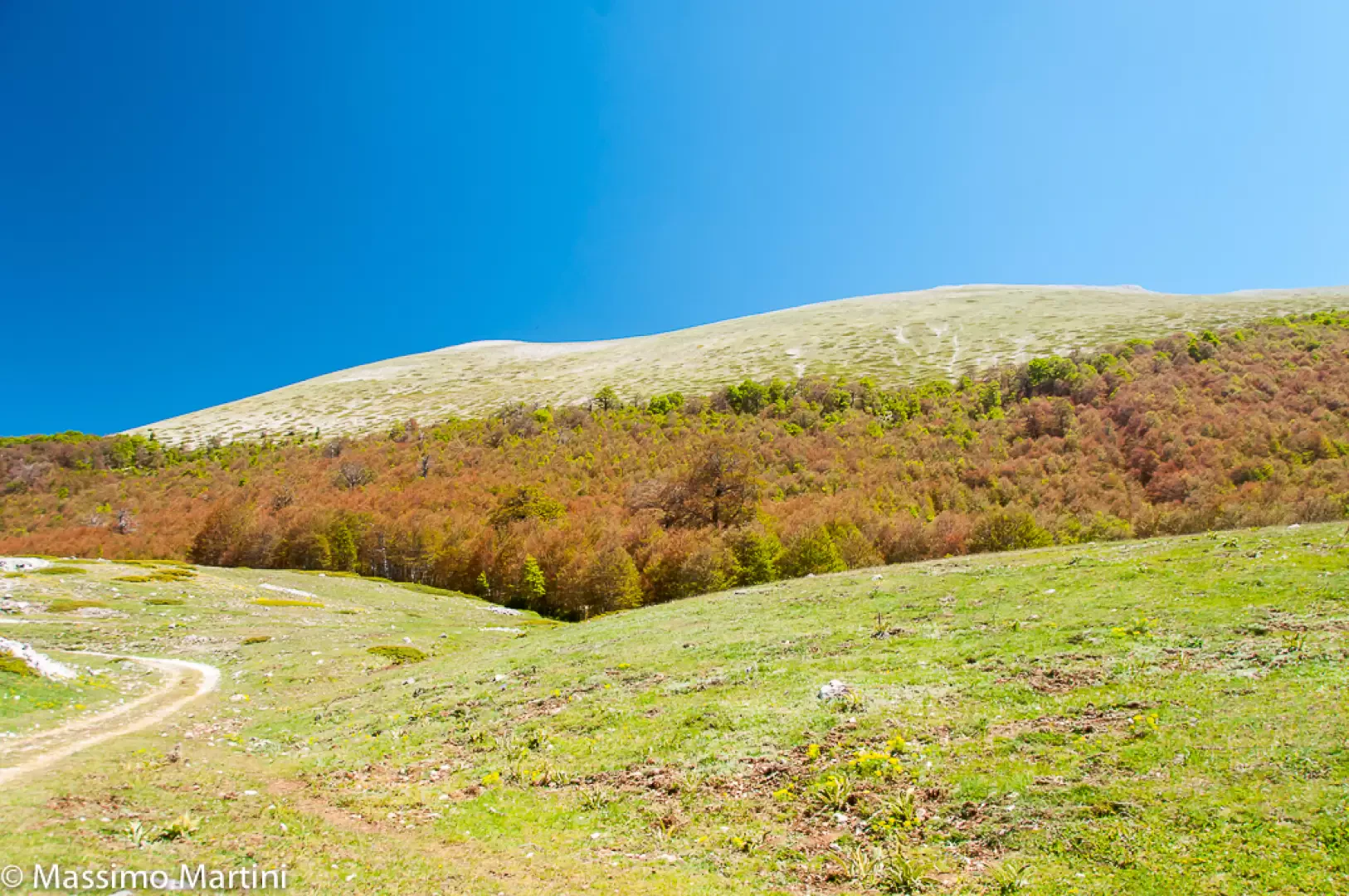
The vegetation cover is dominated for more than 60% of the total surface area by beech trees (Fagus sylvatica), which are distributed between 900 m and 1,800 m above sea level, with nuclei of multi-secotary individuals of particular scientific interest. In 2017, five nuclei of ancient beech forest in the municipalities of Lecce nei Marsi, Opi, Pescasseroli and Villavallelonga - with trees up to 560 years old - were recognised as World Heritage by UNESCO as part of the Carpathian and other European regions' Primordial Beech Forests serial site, the first UNESCO recognition for the entire Abruzzo region. Above the beech forest, between 1.800m and the summit altitudes, the subalpine and alpine plateau is home to grasslands of graminaceous and cyperaceous plants, communities of Pinus mugo - rare in the Apennines;Apennines - and a number of endemic or relict species from the glacial age, including the Marsican Iris (Iris marsica Ricci & Colasante), the most conspicuous endemism of the central Apennines, and the Valais Fescue (Festuca valesiaca Schleich. ex Gaudin). Gentians, primroses and alpine asters can also be found in the glades and meadows at high altitudes, giving the summit area a botanical physiognomy of an alpine type despite its Apennine location.
The park's fauna is among the most significant in Italy in terms of the number of large vertebrates present in stable populations. The Marsican brown bear (Ursus arctos marsicanus), an endemic subspecies of the central Apennines that remained isolated from Alpine populations during the glaciations, finds its main reproductive nucleus here, with a population estimate that the most recent research places at between 50 and 60 individuals in the overall range. The Abruzzo chamois (Rupicapra pyrenaica ornata), an endemic subspecies of the southern Apennines that was once on the brink of extinction, has been brought from a few dozen individuals in the 1920s to a current population of a few hundred, contributing to a reintroduction programme that has affected other Italian national parks. The Apennine wolf (Canis lupus italicus) is present with several packs in the territory, and the progressive recolonisation of red deer (Cervus elaphus) and roe deer (Capreolus capreolus) has allowed the reconstitution of the original food chains. Birds include the golden eagle (Aquila chrysaetos), peregrine falcon (Falco peregrinus), eagle owl (Bubo bubo) and Lilford's woodpecker (Dendrocopos leucotos lilfordi), an endemic subspecies closely dependent on the presence of ancient beech forests with abundant dead wood.
The history of the protected area began in the second half of the 19th century, when the Alto Sangro territory became part of the Crown's hunting reserves. The initiative to establish a national park was promoted by the engineer and deputy Erminio Sipari, originally from Alvito but deeply rooted in the Pescasseroli community, who in 1921 marked a decisive turning point in the project through his presidency of the Pro-Montibus Federation for Lazio and Abruzzo. The park was inaugurated on 9 September 1922 in Pescasseroli - the headquarters of the managing body - and officially recognised by Royal Decree-Law No. 257 of 11 January 1923. Over the following decades, the perimeter of the park was progressively enlarged to include the Lazio sector of the Valle di Comino, the Molise sector of the Mainarde and further portions of the Marsica Abruzzo region, reaching its current configuration through the provisions of 1990, 1993 and 2000. With Law No. 93 of 23 March 2001, the name was officially updated to Parco Nazionale d'Abruzzo, Lazio and Molise, in recognition of the interregional articulation of the protected territory.
In terms of management, the park is divided into zones of differentiated protection: Zone A, of integral reserve, includes the most inaccessible and sensitive areas - the chamois rock cirques, the Scerto valley bottom, the Fondillo Torrent - with forbidden or strictly regulated access; Zone B, of general reserve, regulates motorised access and the taking of natural resources, with free hiking; Zone C, of protection, covers the agricultural valley bottoms and the peri-urban spaces of the inland municipalities. An external protection zone of approximately 775 km² extends around the core of the park, acting as a buffer between the institutional perimeter and the surrounding territories. The scientific research programmes active in the area concern the monitoring of the Marsican bear population, the genetics of the Apennine wolf, the ecology of the ancient beech forests and the monitoring of the residual limestone glaciers in the Monti della Meta.
The park's trail network includes some 137 itineraries with a total length of more than 750 km, with access points distributed over 25 points of entry in the park's main centres. The routes run through wooded valleys, high-altitude meadows and rocky areas, with an offer that covers summer hiking, winter cross-country skiing and cycling on secondary roads. The 24 municipalities in the park preserve historical centres of considerable interest: Pescasseroli, seat of the managing body and birthplace of the philosopher Benedetto Croce, preserves the 12th century Abbey of Saints Peter and Paul; Civitella Alfedena houses the Apennine Wolf Museum; Villavallelonga hosts the Museum of the Apennine Wolf;bear; Opi, perched on a limestone spur in the Fondillo Valley, has medieval remains and the Abruzzo Chamois Museum; Alfedena, in the upper Sangro Valley, has the walls of the medieval castle and a Norman tower. The San Vincenzo al Volturno complex in the Molise sector is one of the most important Benedictine settlements in southern Italy. In the Canneto Valley is the Sanctuary of the Madonna di Canneto, a pilgrimage destination with a medieval wooden statue, probably founded in the 8th century as part of the network of dependencies of the Montecassino Abbey.
.Information
General Data
Typology: National Park
Year of Establishment: 1923 (private inauguration 1922; extensions 1990, 1993, 2000; current name 2001)
Managing body: Ente Parco Nazionale d'Abruzzo, Lazio e Molise (PNALM)
Reference body: Ministero dell'Ambiente e della Sicurezza Energetica
Area: 505 km²
Buffer zone/contiguous area: 775 km²
Minimum altitude: 900m
Maximum altitude: 2.252m
Maximum elevation: 2,252m - Monte Marsicano
Region(s): Abruzzo - Lazio - Molise
Province(s): L'Aquila - Frosinone - Isernia
Municipalities involved: Alfedena - Alvito - Barrea - Bisegna - Campoli Appennino - Castel San Vincenzo - Civitella Alfedena - Filignano - Gioia dei Marsi - Lecce nei Marsi - Opi - Ortona dei Marsi - Pescasseroli - Picinisco - Pizzone - Rocchetta a Volturno - San Biagio Saracinisco - San Donato Val di Comino - Scanno - Scapoli - Settefrati - Vallerotonda - Villavallelonga - Villetta Barrea
Official website: https://www.parcoabruzzo.it