Pontey parish church

Edited by:
Massimo Martini
Introduction
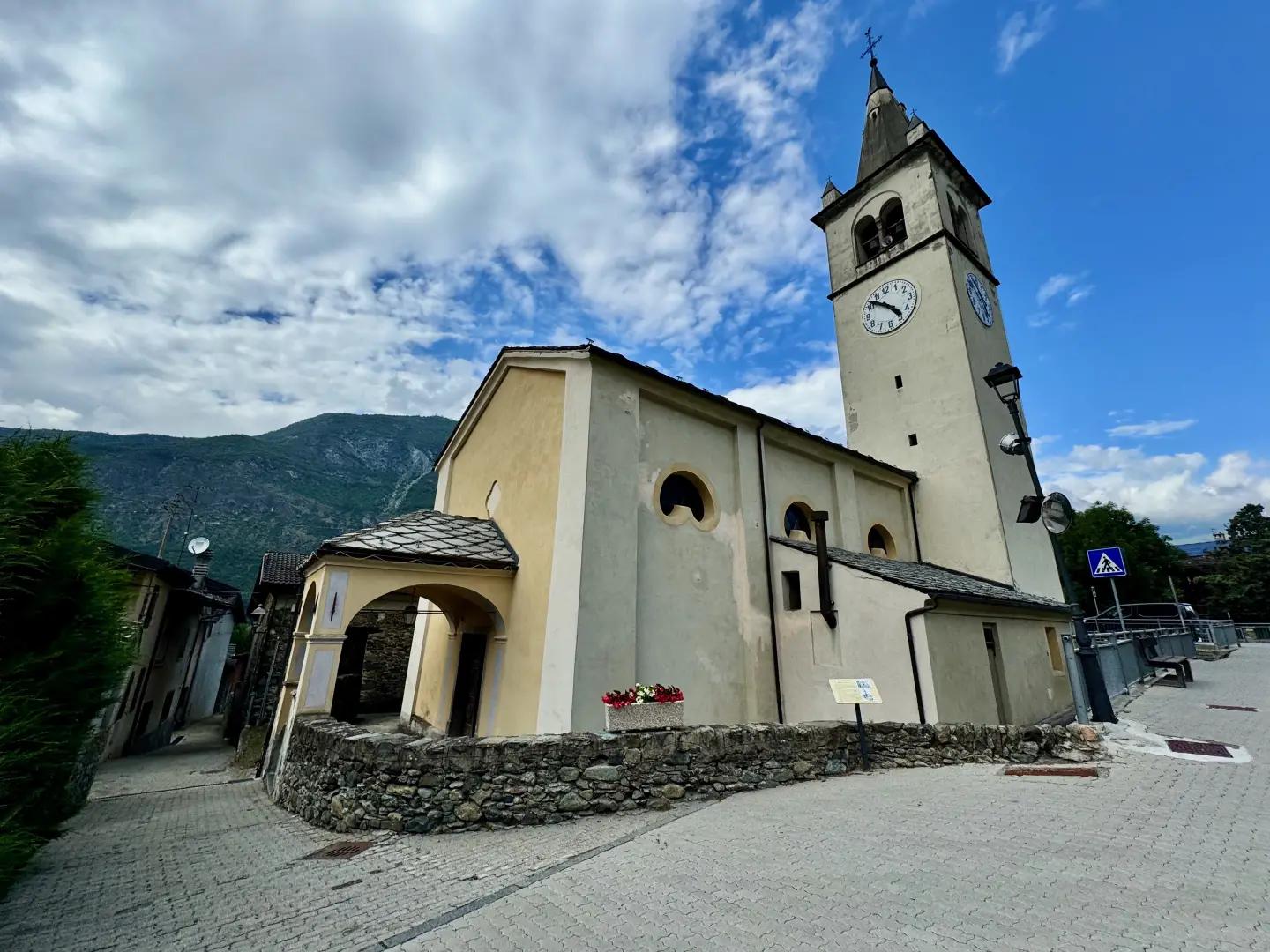
Immersed in the heart of the location of Lassolaz, in a central position with respect to the urban fabric of Pontey, the Parish Church of Saint Martin of Tours presents itself as a stable spiritual and architectural reference point for the community of the lower Aosta Valley. The building rises in a rural mountain setting, surrounded by stone houses and cultivated fields, looking towards the wooded slopes that frame the valley floor.
The first documentary mention of the church dates back to 1176, when it appears in a papal bull issued by Pope Alexander III, among the religious buildings subject to the diocese of Aosta. Although the current structure is the result of later interventions, its medieval origin testifies to the ancient rooting of the cult in this area.
Today, the church is distinguished by its sober but harmonious architecture, enriched by sculpted altars, pictorial decorations and a slender spire, a visible symbol of the Christian presence. The dedication to St. Martin of Tours, a charitable bishop and a very popular figure in the Middle Ages, confirms its central role in the religious and community traditions of the place.
Description
The building has a rectangular ground plan with a slightly raised square presbytery, a typical solution for churches at the bottom of the valley. The façade is simple and plastered, while the stone bell tower, a surviving element from the medieval period, was raised in 1843 to a design by architect Gayo, who also added the spire and clock. Inside, the church retains 18th-century altars that are the only remaining element of the major decorative campaign promoted in 1833, when the stucco work and liturgical furnishings were also renewed. In spite of later alterations, these altars testify to the artistic attention given to the church in the 19th century.
The current appearance of the building dates back to the reconstruction of 1764, probably based on a project that has now been lost, which replaced the previous medieval church. Available documents do not clarify whether any original portions, apart from the bell tower, were integrated into the new building. In 1833, a second phase of work returned a "beautiful and richly decorated" church to the faithful, although much of this decoration is now lost. The sculpted altars, partly reworked over time, remain as tangible traces. Finally, the raising of the bell tower, required to make the sound of the bells audible throughout the village, emphasises the parish church's function, not only liturgical but also civic, regulating the rhythms of rural life with the clock.
No specific legends linked to the church have been passed down, but the dedication to St Martin, known for the episode of the cloak given to the poor man, is a sign of a concrete and popular spirituality, close to the daily life of the community. The patronal feast day of 11 November still represents a moment of identity and cohesion, celebrated with a solemn function and, in the past, with agricultural rites linked to the end of the harvest.
Visits to the church are possible during liturgical celebrations and occasionally at other times of the year, thanks to the parish opening. There are no regular tourist schedules, but the site fits in well with historical and cultural itineraries in the lower Aosta Valley, as it can be easily reached by car or with a short diversions along the network of paths through the commune.