Nanga Parbat

Edited by:
Massimo Martini
Access
Summit routes
Nanga Parbat is reached mainly from the Diamir slope to the north-west, where the Kinshofer route, considered the current normal route and the safest, runs. Base camp is set up at about 4,200 metres in the Diamir valley, which can be reached from Gilgit by road and a short trek. The Kinshofer route was opened in 1962 by Karl Maria Herrligkoffer's expedition and typically involves four camps at altitude, with the last one installed around 7,200 metres. The Rupal Face, on the south-eastern side, is the most challenging and spectacular route: a wall of rock and ice that descends 4,500 metres towards the Rupal Valley and has been climbed very few times since the first ascent in 1970. The Rakhiot slope, climbed by Buhl in 1953, is less frequented today but retains all the historical character of the route of the first ascent. The Mummery Spur, on the Diamir slope, is considered one of the most dangerous routes in the entire Himalaya and has never been climbed to the summit.
Summer ascent routes
" from Diamir Base Camp (4,200m), Kinshofer route - AD - 5-7 weeks (including acclimatisation) - (normal route, Diamir slope)
" from Base Camp Rakhiot (3,600m), Rakhiot and Sella d'Argento route (1953, Buhl) - D - historic first ascent route
" from Base Camp Rupal, Rupal route (1970, Messner brothers) - ED - highest face in the world, ~4.500m altitude difference
" from Base Camp Rupal, Rupal direct route (2005, House-Anderson) - ED+ - Piolet d'Or 2006
" from Base Camp Diamir, Messner solo route (1978) - ED - first solo alpine-style ascent of an eight-thousandthousandth; route never repeated
Winter ascent routes
" Kinshofer route (4.200m) - AD - first winter ascent 26 February 2016 (mountaineering, Moro, Sadpara, Txikon)
Introduction
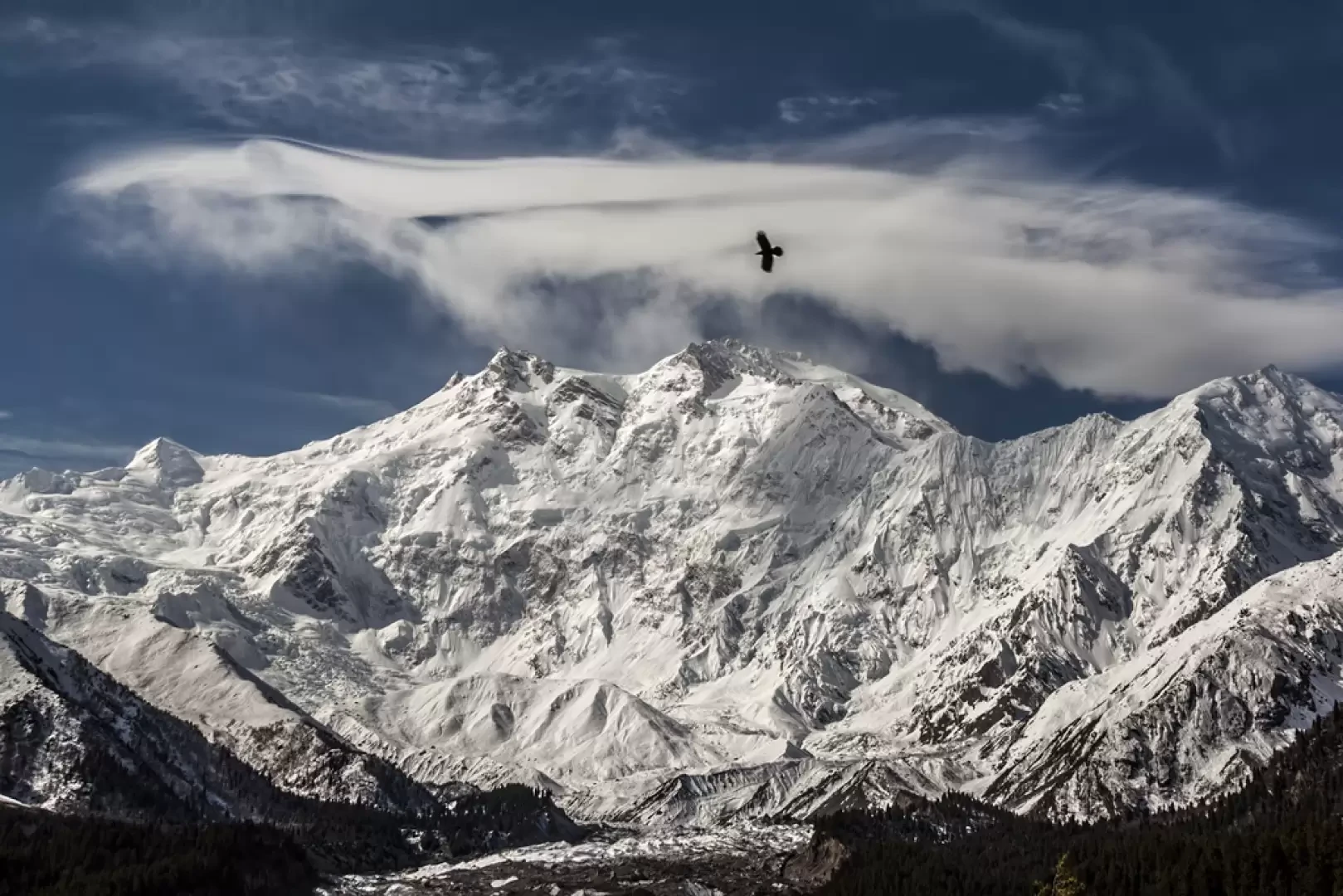
At 8,126 metres, Nanga Parbat is the ninth highest mountain on Earth and the westernmost of the eight-thousanders, located in Pakistan's Gilgit-Baltistan region. Its name means "naked mountain" in Urdu, because of the rocky slopes that in several places emerge through the snow; it is also known as Diamir, "king of mountains" in Balti, and as "Killer Mountain" in international mountaineering, because of its very high mortality rate - the second highest of all eight-thousanders after Annapurna, historically around 28% of attempts. The mountain has three major faces: the Rakhiot Face to the north-east, traversed by the route of the first ascent; the Rupal Face to the south-east, the highest face in the world with around 4,500 metres of vertical drop from base to summit; and the Diamir Face to the north-west, on which the current normal route is built. The first ascent was carried out on 3 July 1953 by the Austrian Hermann Buhl, who reached the summit alone, without oxygen, starting from the last camp in the middle of the night: it is the first and only eight-thousand metre peak to be reached by a single mountaineer. Before that day, thirty-one people had lost their lives attempting to climb it. In 1970, Reinhold Messner and his brother Günther opened the first route on the Rupal face; Günther died in an avalanche during the descent to the Diamir face. In 1978, Messner returned alone from base camp and opened a new route on the Diamir face: the first solo alpine-style ascent on an eight-thousand-meter peak. The first winter ascent was made on 26 February 2016 by Simone Moro, Ali Sadpara and Alex Txikon, after thirty years of failed attempts and tragedy.
Description
Geographical Background
Nanga Parbat is geographically located at the western end of the Himalayan chain, separated from the Karakorum system by the Indus Gorge - one of the deepest on the planet - which flows some 4,600 metres below the summit of the mountain. This isolated and peripheral position in relation to the other eight-thousanders gives it peculiar climatic characteristics: less influenced by the Bengal monsoons, it is instead subject to disturbance systems from the west, which bring heavy winter snowfall and unpredictable weather conditions. The Rupal Wall, which faces southwards over the valley floor of the river of the same name, is the highest wall of rock and ice on the planet: from the base to the summit it descends for about 4,500 metres with average slopes of more than 50°. The Diamir Wall, to the north-west, descends towards the glacier of the same name with a more articulated and less vertical profile. The massif includes a number of secondary summits such as Nanga Parbat North and the West shoulder, connected to the main summit by exposed and technically demanding ridges.
Geologically speaking, Nanga Parbat is an extraordinary case in the Himalayan landscape: its structure is made up of gneiss and granite rocks of the Great Himalayan Sequence subjected to one of the fastest rates of tectonic uplift and erosion on the planet, estimated at more than 5 millimetres per year. This exceptional uplift is linked to the proximity of the Western Himalayas, an area of strong crustal deformation where the Himalayan chain bends westwards. The ice-polished granite walls that characterise the upper slopes of Nanga Parbat are the product of this extreme geological dynamic. The Indus valley floor, to the north, is one of the deepest and oldest watercourses in the region, older than the mountains it crosses.
Fauna in the Nanga Parbat region includes the snow leopard (Panthera uncia), the Central Asian ibex (Capra sibirica) and the markhor (Capra falconeri), Pakistan's emblematic capride. The coniferous and birch forests of the lower slopes quickly give way to alpine pastures and then to the desert scree of the higher altitudes.
Mountaineering history
Nanga Parbat was the first major mountain in the Himalayas to be systematically attempted by European mountaineers. In 1895, the Englishman Albert Mummery - an ingenious and innovative mountaineer, author of some of the most difficult ascents of the time in the Alps - disappeared with two porters on the Diamir slope, probably swept away by an avalanche: he was the first recorded victim in high-altitude mountaineering on the great Asian mountains. Between 1932 and 1939, five Austro-German expeditions attempted the north-eastern Rakhiot slope in increasingly dramatic conditions: in 1934, an avalanche killed four mountaineers and six Sherpas, including Willy Merkl - the expedition leader, whose half-brother Karl Maria Herrligkoffer would later organise the winning 1953 expedition. In 1937, a second avalanche swept over Camp IV, burying seven mountaineers and nine Sherpas: still the season with the most deaths on an eight-thousand metre peak after Manaslu in 1972. In 1939, Peter Aufschnaiter's expedition - which included Heinrich Harrer - was interrupted by the outbreak of World War II; Harrer, interned by the British in India, escaped and reached Tibet, where he lived for seven years in the service of the Dalai Lama: the story is narrated in the famous book Seven Years in Tibet.
The first ascent was carried out on 3 July 1953 as part of the Austro-German expedition led by Karl Maria Herrligkoffer, on the Rakhiot slope and the Silver Saddle. In the hours before dawn, Hermann Buhl - 29 years old, a Tyrolean from Innsbruck, already the author of memorable exploits on the great walls of the Alps - left the last camp alone, without oxygen and without informing the expedition leader. He climbed more than 1,300 metres of altitude difference in snow, rock and mixed terrain, reached the summit at 7 p.m. and was forced into an open bivouac on the descent, standing on a small rock pulpit, without tent or sleeping bag, at an altitude of more than 8,000 metres. The next morning he returned to camp, exhausted but alive. This was the first and only eight-thousand metre first ascent by a single mountaineer, and the first ascent of an eight-thousand metre peak without supplementary oxygen as an intentional fact. The route was not repeated for the first time until eighteen years later, in 1971, by a Czechoslovak expedition.
In June 1970, Reinhold Messner and his brother Günther, as part of a new Herrligkoffer expedition, made the first ascent of the Rupal Face - the highest face in the world - and for the first time, the two brothers from Trento reached the summit. The descent to the opposite side, the Diamir, turned into a struggle for survival: without a rope, without a tent, with exhausted reserves, the two bivouacked two nights in the open. When they were almost safe, Günther was swept away by an avalanche and disappeared. Reinhold searched for his brother for a day and a night, then collapsed exhausted and was rescued by local mountaineers. The controversy over Messner's version lasted decades: Günther's body and boots, found in 2005 and 2022, confirmed exactly what Reinhold had always claimed. In 1978, Messner returned alone to Nanga Parbat, started from base camp and reached the summit by a new route on the Diamir face: the first alpine-style solo on an eight-thousand metre peak, a route that has never been repeated. In 2005, the Americans Steve House and Vince Anderson opened a direct route on the Rupal Face - 4,100 metres of climbing - and won the Piolet d'Or the following year.
The first winter ascent belongs to a 30-year history, starting with the first attempt in 1988 by a Polish expedition. Among the protagonists of the numerous failed attempts were Poland's Tomasz Mackiewicz (six attempts on three different routes), Daniele Nardi, Simone Moro and Denis Urubko. On 26 February 2016, Simone Moro, Pakistani Ali Sadpara and Spaniard Alex Txikon reached the summit via the Kinshofer route, in extremely cold conditions; Tamara Lunger stopped seventy metres below the summit due to altitude-related difficulties. For Moro, it was the fourth winter first on an eight-thousand metre peak: an absolute record that is still unbeaten. On 25 January 2018, Élisabeth Revol and Tomasz Mackiewicz reached the summit by a new route to the north-west; during the descent Mackiewicz suffered cerebral oedema and could no longer descend independently. Revol was rescued by Adam Bielecki and Denis Urubko, who had flown down from K2; Mackiewicz did not survive. In the winter of 2018-2019, Daniele Nardi and Briton Tom Ballard attempted the Mummery Spur - the extremely difficult buttress on the Diamir slope descended by the Messner brothers in 1970 - and disappeared on 24-25 February 2019 after radio communications were cut off. Their bodies were spotted, tied to fixed ropes, at an altitude of around 5,900 metres, but the dangerous nature of the site made recovery impossible.
Cultural context
Nanga Parbat has always been an object of respect and fear among the local populations of the Indus Valley and Gilgit-Baltistan. The nickname "Killer Mountain" is not just a rhetorical formula: before 1953, thirty-one mountaineers had lost their lives there, and after that date the victims have continued to accumulate, making Nanga Parbat the mountain with the second highest death rate of all eight-thousanders. The story of Albert Mummery, the great British mountaineer who died in 1895, opens a saga of tragedies that has involved generations of mountaineers from every nation - German, Austrian, Czechoslovakian, Italian, Polish, French, American. The story of the Messner brothers in 1970, with the death of Günther and the controversy that lasted for decades, is one of the most discussed and painful episodes in 20th century Italian mountaineering. The story of Daniele Nardi, a mountaineer from Lazio who was obsessed with the Sperone Mummery and returned to it season after season until his death in 2019, has become a symbol of the relationship between the mountaineer and his mountain of choice.
Fruition and frequentation
Nanga Parbat is reached by relatively few mountaineers compared to the Nepalese eight-thousanders, due to its remote location, reputation for danger and logistical difficulties. The ascent permit is issued by the government of Pakistan. The base camp on the Diamir slope can be reached from Gilgit via dirt roads and a short trek. The main season is summer (June-August), with often unstable weather windows. The mortality rate remains among the highest of the eight-thousanders.
Hosts
" Diamir Base Camp (4,200m) - on the north-west slope, access from Gilgit
" Rakhiot Base Camp (3,600m) - on the north-east slope, historic camp of the 1953 expedition
Information
Information
Height: 8.126m
Alternative name: Diamir (balti), Nanga Parbat = "naked mountain" (Urdu/Sanskrit); "Killer Mountain"
Mountain group: Western Himalaya - western limit of the chain
Alpine chain: Himalaya
Typology: massif/main summit
Protected area: none
First ascent: 3 July 1953
First climbers: Hermann Buhl (solo)
First winter ascent: 26 February 2016
First ascenders in winter: Simone Moro, Ali Sadpara, Alex Txikon
Vice book: absent
Commune(s): Gilgit-Baltistan (Pakistan)
Valley(s): Diamir Valley (NW); Rupal Valley (SE); Indus Gorge (N)
Mountaineering difficulty: AD (Kinshofer route); ED-ED+ (Rupal and Rakhiot walls)
Average elevation gain: 3.926m (from Diamir Base Camp)
Recommended period: June-August
Prevalent exposure: N-W (Kinshofer route); S-E (Rupal wall)
Presence of glaciers: yes (Diamir glacier, Rakhiot glacier)
Presence of equipped sections: yes (fixed ropes on the Kinshofer route)
Collections
peaks of Pakistan - list - map