Mont Blanc

Edited by:
Massimo Martini
Access
The Mont Blanc ascent itineraries are developed on three main slopes and always require an overnight stay in a refuge before attacking the summit. The terrain is exclusively glacial and mixed in the high sections, with the constant presence of crevasses, steep sections and the risk of seracs in specific sectors. Altitude plays a determining role on progression: even the technically less demanding routes require good acclimatisation, ice progression skills with crampons and ice axe, and snow reading. Conditions vary considerably between June and September, the period during which the routes are practicable; outside this window, the environment is objectively severe and ascents are reserved for experienced mountaineers in a high-altitude winter environment.
Summer ascent routes
" from Nid d'Aigle (2,372m) to the Goûter Refuge - PD - 2 days - (French normal route)
" from Courmayeur - Lac Combal - Gonella hut (3,071m) to Dôme glacier and Bosses ridge - PD+ - 2 days - (1,800mD+ from hut) (Italian normal route)
" from Chamonix - Aiguille du Midi - Refuge des Cosmiques (3.616m) to Mont Blanc du Tacul, Mont Maudit and Col de la Brenva - AD - 2 days - (1,450mD+ from the hut) (Trois Monts route)
Winter ascent routes
Winter ascents to Mont Blanc are reserved for mountaineers with specific experience at high altitude in the cold season. The weather conditions are unpredictable and the objective risks - avalanches, seracs, extreme temperatures - are considerably higher than in the summer season. The first winter ascent was made on 31 January 1876 by Isabella Straton, Jean-Estéril Charlet and Sylvain Couttet.
Introduction
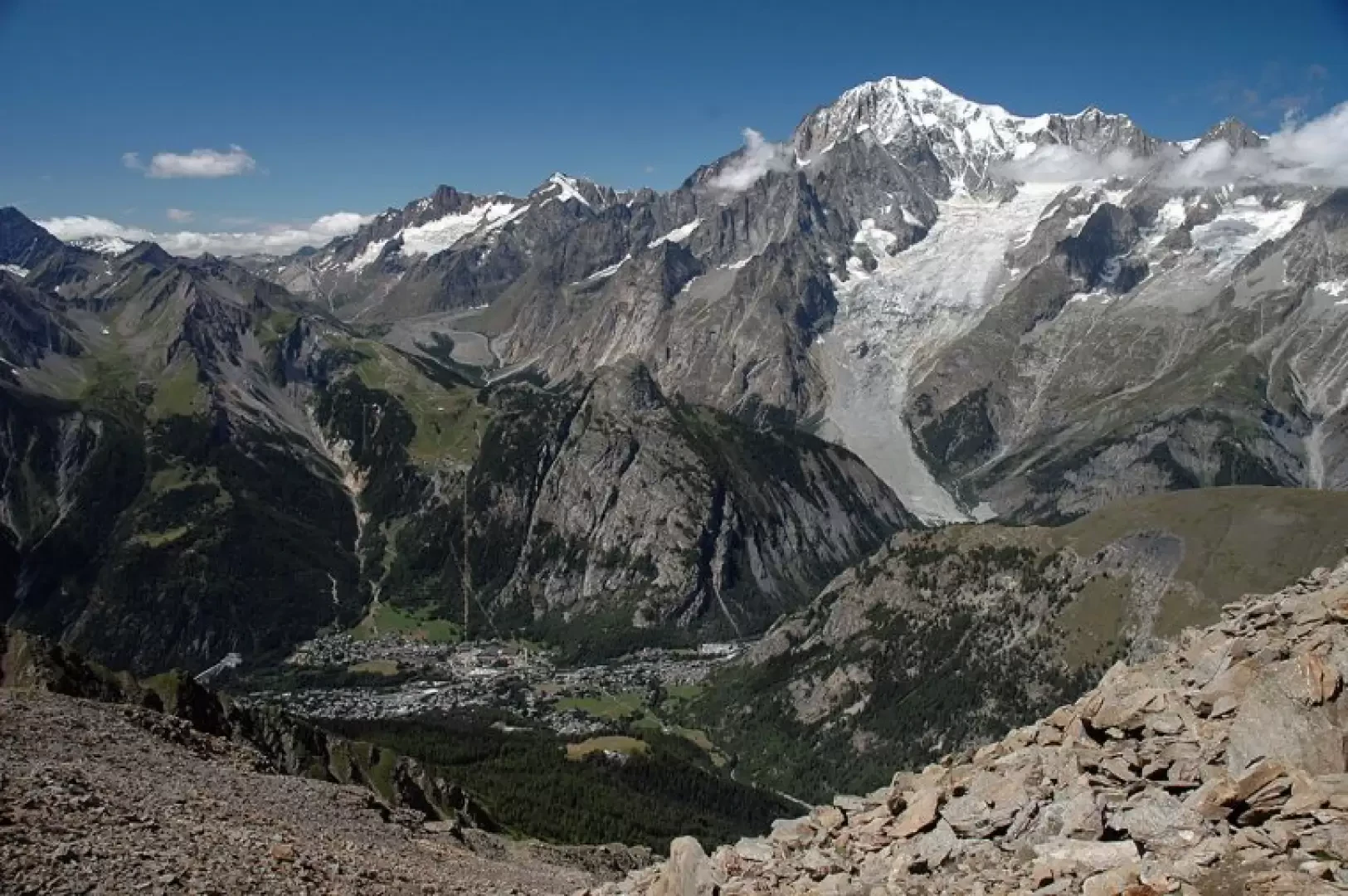
At 4,808 metres, Mont Blanc is the highest peak in the Alps and Western Europe. It is located along the watershed line on the border between Italy and France, in the territory of the municipalities of Courmayeur and Chamonix-Mont-Blanc, dominating Val Veny and Val Ferret on the Italian side, while on the French side it overlooks the Arve valley. In the SOIUSA classification, it belongs to the Graian Alps, subsection Mont Blanc Alps, within the massif of the same name. The mountain consists mainly of granite, with a complex morphology of pinnacles, ridges and deep valleys traversed by one of the most extensive glacial systems in the Alps: the Mer de Glace, the Brenva Glacier and the Glacier du Miage are the main glacial bodies. Historically known as Mont Maudit due to the hostile climatic conditions that discouraged its approach, the summit owes its current name to the blanket of snow and ice that covers it in every season. The first ascent, carried out on 8 August 1786 by Jacques Balmat and Michel Gabriel Paccard starting from Chamonix, is conventionally recognised as the founding act of modern mountaineering: from that date, the systematic phase of conquering the great Alpine peaks began. The Italian side was reached for the first time on 13 August 1863 by three guides from Courmayeur - Julien Grange, Adolphe Orset and Jean-Marie Perrod - together with the Englishman Reginald Head, along the route that was to become known as the Trois Mont Blanc route. The normal Italian route, opened on the descent in 1890 by priest Achille Ratti - the future Pope Pius XI - with Emile Rey and other companions, still bears the name Via Ratti or Via del Papa. The massif is home to numerous trail running and skyrunning competitions of international importance, including the Tor des Géants and the Mont-Blanc Marathon.
Description
Geology and Morphology
The Mont Blanc massif is mainly formed of granite and metamorphic rocks associated with their setting. The granitic pluton, of late-varitic age, emerges in a wide structural window opened by glacial and fluvial erosion during the Quaternary eras. The granite walls that characterise pinnacles such as the Aiguille Noire de Peutérey and the Brenva Pillars are the direct result of this compact petrological structure, which has allowed the formation of rock routes of great quality and continuity. Glaciers descending from the summit ridges have modelled deep U-shaped valleys, shaping the current landscape of Val Veny, Val Ferret and the Chamonix valley. The glacial system of the massif is gradually reducing in volume: the Mer de Glace, the largest glacier in France, lost several kilometres in length and tens of metres in thickness during the 20th century. The Miage Glacier, on the Italian side, is a covered glacier: its surface is partly buried by a mantle of debris that slows down its surface melting locally.
Mountaineering History
The mountaineering history of Mont Blanc spans more than two centuries and covers all the stages of the evolution of European mountaineering. After the first ascent by Balmat and Paccard in 1786, which responded to the scientific impulse promoted by the Genevan naturalist Horace-Bénédict de Saussure - who had offered a reward in 1760 for whoever found the route to the summit - the mountain quickly became the obligatory test bed for every generation of mountaineers. As early as 1808, the guide Marie Paradis reached the summit as the first woman; in 1838, Henriette d'Angeville repeated the feat more independently. The Grands Mulets route, a historic route across the glacier of the same name, was completed in 1859; the French normal route to the Aiguille du Goûter and the Bosses ridge, today the most frequented, was opened in its final form in 1861 by Leslie Stephen, Francis Fox Tuckett and guides Melchior Anderegg, Johann-Josef Bennen and Peter Perren. The first winter ascent, on 31 January 1876, was by Isabella Straton with Jean-Estéril Charlet and Sylvain Couttet: an episode that also marked the first female winter ascent of the peak. In the 1930s, the attention of mountaineers shifted to the big walls, in particular the Walker Spur at the Grandes Jorasses and the Brenva Pillars. Walter Bonatti and Riccardo Cassin left decisive traces on this massif. On 3 November 1950, at an altitude of 4,677m, the Air India flight 245 Malabar Princess crashed into the Rocher de la Tournette, killing 48 people: one of the most serious mountain air accidents in European alpine history. In December 1956, the tragic story of the two young mountaineers Vincendon and Henry, stranded by a storm on the Brenva slope, forced a difficult rescue operation that also involved Walter Bonatti. In the sixties and seventies, the peak became a terrain for fast and solitary ascents; in recent times, it has established itself as a destination for skyrunning competitions.
Cultural context
Mont Blanc exerts a cultural attraction that goes beyond the mountaineering sphere. Its conquest in 1786 is considered the founding moment of mountaineering as an autonomous discipline, and has influenced two centuries of mountain literature, from Saussure's Description of Mont Blanc to contemporary chronicles. The massif is at the centre of a network of historic alpine accommodation, including the Rifugio Francesco Gonella (formerly Rifugio del Dôme), originally built in 1881 on the instructions of Edward Whymper. The Courmayeur Guide Society, founded in 1850, is the second oldest society of mountain guides in the world and represents an institutional reference for Italian mountaineering. The Mont Blanc tunnel, inaugurated in 1965, transformed the area's role as a European transit axis while maintaining the character of the peak as a symbolic destination. The question of sovereignty over the summit - which for topographical reasons tends to shift towards the Italian side according to some recent measurements - is the subject of a geodetic and diplomatic debate that is still open.
Traverses
" Traversing Mont Blanc - Mont Maudit - Mont Blanc du Tacul with descent to Chamonix (report not present on inalto.org)
" Traverse with descent via the Italian normal route (Rifugio Gonella) after the ascent from the French normal route (report not present on inalto.org)
Trail running and races
" Tor des Géants - the Mont Blanc massif is included in the route of the Aosta Valley race; the ridges and passes on the Italian side are part of the overall route of around 450km with 35.000mD+
" Mont-Blanc Marathon - trail running race with start and finish in Chamonix, which runs along the French slopes of the massif up to altitudes of over 2,000m
Hills
" Rifugio Francesco Gonella (3.071m) - Italian side, Val Veny, base for the Italian normal route
" Vallot bivouac (4,362m) - emergency shelter on the ridge
" Refuge des Cosmiques (3.616m) - French slope, base for the Trois Monts route
" Refuge Goûter (3,835m) - French slope, base for the French normal route
" Refuge Torino (3,375m) - Italian slope, reachable via the Mont Blanc Skyway
Information
Height: 4.808m
Alternative name: Mont Blanc
Mountain group: Mont Blanc Alps
Alpine chain: Graian Alps (SOIUSA)
Typology: glacial dome/main summit of massif
Protected area: none
First ascent: 8 August 1786
First climbers: Jacques Balmat, Michel Gabriel Paccard
First winter ascent: 31 January 1876
First ascenders in winter: Isabella Straton, Jean-Estéril Charlet, Sylvain Couttet
Vice book: present
Commune(s): Courmayeur (AO); Chamonix-Mont-Blanc (Haute Savoie, FR)
Valley(s): Val Veny, Val Ferret (IT); Vallée de l'Arve (FR)
Mountaineering difficulty: PD (French normal route); PD+ (Italian normal route); AD (via dei Trois Monts)
Average elevation gain: 1.800-2.500m
Recommended period: June - September
Prevalent exposure: N (French side); S (Italian side)
Presence of glaciers: yes
Presence of equipped sections: yes
Collections
Courmayeur's summits | list - map
vettes of the Mont Blanc Alps | list - map
vette della Valle d'Aosta | list - map
vette of the Graian Alps | list - map