Makalu

Edited by:
Massimo Martini
Access
Summit routes
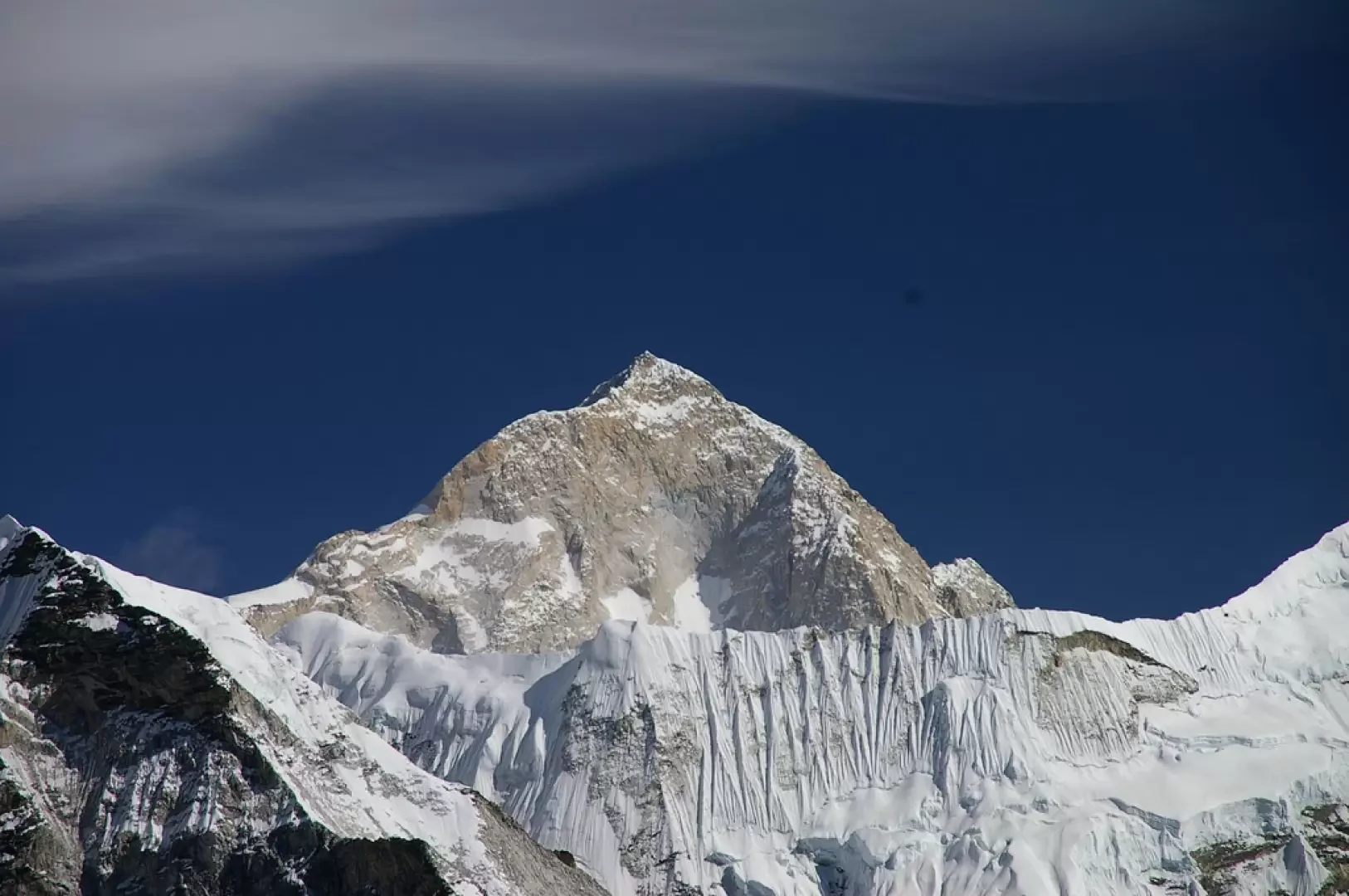
Makalu is one of the most isolated and remote of the eight-thousanders. The trek to the base camp starts from the small town of Thumlingtar at an altitude of only 470 metres, generating the greatest absolute approach height difference of all the peaks above 8,000 metres: a journey of around ten days with continuous ups and downs that puts the mountaineers to the test even in the early stages of the expedition. Base camp is located at around 5,650 metres, on the Makalu glacier. The normal route climbs the northern slope and partly traverses the north-east ridge, passing Makalu La, a pass at around 7,400 metres that constitutes the key point of the itinerary: it is here that the mountain exposes itself to the icy wind that descends from Tibet and that has repelled the vast majority of winter attempts. From Makalu La, the route continues along the ridge towards the summit. The slopes of Makalu all have mandatory rock sections at very high altitudes, which distinguish this mountain from the eight-thousanders where progression is mainly on snow and ice. The west face, the Pillar, is considered one of the most technically challenging routes in the entire Himalayan chain.
Summer ascent routes
" from Base Camp (5.650m), via north-east ridge and Makalu La - AD - 5-7 weeks (including acclimatisation) - (normal route, Nepalese side)
" from Base Camp, via south-east face (Japanese route, 1970) - D - first ascent Y. Ozaki and A. Tanaka
" from Base Camp, West Face Pillar route (1971/1980) - ED - technical route on rock and ice; second ascent 1980 Roskelley, Kopczynski, States, Momb without Sherpa and without oxygen
Winter ascent routes
" normal route, Makalu La (5,650m) - AD - first winter ascent 9 February 2009 (mountaineering, Moro and Urubko)
Introduction
At 8,485 metres, Makalu is the fifth highest mountain on earth. It rises in the eastern section of the Himalayan chain, on the border between Nepal and Chinese Tibet, some 19 kilometres south-east of Everest, in the protected area of Makalu-Barun National Park. Its shape is that of an almost perfect four-sided pyramid with sharp ridges, making it one of the most recognisable and photogenic of all the eight-thousanders. The etymology of the name is uncertain: one of the most credible hypotheses has it derived from the Sanskrit Maha-kala, an epithet of the Hindu deity Shiva meaning "great time" or "great darkness" another, more immediate, links it to a Tibetan term meaning "great black" referring to the dark colour of its rocky walls. Makalu was identified as a distinct peak in 1884 by the surveyors of the Survey of India; it was previously known as Khamba Lung-an. The first ascent was made on 15 May 1955 by Jean Couzy and Lionel Terray, as part of the French expedition led by Jean Franco, in an extraordinarily efficient organisational feat that enabled all members of the expedition to reach the summit within a few days. Makalu has a particularly intense winter history: it was the last of the Nepalese eight-thousanders to be climbed in the coldest season, on 9 February 2009, by Simone Moro and Denis Urubko, after twenty-nine years of failed attempts that cost the life of the great French mountaineer Jean-Christophe Lafaille in 2006.
.Description
Geographical Background
Makalu rises in a relatively isolated geographical position compared to the other major eight-thousanders, surrounded by peaks that do not reach its heights but contribute to one of the most spectacular Himalayan landscapes. To the north-northeast are Kangchungtse or Makalu II (7,678m) and Chomo Lonzo (7,818m); to the west, in close proximity, are the eastern faces of Lhotse and Everest. The mountain has three main peaks in addition to the main one: Makalu Southeast and Makalu Shar, both around 7,800 metres. Base camp is reached through the Barun Valley, one of the deepest and most spectacular canyons in eastern Nepal, which descends from the glacier of the same name into the subtropical forests of the Terai.
The geology of Makalu reflects the structure of the Mahalangur Himal: predominantly granitic and gneissic Himalayan batolite rocks, with areas of high grade metamorphism on the upper slopes. The sharp ridges and vertical walls are the result of glacial erosion and cryoclastic action on a particularly compact and resistant rock substrate, which has shaped the almost perfect pyramid shape of the mountain. The glaciers that descend from the massif - in particular the Barun and Makalu glaciers - feed the Barun Khola hydrographic system, a tributary of the Arun.
The Makalu-Barun National Park, established in 1992, is one of the biologically richest environments in the entire Himalayan chain, with an extraordinary variety of ecosystems ranging from low-altitude tropical forests to perennial snows. The area is home to 440 species of birds, 88 species of mammals - including the snow leopard (Panthera uncia), the red panda (Ailurus fulgens) and the Himalayan wolf (Canis lupus chanco) - 315 species of butterflies and some 3,000 species of vascular plants. The forest of rhododendrons, firs and birches covering the slopes between 3,000 and 4,000 metres is among the largest and best preserved in eastern Nepal.
Mountaineering history
The first reconnaissance of Makalu dates back to 1921, when it was first sighted by scientific observers. However, mountaineering interest only emerged in the 1950s, in parallel with the conquest of neighbouring great peaks. In 1954, three expeditions attempted the mountain almost simultaneously: the California Himalayan Expedition led by physicist William Siri, which reached about 7,100 metres on the south-east face; a New Zealand expedition led by Edmund Hillary, which attempted the north-west ridge; and a French autumn reconnaissance expedition led by Jean Franco, which also made the first ascents of Kangchungtse and Chomo Lonzo. This reconnaissance provided the crucial information for success the following year.
In the spring of 1955, Jean Franco's French expedition returned to Makalu with a precise strategy: a series of lead teams that would set off at twenty-four hour intervals to maximise their chances of success. On 15 May, Jean Couzy and Lionel Terray - two of the strongest French mountaineers of the post-war period - reached the summit after a night at -33°C. The next day it was the turn of Jean Franco and Guido Magnone. In the following days, three more mountaineers of the expedition reached the summit: it was the first time in the history of Himalayanism that all members of an expedition succeeded in climbing an eight-thousand metre peak. The feat was a masterpiece of organisation and timing, carried out under exceptionally favourable weather conditions.
The second ascent took place in 1971 by an international expedition that opened a new route on the West Face, the so-called Pillar. In 1975, an Italian expedition led by Carlo Pinelli attempted the mountain. In the 1970s and 1980s, ascents by variants of the normal route and attempts on new routes multiplied. In 1980, the Pillar route on the West Face was repeated by an American team of four climbers - John Roskelley, Chris Kopczynski, James States and Kim Momb - without Sherpa porters and without supplementary oxygen.
The winter history of Makalu is among the most dramatic of all the eight-thousanders. The first attempt dates back to the winter of 1980-81, by the Italian Renato Casarotto. In the following twenty-eight years, thirteen winter expeditions followed, all of them rejected by the combination of extreme wind and intense cold that characterises the Makalu La area between January and February. Among the protagonists of these attempts were: Reinhold Messner and Hans Kammerlander (1985, stopped at 7,500m on 9 February - the same date Moro and Urubko reached the summit in 2009 - and during the descent found the bodies of two French mountaineers who had disappeared weeks earlier); Krzysztof Wielicki on two different occasions; Nives Meroi, Romano Benet and Luca Vuerich in 2008. On 27 January 2006, the Frenchman Jean-Christophe Lafaille disappeared on Makalu during a solo attempt in winter, after having bivouacked the night of the 26th to the 27th at 7,600 metres: he was last seen ascending to the summit and was never found. Lafaille was considered to be one of the best mountaineers of his time.
On 9 February 2009, at 14:00 Nepalese time, Simone Moro and Denis Urubko reached the summit in extreme conditions - perceived temperature around -40°C, wind between 90 and 100 km/h - and completed the ascent seventeen days after arriving at base camp. The expedition was also the first winter ascent of an eight-thousand metre peak by a team without Polish mountaineers, symbolically marking the transition of this tradition to international himalayering. For Moro, it was the second winter ascent of an eight-thousander after Shisha Pangma in 2005; for Urubko, it was the completion of a long dream, having already attempted Makalu in winter the previous year without success.
Cultural background
Makalu is at the centre of the Makalu-Barun National Park, established in 1992 in close cooperation with the Sagarmatha National Park to protect the transboundary ecosystem of eastern Nepal. The Barun valley, which descends from the glaciers of the massif towards the plains of the Terai, is inhabited by Rai and Sherpa communities with cultural traditions deeply connected to the mountains. Makalu does not have the popular notoriety of Everest or K2, but in mountaineering circles it is considered one of the purest and most difficult eight-thousanders: far from the trade routes, with a long and tiring approach, and without the logistical infrastructure of crowded base camps. This characteristic has made it a favourite destination for light expeditions and mountaineers seeking a Himalayan experience far removed from the commercial dimension.
Frequentation and attendance
Makalu is one of the least frequented eight-thousanders in the world. The long and difficult approach, the technical complexity of the ascent and the absence of commercial infrastructure keep mass expeditions away. The ascent permit is issued by the government of Nepal. The spring season (April-May) is the main one; the autumn season is less used. The base camp is reached from Thumlingtar by a trek of about ten days through Makalu-Barun National Park.
Locations
" Makalu Base Camp (5,650m) - on the Makalu Glacier, Nepalese side
Information
Quota: 8.485m
Alternative name: Khamba Lung-an (historical); Makalu = "great black" (Tibetan) or from "Maha-kala" (Sanskrit)
Mountain group: Eastern Himalayas - Mahalangur Himal
Alpine chain: Himalaya
Typology: four-sided rock pyramid/main summit
Protected area: Makalu-Barun National Park (Nepal, established 1992)
First ascent: 15 May 1955
First climbers: Jean Couzy, Lionel Terray
First winter ascent: 9 February 2009
First winter climbers: Simone Moro, Denis Urubko
Vice book: absent
Commune/s: Sankhuwasabha / Solukhumbu (Nepal) / Tibet (China)
Valley/s: Barun Valley (Nepal)
Mountaineering difficulty: AD (normal route); ED (west face - Pillar)
Average elevation gain: 2.835m (from Base Camp)
Recommended period: April-May
Prevalent exposure: N (normal route); W (Pillar)
Presence of glaciers: yes (Makalu Glacier, Barun Glacier)
Presence of equipped sections: yes (fixed ropes on the normal route)
Collections
Snowhills of Nepal - list - map