Luxembourg

Edited by:
Massimo Martini
Access
Luxembourg, despite being a small state, is well connected thanks to its central location in Europe and an efficient transport network. The Luxembourg-Findel Airport (LUX) is the country's only international airport, with direct flights to major European cities and some intercontinental connections. For those travelling with low-cost airlines, the nearest airports are Charleroi (Belgium), Frankfurt-Hahn (Germany) and Saarbrücken (Germany), all of which can be reached by car or shuttle bus in about 1.5-2 hours.
The railway network, operated by the CFL (Chemins de Fer Luxembourgeois), connects the Grand Duchy to Belgium, France and Germany with high-frequency international trains. The main stations are Luxembourg (Gare Centrale), a central hub with direct connections to Paris (TGV), Brussels, Strasbourg and Trier, and the stations of Esch-sur-Alzette, Differdange and Mersch, useful for regional travel. The national rail service is complemented by efficient buses, which also cover rural areas.
For those travelling by car, Luxembourg is criss-crossed by a well-developed and free motorway network. The main arteries are the (Luxembourg-Treviri), the (towards France via Thionville) and the (towards Brussels). Signage is clear and multilingual (French, German and Luxembourgish), while traffic is generally smooth, with possible delays only in the capital area during rush hours.
Urban travel in Luxembourg city is facilitated by a network of trams, buses and bike-sharing services, with free public transport throughout the country from 2020. For those who prefer alternative means of transport, the PC1 (Piste Cyclable de la Moselle) cycle network and routes in the Luxembourg Ardennes offer scenic options for cycling.
Travelers arriving from other European countries can also use long-distance buses (FlixBus, Eurolines), which connect Luxembourg with cities such as Lyon, Amsterdam and Frankfurt, while river ports on the Moselle River provide waterborne access for cruises and freight transport.
In summary, Luxembourg is easily accessible by air and land, with a well-organised transport infrastructure that makes travelling both nationally and internationally convenient.
The Luxembourgers can also use the Piste Cyclable de Moselle (Piste Cyclable de la Moselle) and the Charter de la Moselle (Piste Cyclable de la Moselle) offer scenic options for cycling.
Introduction
Hidden between Belgium, France and Germany, the Grand Duchy of Luxembourg is a jewel of contrasts: a crossroads of cultures where three official languages are spoken, and where ancient medieval fortresses stand out against green valleys furrowed by tranquil rivers. Despite its small size, this country surprises with its historical richness, lush nature and dynamic economy, all condensed into a territory that invites slow exploration, between forest paths and cities with a timeless atmosphere.
Description
Luxembourg is divided between the Ösling, a northern region of wooded hills and deep gorges carved by the Our and Sûre rivers, and the Gutland, to the south, with fertile plains and vineyards sloping down towards the Moselle. The landscape, shaped by erosion and traditional agriculture, offers striking views such as the Mullerthal rock formations, nicknamed 'Little Switzerland' for the paths that meander through sandstone and moss. The rivers not only define the natural borders with Germany and France, but also create ideal reserves for wildlife, including storks and otters, while beech and oak forests cover more than a third of the territory.
The history of Luxembourg begins with Sigfried, Count of the Ardennes, who in 963 built a castle on the promontory of Bock, thus founding the city that became the heart of a powerful duchy. Passed between Burgundy, Spain and the Habsburgs, the country gained independence in 1815 as a Grand Duchy, maintaining a strategic neutrality sanctioned by the Treaty of London (1867). Figures such as the Grand Duchess Carlotta, who led the resistance during the Nazi occupation, and the current Grand Duke Henry, a symbol of stability, have shaped a proud identity, now reflected in its role as the seat of EU institutions such as the Court of Justice.
Thriving economy and rural traditions coexist in a unique balance. Luxembourg is a global financial hub, with one of the highest GDPs in the world thanks to banks and investment funds, but also innovative sectors such as space (it is the first country to regulate the extraction of asteroidal resources). Agriculture, especially viticulture along the Moselle River, produces renowned wines such as Riesling and Crémant, while wood and ceramic handicrafts endure in the villages of the Ardennes.
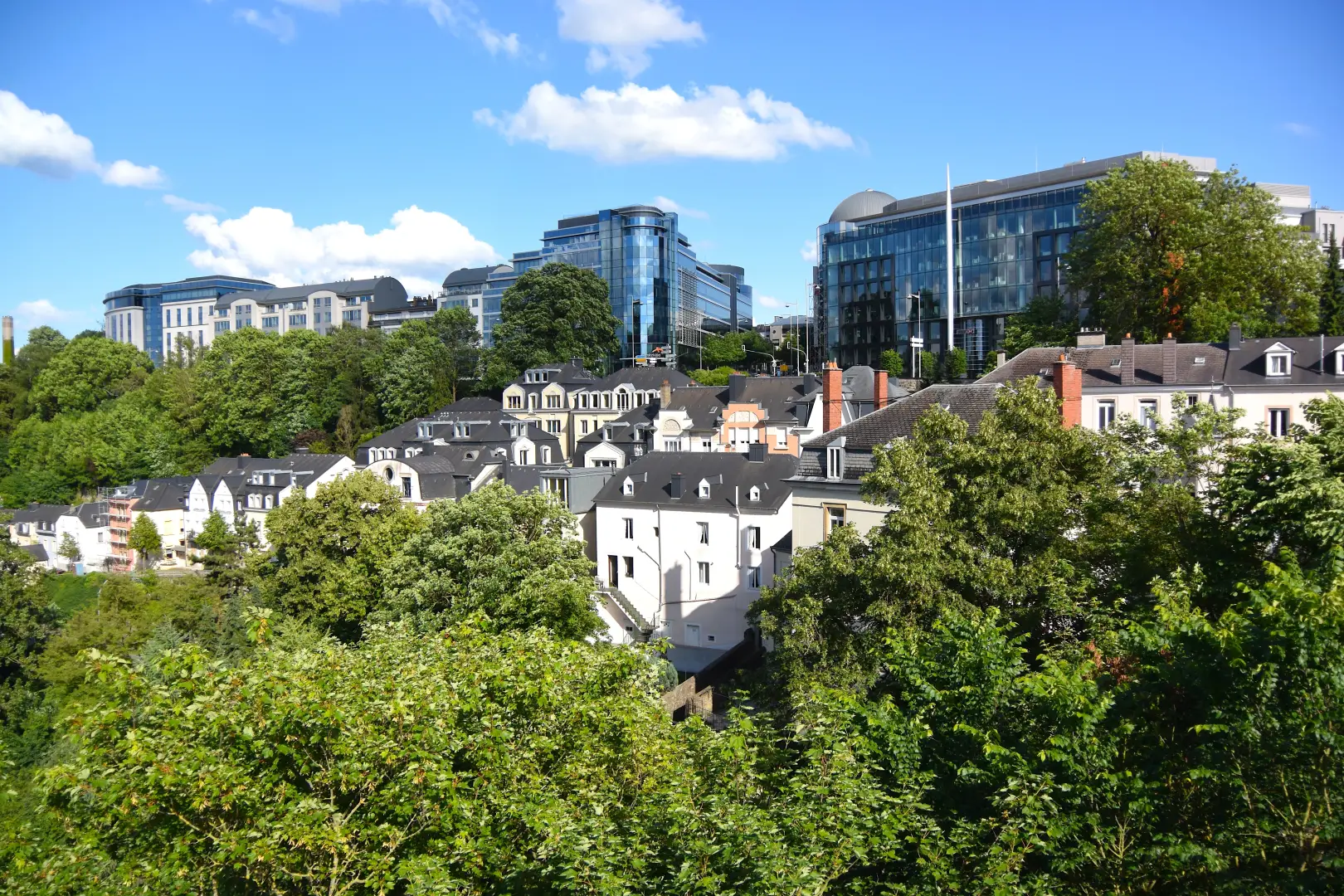
Luxembourg's culture mixes Celtic, Germanic and Romance influences. The Éimaischen, an Easter festival with bird-shaped pottery markets, and the Schueberfouer, a summer fair with centuries-old jousts, celebrate peasant and merchant roots. Luxembourgeois, the national language, coexists with French and German, while folk music, with instruments such as the accordion, enlivens the festivities in the dörfer (villages). The capital, with its Grund district UNESCO World Heritage Site, embodies this layering: cobbled streets lead to modern art museums and cellars where you can enjoy judd mat gaardebounen (smoked ham with beans).
For those who enjoy active tourism, Luxembourg offers 1,100 km of marked trails, including the Mullerthal Trail, a labyrinth of rocks and waterfalls, and the Escapardenne Eisleck Trail, which crosses the Ardennes. Cyclists can ride the Moselle Cycle Path, while in winter, the Ösling hills lend themselves to snowshoeing. Refuges such as the Heringer Millen and views such as the Vallée des Seven Castles offer unforgettable stops, perhaps while listening to legends about Mélusine, the river fairy.
The Protected areas, including the Natural Park of Our and the Natural Reserve Haff Réimech, protect wet habitats and primary forests, where eagles and ospreys nest. Geosites such as the Wolfsschlucht gorges tell the story of millions of years of erosion, while the Castles of Vianden and Bourscheid, perched on rocky spurs, dominate fairytale landscapes.
Highlights include the Cathedral of Notre-Dame in Luxembourg city, with its Gothic stained-glass windows, and the iron mines of Rumelange, now a UNESCO museum. The Bock casemates, galleries excavated in the 17th century, and the Mudam, a contemporary art museum designed by Pei, show the dialogue between past and future. Not forgetting Clervaux, with its Benedictine abbey and the photographic exhibition The Family of Man, also a World Heritage Site.
Luxembourg is an invitation to discover Europe in miniature: a place where every castle, every path and every glass of wine tells an ancient, yet ever-living story.
Information
General Data
Capital: Luxembourg
Area: 2,586 km²
Minimum elevation: 132 m (confluence of the Moselle and Sauer rivers)
Maximum elevation: 560 m - Kneiff
Number of inhabitants: 660.809 (estimated 2023)
Official name:Grand Duchy of Luxembourg (Groussherzogtum Lëtzebuerg/Grand-Duché de Luxembourg/Großherzogtum Luxemburg)
Inhabitants name:Luxembourgers
Regions: Luxembourg, Diekirch, Grevenmacher
Canton: Capellen, Clervaux, Diekirch, Echternach, Esch-sur-Alzette, Grevenmacher, Luxembourg, Mersch, Redange, Remich, Vianden, Wiltz
Bordering Nations: Belgium, France, Germany
Territory
Cultural Goods
Collections
Travel routes
- Travel routes - map
- Mountain biking - map
- Snowshoeing - map
- Skiing - map
- Trail running - map
- Trekking - map