Lhotse

Edited by:
Massimo Martini
Access
Summit routes
The Lhotse shares base camp with Everest, the approach through the Khumbu Valley and the first part of the route up to Western Cwm. The normal route follows the Khumbu glacier - with its seracs and crevasses, the most unpredictable section of the entire route - to Western Cwm, and then ascends the north-west face of Lhotse via a couloir to the summit. The last camp is set up at around 7,800 to 8,000 metres; from there, the final attack follows the north-west couloir to the summit. The route is technically less demanding than the south face, but requires consolidated experience on ice and mixed terrain at very high altitude. The South Face, on the southern Nepalese side, is a completely different itinerary in terms of character and difficulty: vertical, exposed to the ice and with passages on rock and ice up to grade VI, it still represents one of the most arduous routes in the eight-thousanders.
Summer ascent routes
" from Everest/Lhotse Base Camp (5,364m), Khumbu glacier route and north-west couloir - AD - 5-7 weeks (including acclimatisation) - (3.152mD+) (normal route)
" from South Base Camp (5,100m approx.), south face route - ED+ - route of extreme technical difficulty on rock and ice; first ascent verified 1990 Soviet expedition
Winter ascent routes
Ski mountaineering
" normal route (5,364m) - AD - first winter ascent 31 December 1988 (mountaineering, Wielicki solo)
Introduction
At 8,516 metres, Lhotse is the fourth highest mountain on earth. It rises in the central section of the Himalayan chain, on the border between Nepal - in the Khumbu region - and Chinese Tibet, connected to Everest by the South Col at 7,906 metres, one of the highest passes on the planet. The name Lhotse, which means "South Peak" in Tibetan, was assigned in 1921 by the British explorer Charles Howard-Bury, who noted its position to the south of Everest; the Indian mapping service simply identified it as E1, as the mountain has no traditional name in local languages. Besides the main summit, the massif includes two other peaks above eight thousand metres: Lhotse Mig, also known as Lhotse Middle or Lhotse East (8,414m), and Lhotse Shar (8,383m). The first ascent was carried out on 18 May 1956 by the Swiss Ernst Reiss and Fritz Luchsinger, as part of the expedition led by Albert Eggler, who also carried out the second absolute ascent of Everest at the same time. Lhotse is known in the history of mountaineering for its South Face, a vertical wall of over 3,000 metres, which for decades was considered the greatest unresolved problem in himalayering: Jerzy Kukuczka lost his life on it in 1989, and the first verified ascent of the face was in the autumn of 1990 by a Soviet expedition. On 16 October 1986, Reinhold Messner reached the summit of Lhotse, becoming the first man to have climbed all fourteen eight-thousanders.
.Description
Geographical Background
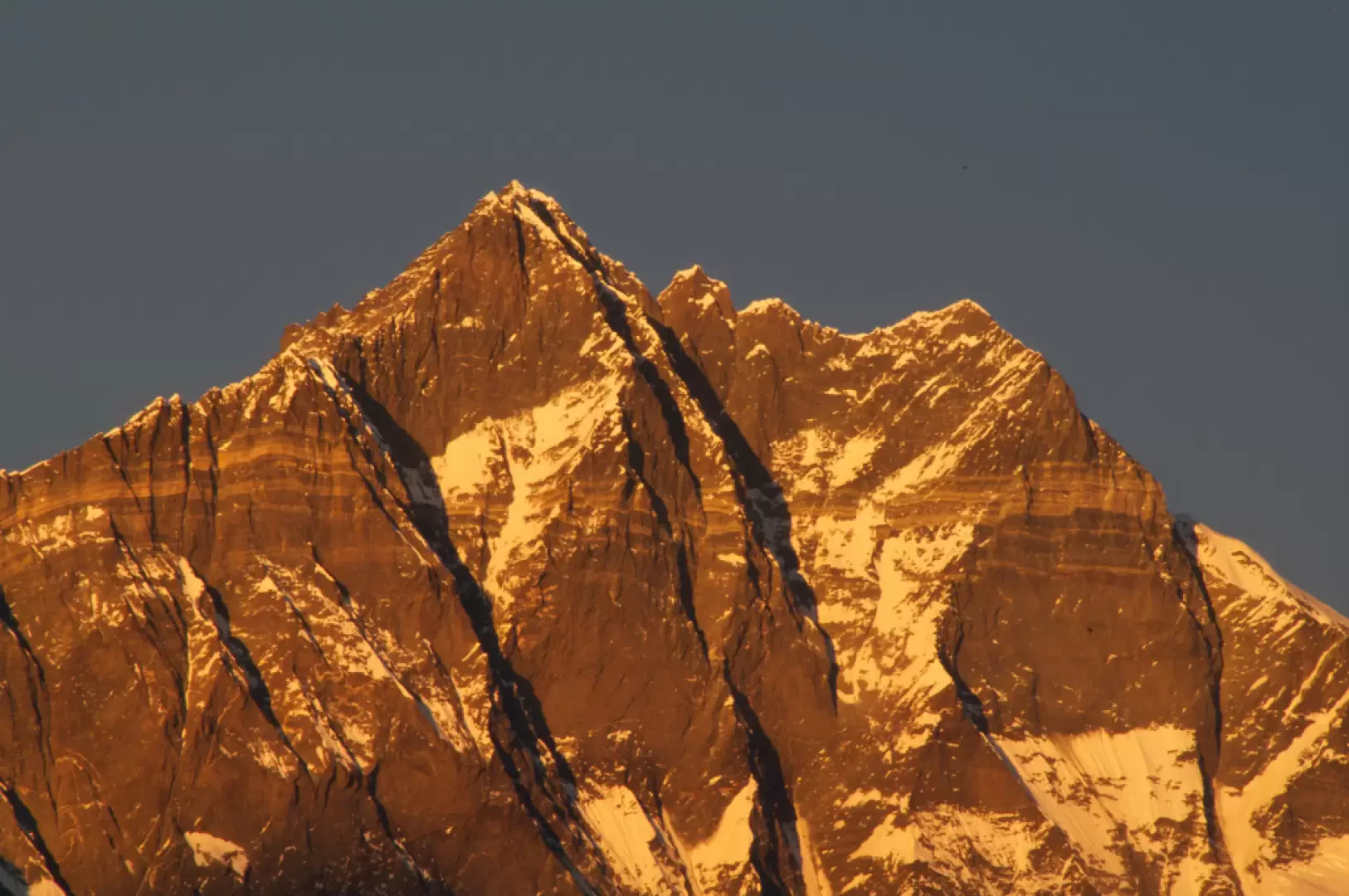
The Lhotse forms with Everest and Nuptse (7,864m) the great glacial cirque of the Western Cwm, one of the most iconic and photographed Himalayan landscapes. The summit ridge runs in a north-east-south-west direction; to the north, the South Col separates it from Everest, to the west the Nuptse closes the Khumbu basin, and to the east the walls overlooking the Kangshung glacier descend towards Tibet. The south face, which plummets over southern Nepal by more than 3,300 metres with average slopes between 60° and 70°, is one of the most impressive vertical structures in the entire Himalayan chain: as high as the great north faces of the Alps, but at more than twice their absolute height. Lhotse Shar, separated from the main summit by a deep notch, stands to the east as an autonomous peak with its own mountaineering history. Lhotse Mig, the intermediate summit, was the last of the eight-thousanders to be summited for the first time, in 2001, by a Russian expedition led by Evgeny Vinogradsky.
The geology of Lhotse mirrors that of the entire Everest massif: the summit is made up of the same sequence of metamorphic limestones and phyllites as the Everest Formation, while the lower walls expose the gneisses and schists of the Rongbuk Formation. The south face, with its blackish rock flakes alternating with blue ice channels, offers an extraordinarily legible vertical geological section, in which the different lithological formations that make up the structure of the massif can be distinguished with the naked eye.
Mountaineering History
The first reconnaissance of Lhotse was conducted by participants in the Everest expeditions of the 1950s, who climbed the western side of the mountain to reach the South Col. The first direct attempt to the main summit was in 1955, led by an international expedition led by Norman Dyhrenfurth that reached about 8,100 metres in the north-west couloir. The following year, in 1956, the Swiss Foundation for Alpine Research organised an expedition with a double objective: the first ascent of Lhotse and the second ascent of Everest. Led by Albert Eggler and consisting of the best Swiss mountaineers around, the expedition set up six camps. On 18 May, Fritz Luchsinger and Ernst Reiss set off from the last camp at about 7,400 metres and reached the summit in six hours, spending three quarters of an hour there before starting their descent. A few days later, on 23 and 24 May, four of their expedition mates - Ernst Schmied, Jürg Marmet, Adolf Reist and Hans Rudolf von Gunten - also completed the second ascent of Everest, a double first that has remained in the history of Swiss mountaineering.
In 1979, Andrzej Czok and Jerzy Kukuczka made the first ascent without supplementary oxygen. In 1981, Bulgarian Hristo Prodanov made the first solo ascent of the normal route. On 16 October 1986, Reinhold Messner and Hans Kammerlander reached the summit in difficult weather conditions, completing the collection of all fourteen eight-thousanders: Messner thus became the first man to have climbed them all, each time without oxygen.
The first winter ascent belongs to Krzysztof Wielicki, made on 31 December 1988 in extraordinary circumstances. He was part of a Belgian-Polish expedition whose primary objective was winter Everest; after the failure of the Belgian attempt on Everest, on 30 December the three Poles - Wielicki, Andrzej Zawada and Leszek Cichy - bivouacked at Camp 3 at 7,400 metres. The following day, only Wielicki felt fit: he climbed alone, without supplementary oxygen, wearing an orthopaedic corset to support his spine after a serious injury on Bhagirathi II, and reached the summit. It was 31 December 1988, the last day of the year.
The south face of Lhotse is the most dramatic chapter of mountaineering on the eight-thousanders. Some 3,300 metres high, with vertical sections of blackish rock furrowed by ice channels, it was first attempted by Reinhold Messner back in 1975 as part of the Italian national expedition led by Riccardo Cassin, without success. The following decades saw attempts by the strongest mountaineers of the day - including Messner again in 1989, Christophe Profit and Marc Batard - all of which were rejected above 8,000 metres. On 24 October 1989, Jerzy Kukuczka, the second man in the world to have climbed all fourteen eight-thousanders, plunged to 8,200 metres during an attempt on the south face due to a broken old rope, losing his life. His death was a mourning for the entire world mountaineering community.
On 24 April 1990, the Slovenian Tomo Česen claimed to have made the first solo ascent of the South Face in alpine style, with two bivouacs at 7,500 and 8,200 metres and 45 hours of climbing in total. The feat was immediately disputed due to the absence of photographs at the summit and, later, the presentation of images that turned out to belong to other mountaineers. The issue remained open and Česen's credibility severely compromised. A few months later, on 16 October 1990, the Russians Sergei Bershov and Vladimir Karatayev reached the summit on the south face, documenting the ascent: their ascent is considered the first ascertained ascent of the face. In 1996, the Frenchwoman Chantal Mauduit became the first woman to summit Lhotse by the normal route.
Cultural context
Lhotse has no proper name in local Khumbu traditions - it is simply "the southern peak of Everest" which says a lot about the role that the highest mountain on the planet has always played in the Sherpa imagination. This lack of autonomous identity has paradoxically contributed to making Lhotse an almost anonymous mountain for the general public, despite being the fourth highest peak on Earth: its fame has always been overshadowed by Everest, from which it shares the base camp and most of the logistics. In the history of mountaineering, on the other hand, Lhotse is emblematic for having hosted some of the most intense and controversial pages of the post-war period: the death of Kukuczka, the Česen enigma, Wielicki's first solo winter ascent on 31 December 1988 are episodes that marked an epoch in world himalayering.
Fruition and attendance
Lhotse has been climbed with a frequency comparable to the other Nepalese eight-thousanders, although it is less well known to the public than Everest. Sharing base camp with the world's highest mountain leads many mountaineers to attempt both summits during the same expedition, taking advantage of the common acclimatisation. The spring season (April-May) is the main one. Permission to climb is issued by the government of Nepal.
Holds
" Everest/Lhotse Base Camp (5,364m) - shared with expeditions to Everest
Information
Height: 8.516m
Alternative name: E1 (Survey of India); Lhotse = "south peak" (Tibetan)
Mountain group: Central Himalayas - Mahalangur Himal
Alpine chain: Himalayas
Typology: three-peaked massif / main summit
Protected area: Sagarmatha National Park (Nepal) / UNESCO heritage site
First ascent: 18 May 1956
First climbers: Ernst Reiss, Fritz Luchsinger
First ascent in winter: 31 December 1988
First ascenders in winter: Krzysztof Wielicki (solo)
Vice book: absent
Commune/s: Solukhumbu (Nepal) / Tibet (China)
Valley/s: Khumbu Valley (Nepal)
Mountaineering difficulty: AD (normal route); ED+ (south face)
Average elevation: 3.152m (from Base Camp)
Recommended period: April-May; September-October
Prevalent exposure: N-W (normal route); S (south face)
Presence of glaciers: yes (Khumbu, Kangshung)
Presence of equipped sections: yes (fixed ropes on the normal route)