Lake Villa

Edited by:
Massimo Martini
Access
Lake Villa is easily accessible via hiking trails suitable for all levels:
- **Main route**: Starting from the village centre of Challand-Saint-Victor with a well-marked path leading to the lake in about 30-40 minutes. The path has an **easy** level of difficulty and crosses a forest full of typical vegetation.
- **Alternative route**: A slightly longer route starts from Villa-nuova and offers panoramic views over the valley. It requires about 1 hour of walking with a **medium-easy** difficulty.
Introduction
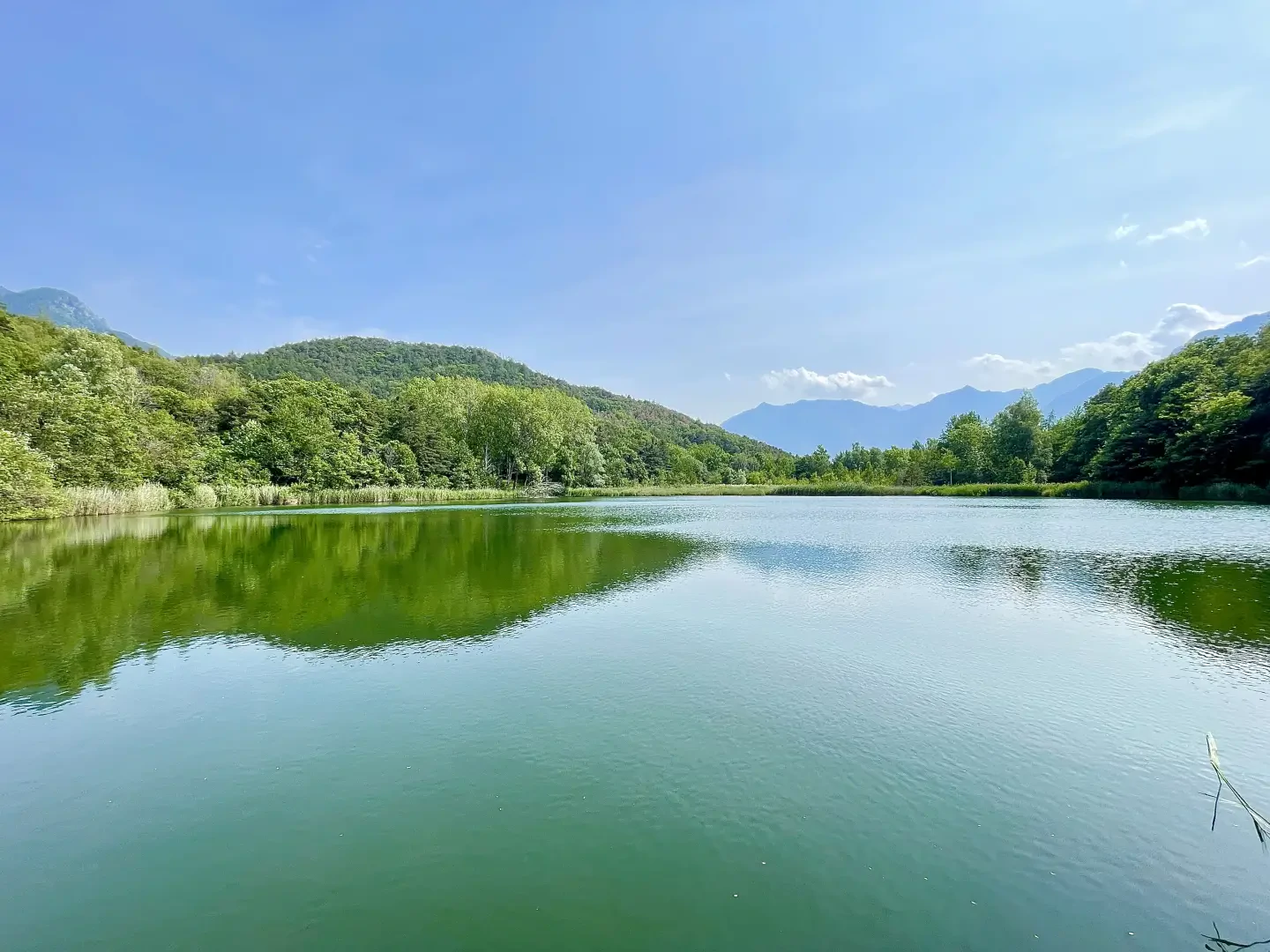
Lake Villa, located in Challand-Saint-Victor, in Valle d'Aosta, is a small basin of glacial origin that is set in a natural context of great beauty. This body of water lies at an altitude of about 760 metres above sea level and is immersed in an environment dominated by chestnut, Scots pine, downy oak and birch forests. The presence of these trees reflects the gradual abandonment of traditional chestnut cultivation, once central to the local economy and food supply.
Description
The lake is fed by underground springs and meteoric seepage water, with a small contribution from a canal that is occasionally activated. It has an area of approximately 14,365 square metres, a volume of 64,500 cubic metres and a maximum depth of 7.5 metres. Its waters are home to a remarkable plant and animal biodiversity.
The name of Lake Villa probably recalls the ancient human settlement in the vicinity and may be linked to the presence of a 'villa rustica' from the Roman era, although there is no certain evidence. According to local traditions, the lake would have had symbolic meanings linked to the rituals of the pastoral communities that inhabited the valley.
The area surrounding the lake is an oasis of biodiversity. Mammals in the woods include the squirrel, badger, fox, roe deer and wild boar. For ornithology enthusiasts, species such as green woodpeckers, great spotted woodpeckers, several tits and jays can be observed. The lakeside vegetation is characterised by marsh reeds, willows and alders, which create a dense and impenetrable reed thicket, an ideal habitat for amphibians such as the green frog and the common toad, as well as for the water snake and the occasional red heron.
There are no refuges in the immediate vicinity, but the site does offer some natural resting areas where you can stop for a picnic.
The lake is home to a variety of fish introduced in the past for fishing purposes, such as catfish, sun perch, trout perch, rudd and tench. This wealth of food sustains the ecosystem, providing food for species such as the collared natrix. The reed bed, with stems up to 2 metres high, represents a transition zone between land and water, ideal for bird nesting and biodiversity conservation.
This site, framed by unspoilt nature, is an ideal destination for those seeking peace, contact with nature and an environment rich in history and biodiversity.
Information
- **Height**: 760 m a.s.l.
- **Surface area**: 0.014 km²
- **Origin**: Glacial
- **Fish fauna**: Present (catfish, sun perch, trout perch, rudd, tench)
- **Surrounding forest**: Chestnut, Scots pine, downy oak, birch
- **Main animal species**: squirrel, roe deer, wild boar, great spotted woodpecker, red heron
- **Main routes**: Trails from Challand-Saint-Victor (30-40 minutes, easy)