Kangchenjunga

Edited by:
Massimo Martini
Access
Summit routes
Kangchenjunga can be reached from distinct slopes, of which the main and most frequented is the south-west slope, traversed by the first expedition in 1955 and still considered the normal route to the main summit. Base camp is set up on the Yalung glacier, on the Nepalese side, at an altitude of about 5,100 metres. The route ascends through the great south-west face, which is about 3,000 metres high, with the setting up of six camps. The central section is characterised by the Great Shelf, a vast hanging glacial plateau that allows rest before the final attack: from the Great Shelf, the route climbs up the gully known as the Gangway to the west ridge, from where a traverse leads to the summit. The proximity to the Bay of Bengal makes Kangchenjunga particularly exposed to monsoons and disturbances from the east, with weather windows often shorter than in other eight-thousanders. The north-west side, on the Indian Sikkim side, is only accessible with permission from the Indian authorities and has been traversed by a few significant expeditions, including the first female ascent in 1998.
Summer ascent routes
" from Yalung Base Camp (5,100m), Southwest Face Route and Gangway - AD - 5-7 weeks (including acclimatisation) -
" from North Base Camp (Sikkim), via north ridge and east spur - AD - second absolute ascent in 1977, requires Indian permits
" from North Base Camp (Sikkim), via north col and north-west ridge (Scott-Boardman-Tasker, 1979) - D - mixed terrain route
Introduction
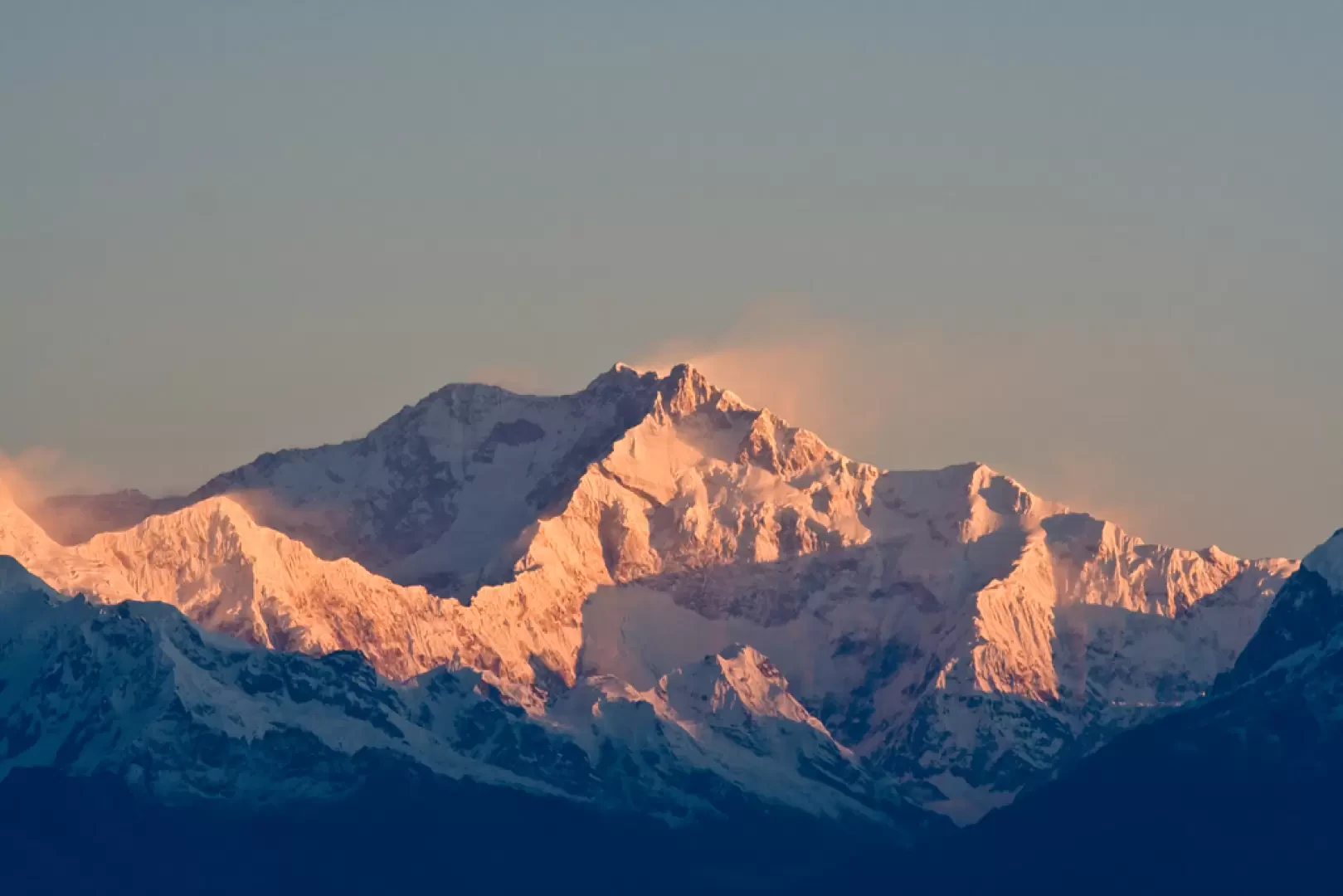
At 8,586 metres, Kangchenjunga is the third highest mountain on earth and the easternmost of all eight-thousanders. It rises on the border between eastern Nepal and the Indian state of Sikkim, in the eastern section of the Himalayan range, in a position relatively close to the Bay of Bengal, which crucially affects its climate, making it prone to heavy rainfall and frequent storms. The massif is a complex system of five peaks, four of which exceed 8,000 metres: the Main Peak (8,586m), the West Peak or Yalung Kang (8,505m), the Central Peak (8,482m) and the South Peak (8,476m), as well as the Kangbachen (7,902m). The name Kangchenjunga is traditionally translated as "the five coffers of the great snow" with symbolic reference to the five peaks that make up the massif and the treasures - gold, silver, gems, wheat and sacred books - that the local people believe are kept in its snows. Until 1849, Kangchenjunga was considered the highest mountain on Earth, before the British Survey of India established the supremacy of Everest and K2. The first ascent was carried out on 25 May 1955 by British mountaineers George Band and Joe Brown, as part of the expedition led by Charles Evans; the two men deliberately stopped only a few metres from the summit, respecting an agreement made with the Sikkim government as a sign of respect for the sacredness of the place - a tradition that most subsequent mountaineers have continued to honour. The first winter ascent, carried out on 11 January 1986 by Poles Jerzy Kukuczka and Krzysztof Wielicki, remains one of the most significant achievements of the golden age of Polish mountaineering in the Himalayas.
Description
Geographical Background
Kangchenjunga dominates a region of extraordinary scenic richness that includes the subtropical forests of Sikkim to the south and the glacial valleys of eastern Nepal to the west. The main summit ridge runs for about 1.5 kilometres in a northwest-southeast direction, with the main summit to the north and the south summit to the south. On the Nepalese side, the Yalung Glacier, one of the largest glaciers in the region, descends, while on the Indian side, the Zemu Glacier feeds the North Sikkim Valley. To the west, the massif is connected to the peaks of Jannu (7,710m) and Tent Peak (7,365m); to the east, the border with Sikkim also marks the geographical boundary of the eastern Himalayas with respect to the successive ranges to the east. The relatively southerly location and exposure to monsoon winds make the lower slopes of the massif some of the richest vegetation in the entire Himalaya, with rhododendron, fir and bamboo forests reaching up to more than 4,000 metres above sea level.
Geologically speaking, Kangchenjunga belongs to the Great Himalayas, with predominantly crystalline rocks - granite, gneiss and schist - of Precambrian and Palaeozoic age, uplifted and deformed by the collision of the Indian and Eurasian plates. The main summit consists of high-grade metamorphic rocks, with the presence of garnets and sillimanite, typical of the crystalline middle zone of the chain. Intense Quaternary glaciation sculpted the massif into its present form, producing cirques, gullies and sharp ridges that characterise all the slopes above 6,000 metres.
The fauna of Kangchenjunga National Park, established in 1997 on the Nepalese side, includes the snow leopard (Panthera uncia), red panda (Ailurus fulgens), Himalayan tahr (Hemitragus jemlahicus) and musk deer (Moschus chrysogaster). Sikkim, on the Indian side, is one of the biologically richest regions in Asia, with over 5,000 species of flowering plants, including some 600 species of orchids.
Mountaineering history
The first reconnaissance of Kangchenjunga dates back to British explorer Douglas Freshfield, who in 1899, accompanied by photographer Vittorio Sella, made the first circumnavigation of the massif, documenting it with images that would remain the main cartographic reference for decades. The first ascent attempt was in 1905, led by the eccentric Aleister Crowley with Jules Jacot-Guillarmod, who reached about 6,500 metres on the south-west face before an avalanche killed mountaineer Alexis Pache and three porters during the descent. Between 1929 and 1931, the German Paul Bauer led two expeditions to the north-eastern spur, reaching 7,400 metres in 1929 and 7,700 metres in 1931 in extreme weather conditions and with human losses. In 1930, an international expedition led by Günter Dyhrenfurth attempted the north-west face, opening up a new access corridor.
The decisive breakthrough came in 1954, when John Kempe's expedition systematically explored the south-west face, gathering the information that would enable success the following year. In the spring of 1955, the British expedition led by Charles Evans - a veteran of the 1953 Everest expedition - established base camp on the Yalung Glacier and set up six camps along the great wall. On 25 May, at 2.45 p.m., George Band, a geologist from Cambridge, and Joe Brown, a legendary rock climber from Manchester who used to be a bricklayer in life, reached the main summit, stopping only a few metres from the summit spur in order to respect the agreement with the Sikkim government: the mountain was sacred, and the highest peak had to remain untouched. The following day, Norman Hardie and Tony Streather repeated the ascent with the same respectful gesture. The tradition of stopping below the summit has since become an almost universal practice among mountaineers climbing Kangchenjunga.
The second ascent took place twenty-two years later, in 1977, by an Indian expedition that climbed the east spur and north ridge. In 1978, the Polish school made the first ascents of the south and central summits, completing the framework of the main ascents of the massif. In 1979, Doug Scott, Peter Boardman and Joe Tasker opened a new route for the north col and north-west ridge, in light style. In 1980, a Japanese expedition opened a route on the main summit. In 1982, the first Italian ascent was carried out by Innocenzo Menabreaz and Oreste Squinobal, with Sherpa porter Nga Temba, as part of an expedition led by Franco Garda, by the normal route. On October 17, 1983, Frenchman Pierre Béghin made the first solo ascent in alpine style, without supplementary oxygen.
On January 11, 1986, Jerzy Kukuczka and Krzysztof Wielicki made the first winter ascent, as part of a Polish expedition led by Andrzej Machnik, who had established Camp IV at around 7,800 metres. Kukuczka and Wielicki reached the summit by the normal route in the intense cold of the Himalayan winter, while companion Andrzej Czok died of pulmonary oedema during the ascent: a fate that was repeated in different forms in many subsequent seasons, confirming the extreme danger of Kangchenjunga in winter conditions. 1992 brought the death of Wanda Rutkiewicz on the north-west face, who disappeared on 12 April after being last seen at 8,250 metres by Carlos Carsolio, who had reached the summit that day. The first female ascent of the main summit was made on 18 May 1998 by Britain's Ginette Harrison on the north-west face. In 1989, the great Soviet traverse of all the summits of the massif - including the first repeats of routes on all four peaks above 8,000 metres - was one of the most ambitious collective feats of 20th-century Himalayan mountaineering.
Cultural background
Kangchenjunga is considered a protective deity by all the peoples living at its foot, particularly the Lepcha and Limbu peoples of Sikkim and eastern Nepal. The mountain is the official symbol of the state of Sikkim and is depicted on government signs. The tradition of stopping a few metres from the summit - started by Band and Brown in 1955 out of respect for the Sikkim government and local religious beliefs - has over time become a gesture of respect shared by the international mountaineering community, unique among all eight-thousanders. The name itself, with its reference to the "five chests of the great snow", reflects a cosmology in which the mountain is the custodian of precious goods and sacred knowledge. The British wayfarer and naturalist Joseph Dalton Hooker, who explored Sikkim in the second half of the 19th century and gathered his famous botanical collections, dedicated enthusiastic pages to Kangchenjunga, helping to spread knowledge of this region in Europe.
Frequentation and attendance
Kangchenjunga is one of the least frequented eight-thousanders in absolute terms, due to both the logistical complexity of the approach and the technical difficulty of the ascent routes. On the Nepalese side, access is regulated by the Kangchenjunga National Park, with permits issued by the Nepalese government. On the Sikkim side, permits are issued by the Indian government and are historically more difficult to obtain. The spring weather window, between April and May, is the main season; the autumn season, between September and October, is less busy. The mortality rate remains high, historically estimated at around 20% of attempts.
Traverses
" traverse of the four peaks of Kangchenjunga - first carried out by the Soviet expedition in 1989
Supports
" Yalung Base Camp (5,100m) - Nepalese side, starting point of the normal route
Information
Table: 8.586m
Alternative Name: Kangchenjunga, The Five Forts of the Great Snow
Mountain Group: Eastern Himalaya
Alpine Range: Himalaya
Typology: pyramidal massif / main summit of five-peak system
Protected area: Kangchenjunga National Park (Nepal, established 1997) / Khangchendzonga National Park (India / UNESCO heritage site)
First ascent: 25 May 1955
First climbers: George Band, Joe Brown
First ascent in winter: 11 January 1986
First ascenders in winter: Jerzy Kukuczka, Krzysztof Wielicki
Vice book: absent
Commune(s): Taplejung (Nepal) / Sikkim (India)
Valley/s: Yalung Valley (Nepal), Zemu Valley (Sikkim)
Mountaineering difficulty: AD (normal route); D-TD (alternative routes)
Average elevation gain: 3.486m (from Yalung Base Camp)
Recommended period: April-May; September-October
Prevalent exposure: S-W (normal route); N-W (Sikkim side)
Presence of glaciers: yes (Yalung, Zemu, Kangchenjunga)
Presence of equipped sections: yes (fixed ropes on the normal route)
Collections
country high point - list - map