K2

Edited by:
Massimo Martini
Access
Summit routes
K2 does not offer any properly easy routes: each ascent route presents sustained mountaineering difficulties on mixed terrain, extreme exposures and sections that require full mastery of progression on rock and ice at high altitude. The most popular route is the Sperone Abruzzi, on the Pakistani side, which is the mountain's normal route and was opened for exploration in 1909 by the Duke of Abruzzi's Italian expedition. Access to the base camp requires an approach of around 80 kilometres on foot from the village of Askole - the last one reachable by vehicle - of which 60 are on the Baltoro glacier; a trek of around eight days that is in itself a challenging mid-mountain experience. There are typically four high altitude camps in addition to the base camp, with the last one set up around 7,800m. The most dangerous section of the entire route is the Bottle Neck, a steep gully at around 8,200m topped by a huge hanging serac that threatens the entire route below; it is here that the greatest tragedies on the mountain have been concentrated. Weather conditions on K2 are notoriously unstable and unpredictable, with windows of good weather often reduced to a few days in the spring and summer seasons.
Summer ascent routes
" from Base Camp (4,970m), via Sperone Abruzzi - AD - 6-8 weeks (including acclimatisation) - (normal route, Pakistani side)
" from Base Camp, via Cresta Nord-est - AD+ - route on the Pakistani side, variant to the normal route
" from Base Camp, via Cresta Ovest (1981) - D - first completely new route after the normal route
" from Base Camp Magic Line / S-SO Pillar (1986) - ED - one of the most technically difficult routes in the eight-thousand-meter peaks, opened by the Polish-Slovak trio Piasecki-Wroz-Bozik
" from Base Camp, West Ridge (2007) - ED - Russian route on technical terrain at high altitude
Introduction
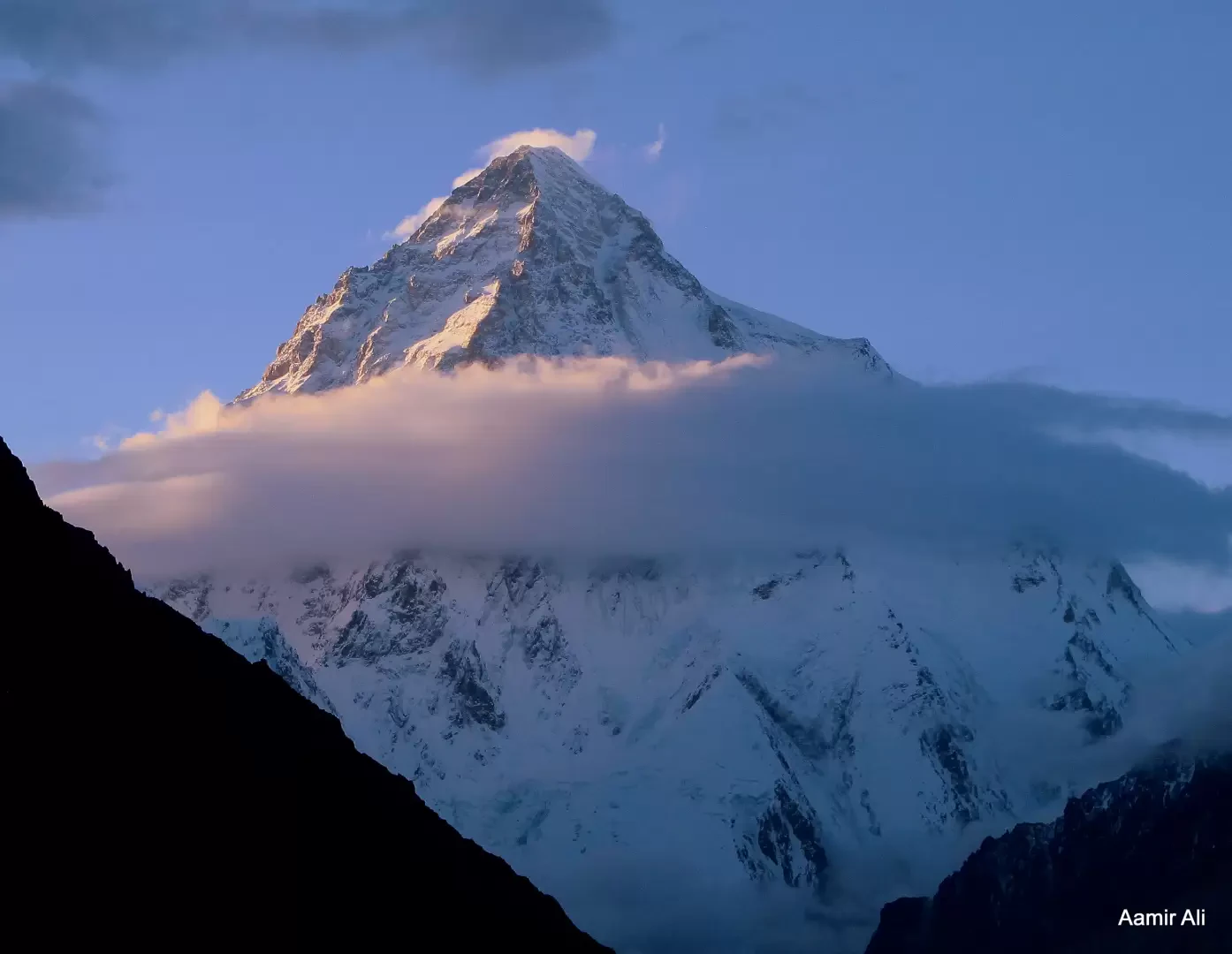
At 8,611 metres, K2 is the second highest peak on earth and the highest in the Karakorum range. It stands on the border between Pakistan - in the Gilgit-Baltistan region - and China, in the Tashkurgan Tajik Autonomous Province of Xinjiang, in the heart of one of the most remote and wildest mountain systems on the planet. The name K2, assigned in 1856 by Colonel Thomas George Montgomerie during the Great Trigonometric Survey of India, stands for "Karakorum 2" the second summit surveyed in the chain; the alternative names Chogori, in the Balti language, and Godwin-Austen, from the name of the geographer who completed the surveys, remain in specialist use. The mountain has the shape of an almost perfect pyramid, with extremely steep slopes on all sides and no route that can be defined as easy: it is this characteristic that makes it, in the unanimous opinion of the international mountaineering community, the most difficult and dangerous of the eight-thousanders. K2 is inextricably linked to Italian mountaineering: the first ascent was made on 31 July 1954 by Achille Compagnoni and Lino Lacedelli, as part of the great national expedition led by the geologist Ardito Desio and organised by the Club Alpino Italiano under the patronage of the CNR, during which Walter Bonatti made a heroic night bivouac at over 8,100 metres to bring oxygen cylinders to his two leading companions. The feat consigned the mountain to history as "the Italians' mountain" an appellation that still endures today. On 16 January 2021, a team of ten Nepalese mountaineers led by Nirmal Purja made the first winter ascent, the last remaining among all eight-thousanders and considered for decades almost impossible to achieve.
.Description
Geographical Background
K2 dominates the Baltoro glacier system, one of the longest valley glaciers in the world outside the polar regions, stretching some 62 kilometres into the heart of the Pakistani Karakorum. The mountain rises like an almost symmetrical pyramid with four main slopes: the south-eastern slope, on which the Abruzzi Spur is developed; the north-eastern slope, with access from China; the western wall, of extraordinary verticality; and the southern wall, called the Polish Wall because of the numerous attempts of that mountaineering school. The summit is set in a context of exceptional altitude concentration: within a few kilometres are Broad Peak (8,051m), Gasherbrum I (8,080m) and Gasherbrum II (8,035m), all eight-thousanders. Base camp is at an altitude of 4,970m, on the Godwin-Austen Glacier, a tributary of the Baltoro.
Geologically speaking, the Karakoram is one of the youngest and most tectonically active ranges on the planet, the result of the same collision between the Indian and Eurasian plates that generated the Himalayas. The rocks of K2 are predominantly granitoid rocks of the Karakorum batholith, a magmatic intrusion of Miocene age, interspersed with metamorphic sequences of paragneiss and micaschists. The morphology of the mountain, with its slopes of almost uniform gradient between 55° and 70°, is the product of the combined action of glacial erosion and cryoclastic processes that have shaped the pyramid into its present form. Glaciers flowing down the slopes feed the Baltoro system, contributing to the hydrology of the Indus basin.
The fauna in the Karakoram region includes species adapted to high-altitude environments: the snow leopard (Panthera uncia), the Central Asian ibex (Capra sibirica) and the Marco Polo (Ovis ammon polii) frequent the lower slopes. The human populations of the region belong mainly to the Balti ethnic group, of Shiite Islamic culture, who have lived in subsistence farming and pastoral economies for centuries and have provided indispensable support as low-altitude porters since the earliest expeditions.
Mountaineering history
The first scientific sightings of K2 date back to 1856, when Colonel Montgomerie surveyed it and gave it the name it would retain. In 1892, geographer Martin Conway conducted the first reconnaissance on the slopes of the mountain, followed in 1902 by an expedition led by the eccentric occultist Aleister Crowley and the more serious Oscar Eckenstein, who reached about 6,600m before being forced to retreat by bad weather. The most important exploratory breakthrough came in 1909, when the great Italian expedition led by Luigi Amedeo di Savoia, Duke of the Abruzzi, accompanied by the photographer Vittorio Sella, identified the south-eastern spur as the most feasible ascent route, opening up what still bears the name Sperone Abruzzi. In 1938, the American expedition of Charles Houston and Robert Bates reached 7,800m before being stopped by a lack of matches for the stoves. The following year, Fritz Wiessner with Pasang Dawa Lama reached 8,382m - less than 300 metres from the summit - before the tragic death of millionaire Dudley Wolfe forced a retreat.
The first ascent is one of the most famous feats of Italian and world mountaineering. The 1954 expedition, organised by the Club Alpino Italiano under the patronage of the CNR and led by the geologist Ardito Desio, gathered twelve mountaineers from all the alpine regions of the peninsula: mountain guides, craftsmen, an engineer and a doctor. The youngest was Walter Bonatti, twenty-four years old. The expedition lost Mario Puchoz, a Mont Blanc mountain guide, to pulmonary oedema in the second camp on 21 June. After seventy-two days of siege, on 31 July 1954, at 6 p.m., Achille Compagnoni and Lino Lacedelli reached the summit via the Sperone Abruzzi, planting an ice axe with the Italian and Pakistani flags on the summit. A decisive contribution was made by Walter Bonatti and the Hunza porter Amir Mahdi, who made a forced bivouac without a tent at 8,100m the night before to deliver oxygen cylinders essential for the final assault to their companions. The expedition returned to Italy as a national feat: it was the first Italian conquest of an eight-thousandthousander and came only a year after the British conquest of Everest. In the years that followed, the question of Bonatti's bivouac - and how Compagnoni had set Camp IX higher than planned to prevent him from reaching the summit - became the subject of a long controversy that only ended in 2008 with the CAI's official recognition of Bonatti's version.
The second ascent took place only twenty-three years later, in 1977, by a mixed Japanese-Pakistani expedition. In 1978, Jim Wickwire's American expedition led Louis Reichardt to the summit without oxygen, the first proven ascent without artificial support. In 1979, Reinhold Messner and Michael Dacher made the fourth ascent and the first in alpine style, with only three pitches. 1986 was the darkest year in the history of K2: twenty-seven ascent attempts and thirteen deaths, including the Italian Renato Casarotto, the Pole Wanda Rutkiewicz - the first woman to summit on 23 June - and the Briton Julie Tullis. In the same year, the Polish-Slovak trio Piasecki-Wroz-Bozik opened the Magic Line on the S-SO Pillar, one of the most technically difficult routes of all eight-thousanders. 2008 brought another great tragedy: on 11 August, a serac fall killed eleven mountaineers on the descent from the Sperone Abruzzi, the most serious accident in the history of K2.
The first winter ascent remained the main mountaineering objective still open on the eight-thousanders for decades. After seven unsuccessful attempts - the first in 1987 by a Polish expedition led by Andrzej Zawada - a team of ten Nepalese mountaineers reached the summit on 16 January 2021 at 5 p.m. local time. The group, consisting of nine Sherpas and Nirmal Purja - a former Gurkha of the British army special brigades, who had climbed all fourteen eight-thousanders in 189 days the year before - decided to stop ten metres from the summit to wait for each other and reach the summit together, singing the Nepalese national anthem. Only Nirmal Purja climbed without supplementary oxygen. It was the last eight-thousand metre peak still unclimbed in winter, and its conquest closed the chapter of the first winter ascents of all fourteen peaks above 8,000 metres, inaugurated by Everest in 1980.
Cultural context
The name Chogori, by which the Balti people know the mountain, simply means "big mountain" in the local language - a name that in its simplicity says it all. K2 does not have the mythical allure of Everest, is not visible from any village and is not a pilgrimage destination: it is a mountain that is reached after days of walking in an environment with no permanent settlements, and that is tackled without the logistical infrastructure that characterises the Nepalese Himalayas. It is precisely this inaccessibility that constitutes part of its charisma in the mountaineering imagination: K2 is considered by most experienced mountaineers to be the true ultimate test of high altitude, more so than the highest peak. Reinhold Messner wrote that, with the same technical difficulty spread over the entire route, K2 is unrivalled among the eight-thousanders. The link with Italian mountaineering is deep and deep-rooted: the name "mountain of the Italians" is universally recognised, and the 1954 expedition - with its lights and shadows, including the Bonatti affair - is part of the country's cultural and sporting history.
Fruition and attendance
K2 is reached by far fewer mountaineers than Everest: until 2007, only 278 people had reached the summit. The death rate - about one in five of those who attempted the ascent in the historically most difficult seasons - is among the highest of all eight-thousanders. Base camp can only be reached after an eight- to ten-day trek from Askole, which naturally limits access to expeditions with adequate logistical preparation. Permission to climb is issued by the Pakistani government. Favourable weather windows typically open between the end of June and August.
Traverses
" K2-Broad Peak traverse
Posts
" Baltoro Base Camp (4,970m)
Information
Height: 8.611m
Alternative names: Chogori, Godwin-Austen, Dapsang, K2
Mountain group: Central Karakorum - Baltoro sub-chain
Alpine chain: Karakorum
Typology: rock pyramid/main summit
Protected area: none
First ascent: 31 July 1954
First ascenders: Achille Compagnoni, Lino Lacedelli
First winter ascent: 16 January 2021
First ascents in winter: Nirmal Purja, Mingma Gyalje Sherpa, Kili Pemba Sherpa, Dawa Tenjin Sherpa, Mingma David Sherpa, Mingma Tenzi Sherpa, Gelje Sherpa, Pem Chiiri Sherpa, Dawa Temba Sherpa, Sona Sherpa
Peak Book: absent
Commune(s): Gilgit-Baltistan (Pakistan) / Xinjiang (China)
Valley(s): Baltoro Valley (Pakistan)
Mountaineering difficulty: AD (normal route); ED (walls and technical routes)
Average elevation gain: 3.641m (from Base Camp)
Recommended period: June-August
Prevalent exposure: S-E (Sperone Abruzzi); N-E (Chinese side)
Presence of glaciers: yes (Godwin-Austen, Baltoro)
Presence of equipped sections: yes (fixed ropes on Collo di Bottiglia and Sperone Abruzzi)
Collections
country high point - list - map
vettes of Pakistan - list - map