Gasherbrum II

Edited by:
Massimo Martini
Access
Summit routes
The Gasherbrum II shares with Gasherbrum I the long approach from Askole across the Baltoro glacier to the common base camp, at about 5,200 metres. The normal route ascends the south-west ridge, identified by the Austrian 1956 expedition, through a series of snow and ice fields. Between camp 1 and camp 2, a steep icy section, often equipped with fixed ropes, is the most technically demanding section of the normal route. The Gasherbrum La col (6,600m), which separates Gasherbrum II from Gasherbrum I to the south-east, is the transit point for the chaining of the two eight-thousanders. The North Face, steeper and more technical, was only opened in 2007.
Summer ascent routes
" from Base Camp (5,200m), south-west ridge route (route of the first climbers, 1956) - PD+ - 5-7 weeks (including acclimatisation) - (normal route)
" from Base Camp, north face route (Unterkircher-Bernasconi, 2007) - D - first route on the north face untouched in alpine style
Transverses
" Gasherbrum II-Gasherbrum I concatenation (Messner-Kammerlander, 1984) - first ever concatenation of two eight-thousanders
Ski mountaineering
" south-west ridge route (5.200m) - PD+ - first complete ski descent of an eight-thousander: 1982 (Saudan); first modern descent 2005 (Ericsson-Aamot)
Introduction
At 8,035 metres, Gasherbrum II is the 13th highest mountain on Earth. It rises in the central Karakoram, on the border between Pakistan and China, in the heart of the Gasherbrum massif - one of the most concentrated mountain systems on the planet, with three peaks above 8,000 metres and numerous others over 7,000 metres. Also known as K4, the fourth peak catalogued by the Great Trigonometrical Survey in 1856. The name Gasherbrum comes from the Balti language and means "splendid peak" (rgasha + brum). The first ascent was carried out on 8 July 1956 by an Austrian expedition led by Fritz Moravec: mountaineers Fritz Moravec, Josef Larch and Hans Willenpart climbed the south-west ridge without supplementary oxygen in difficult weather conditions that had already destroyed Camp 1 before the decisive attempt. Gasherbrum II is considered to be among the most accessible of the eight-thousanders, with a relatively logical normal route and increasing frequentation in recent decades - characteristics that make it a favourite destination for first expeditions to eight-thousanders. The first winter ascent was carried out on 2 February 2011 by Simone Moro, Denis Urubko and Cory Richards: it was the first ever winter ascent of an eight-thousander in the Karakorum, which had until then remained untouched in the cold season despite years of attempts. In 2007, the Italians Karl Unterkircher and Daniele Bernasconi opened the first route on the untouched north face in alpine style.At 8,035 metres, Gasherbrum II is the 13th highest mountain on Earth. It rises in the central Karakorum, on the border between Pakistan and China, in the heart of the Gasherbrum massif - one of the most concentrated mountain systems on the planet, with three peaks above 8,000 metres and numerous others over 7,000 metres. Also known as K4, the fourth peak catalogued by the Great Trigonometrical Survey in 1856. The name Gasherbrum comes from the Balti language and means "splendid peak" (rgasha + brum). The first ascent was made on 8 July 1956 by an Austrian expedition led by Fritz Moravec: mountaineers Fritz Moravec, Josef Larch and Hans Willenpart climbed the south-west ridge without supplementary oxygen in difficult weather conditions that had already destroyed Camp 1 before the decisive attempt. Gasherbrum II is considered to be among the most accessible of the eight-thousanders, with a relatively logical normal route and increasing frequentation in recent decades - characteristics that make it a favourite destination for first expeditions to eight-thousanders. The first winter ascent was carried out on 2 February 2011 by Simone Moro, Denis Urubko and Cory Richards: it was the first ever winter ascent of an eight-thousander in the Karakorum, which had until then remained untouched in the cold season despite years of attempts. In 2007, the Italians Karl Unterkircher and Daniele Bernasconi opened the first route on the untouched North Face in alpine style.
Description
Geographical Background
Gasherbrum II is located within the Gasherbrum massif, which comprises Gasherbrum I (8,080m) to the south-east - separated from Gasherbrum II by the Gasherbrum La pass (6,600m) - and Gasherbrum IV (7,925m) to the north. The massif is bordered to the west by the Baltoro Glacier and to the east by the Urdok Glacier, which drains towards China. From Concordia Circus, the confluence point of the Baltoro and Godwin-Austen glaciers, K2, Broad Peak and the Gasherbrums can be seen simultaneously: one of the most famous mountaineering panoramas on the planet. The summit ridge of Gasherbrum II is relatively compact in comparison to the neighbouring Broad Peak, with a single main peak and slopes that descend symmetrically towards the two lateral glaciers.
The geology of the massif is typical of the Karakoram batolite: leucocratic granitoids of Miocene age, rich in feldspar and quartz, which in the high sections outcrop into compact rock walls. The lower slopes, as on almost all Karakoram eight-thousanders, are characterised by complex seracs that make the safety of approaching the high camps variable and unpredictable. The north face, first opened in 2007 by Unterkircher and Bernasconi, has a more complex and alpinistically demanding structure than the regular south-west ridge. The Gasherbrum La pass, at 6,600 metres between the two main eight-thousanders of the massif, is one of the highest and most panoramic points of the Karakorum's inner ridge.
Mountaineering History
The first reconnaissance of Gasherbrum II dates back to the same expeditions that explored Gasherbrum I in the 1930s: Dyhrenfurth's International Expedition in 1934, which included Italy's Piero Ghiglione, and De Ségogne's French expedition in 1936. The first proper ascent was made in 1956 by an eight-member Austrian expedition led by Fritz Moravec. The season was marked by difficult weather conditions: an avalanche destroyed Camp 1 at the end of June, carrying away material and provisions. With great determination the expedition set off again, set up camps 2 and 3 at 6,700 and 7,150 metres respectively, and the final plan was to bivouac at very high altitude before the final assault. On 8 July 1956, Fritz Moravec, Josef Larch and Hans Willenpart reached the summit via the south-west ridge, without oxygen: it was the third summit above 8,000 metres to be conquered by Austrian mountaineers, after Nanga Parbat (1953) and Cho Oyu (1954).
In 1975, a strong French expedition opened a variant on the normal route and the mountain was climbed for the fourth and fifth time. In the same year, the Polish Halina Kruger-Syrokomska and Anna Okopinska, as part of a women's expedition led by Wanda Rutkiewicz, made the first female ascent on 12 August. In 1982, the Swiss Sylvain Saudan made the first complete ski descent from an eight-thousand metre peak on Gasherbrum II - his wife Marie-José Valençot, who climbed with him, simultaneously made the first documented female ascent for that season. Between 23 and 30 June 1984, Reinhold Messner and Hans Kammerlander climbed Gasherbrum II as the first stage of the first ever chaining of two eight-thousanders: without returning to base camp, they then reached Gasherbrum I via Gasherbrum La. The expedition was followed and documented by director Werner Herzog in the film Gasherbrum - Der leuchtende Berg. On 11 July 1985, Goretta Traverso, roped together with her husband Renato Casarotto, reached the summit of Gasherbrum II: she was the first Italian mountaineer ever to summit an eight-thousand metre peak, a historical first for Italian female mountaineering.
In 2007, Karl Unterkircher and Daniele Bernasconi opened the first route on the previously untouched north face in alpine style. The third member of the rope team, Michele Compagnoni, stopped 150 metres from the summit. It was one of the last major Karakoram eight-thousanders remaining without an ascent route.
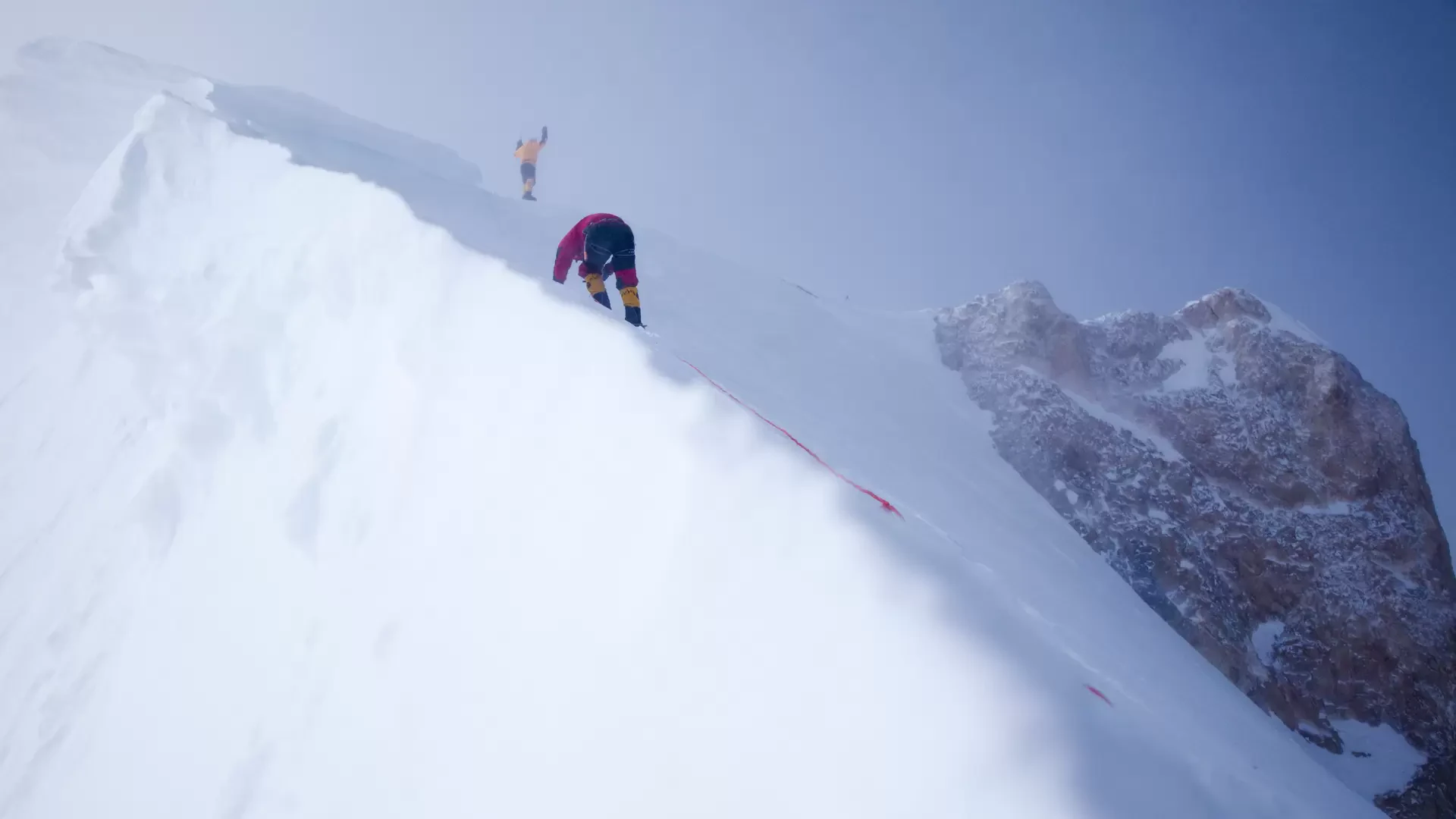
The first winter ascent, on 2 February 2011, was a historic feat on several levels: it was not only the first winter ascent of Gasherbrum II, but the first ever winter ascent of any Karakoram eight-thousander - a chain that had until then totally resisted winter challenges. Simone Moro, Denis Urubko and the American Cory Richards reached the summit just 22 days after setting up base camp. The descent took place in blizzard conditions with winds of 120 km/h; Richards documented the descent with a camera, producing images that won the World Press Photo. It was Moro's third first winter ascent of an eight-thousand-meter peak, after Shishapangma (2005) and Makalu (2009).
Cultural context
The Gasherbrum II is the gateway to the eight-thousand-meter peaks of the Karakoram for many mountaineers from all over the world: the relatively accessible normal route, combined with the approach on Baltoro - one of the most beautiful in the Karakoram - makes it the preferred choice for first expeditions to eight-thousand-meter peaks in the Pakistani range. The association with Gasherbrum I, both in the history of Messner and Kammerlander's concatenation and as a common goal of the most ambitious expeditions, links it inextricably with the neighbouring eight-thousander. Goretta Traverso's record in 1985, the first Italian to climb an eight-thousandthousander, is an element of Italian mountaineering history worth remembering: it paved the way for a generation of Italian female mountaineers in Himalayan and Karakoram expeditions.
Fruition and attendance
The Gasherbrum II is among the most frequented of the Karakoram eight-thousanders, with several dozen expeditions each summer season. The ascent permit is issued by the Pakistani government. The common base camp with Gasherbrum I (5,200m) is reached after the long trek up Baltoro from Askole. The main season is the summer season (June-August).
Supports
" Baltoro Base Camp (5,200m) - shared with Gasherbrum I
Information
Quota: 8.035m
Alternative name: K4; Gasherbrum = "splendid peak" (balti)
Mountain group: Central Karakorum - Gasherbrum massif, Baltoro Muztagh sub-chain
Alpine chain: Karakorum
Typology: rock pyramid/main summit
Protected area: none
First ascent: 8 July 1956 (note: inalto.org reports 7 July - discrepancy to be verified)
First ascenders: Fritz Moravec, Josef Larch, Hans Willenpart
First winter ascent: 2 February 2011
First winter ascent: Simone Moro, Denis Urubko, Cory Richards
Vice book: absent
Commune/s: Gilgit-Baltistan (Pakistan) / Xinjiang (China)
Valley/s: Baltoro Valley (Pakistan)
Mountaineering difficulty: PD+ (normal route); D (north face)
Average elevation: 2.835m (from Base Camp)
Recommended period: June-August
Prevalent exposure: S-W (normal route); N (north face)
Presence of glaciers: yes (Baltoro, southern glacier of the Gasherbrum)
Presence of equipped sections: yes (fixed ropes on the normal route)
Collections
peaks of Pakistan - list - map