Gasherbrum I

Edited by:
Massimo Martini
Access
Summit routes
The Gasherbrum I is reached after the same long approach that leads to K2: from Askole, the most advanced village reachable by vehicle in Pakistani Baltistan, you drive about 60 kilometres over the Baltoro glacier to Concordia (4,700m), the great glacial confluence from which four eight-thousanders can be observed simultaneously. From Concordia, one continues to the Gasherbrum base camp at about 5,200 metres. The normal route follows the south-east ridge, the route of the first ascent in 1958, which is long and relatively safe. The 1975 Messner-Habeler route on the north-west face is the most technically significant and historically important route; the Japanese route on the north-west ridge is the one climbed during the first winter in 2012. The three main walls - south-west, north-west and north-east - offer routes of increasing difficulty and very different character.
Summer Ascent Routes
" from Base Camp (5,200m), south-east ridge route (route of the first climbers, 1958) - AD - 5-7 weeks (including acclimatisation) - (normal route)
" from Base Camp, via north-west face (Messner-Habeler, 1975) - D - first ascent in alpine style of an eight-thousander, without oxygen
" from Base Camp, via Japans, north-west ridge - AD+ - route climbed during the first winter of 2012
" from Base Camp Kukuczka-Kurtyka route (1983) - D - new route in alpine style without oxygen
Traverses
" Gasherbrum II-Gasherbrum I concatenation (Messner-Kammerlander, 1984) - first ever concatenation of two eight-thousanders
Introduction
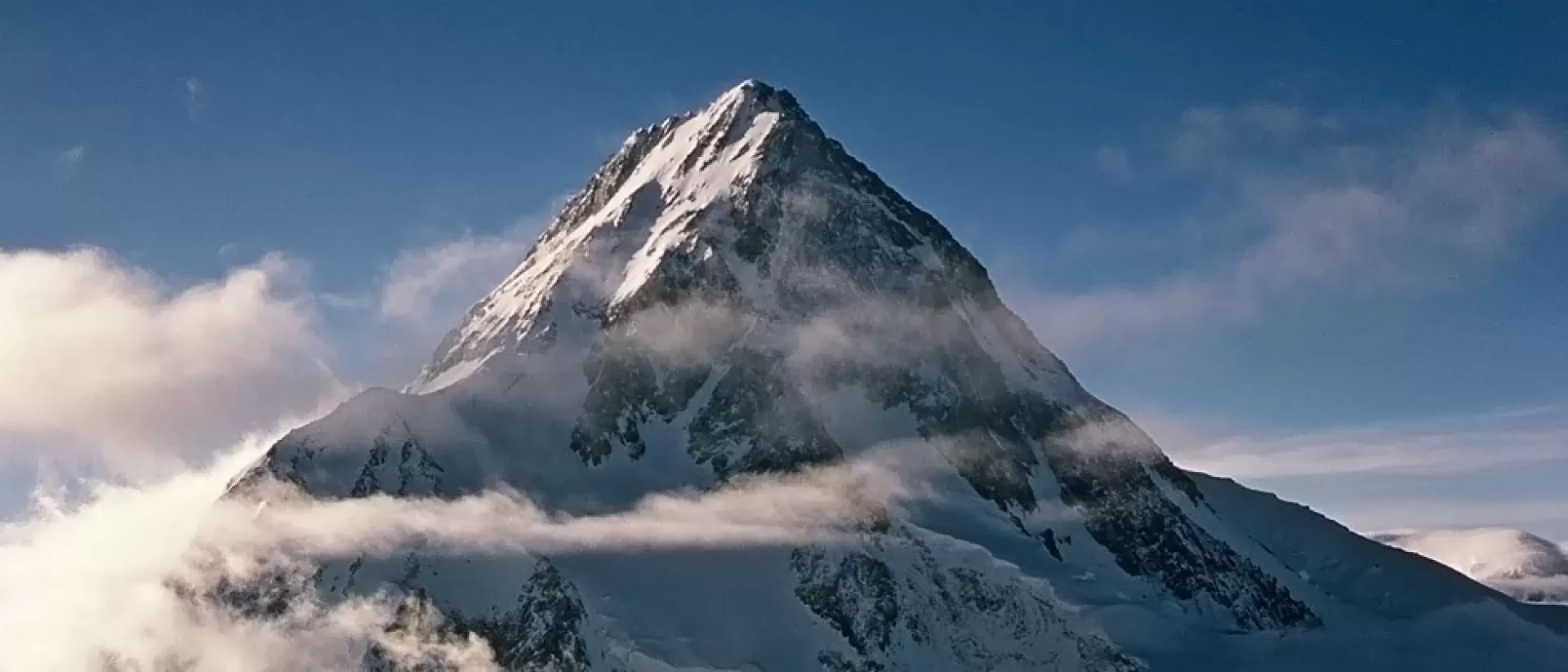
At 8,080 metres, Gasherbrum I is the eleventh highest mountain on earth. It rises in the central Karakorum, on the border between Pakistan - in the Gilgit-Baltistan region - and China, at the head of the Baltoro glacier, in one of the most extraordinary concentrations of peaks above 7,000 metres on the planet. Also known as Hidden Peak - "hidden peak", a name given to it in 1892 by the British explorer William Martin Conway in reference to its remote location, visible only to those who traverse the Baltoro Glacier - and as K5, the original name of the Great Trigonometrical Survey. The name Gasherbrum derives from the Baltic language and means "splendid peak" (rgasha + brum). The first ascent was made on 5 July 1958 by American climbers Pete Schoening and Andy Kauffman, as part of the expedition led by Nicholas B. Clinch. Clinch: Gasherbrum I was at that point the last of the Karakoram eight-thousanders still untouched. In 1975, Reinhold Messner and Peter Habeler made the first ascent of an eight-thousandthousander in alpine style - a new route on the north-west face, without oxygen, without high altitude porters and without camps - inaugurating a mountaineering philosophy that would revolutionise the approach to high altitude for decades to come. In 1984, Messner and Hans Kammerlander achieved the first ever chaining of two eight-thousanders, climbing Gasherbrum II and Gasherbrum I in sequence without returning to base camp. The first winter ascent was carried out on 9 March 2012 by Poles Adam Bielecki and Janusz Gołąb.
.Description
Geographical Background
Gasherbrum I is part of the Gasherbrum massif, which includes three peaks above eight thousand metres - Gasherbrum I (8,080m), Gasherbrum II (8,035m) and Gasherbrum IV (7,925m, technically not an eight-thousand metre peak but alpinistically among the most difficult in the Karakoram) - as well as numerous secondary peaks between 7,000 and 7,500 metres. The mountain overlooks the Baltoro Glacier to the south-west, the longest glacier outside the polar regions, and the Urdok Glacier to the north-east, which drains into China. The Gasherbrum La pass (6,600m) separates it from the Gasherbrum II to the north-west, and it was across this pass that Messner and Kammerlander carried out the 1984 ascent. The Concordia Circus, where the Baltoro and Godwin-Austen glaciers converge, offers one of the most spectacular views of the entire planet: K2, Broad Peak, Gasherbrum IV and the Gasherbrums are all visible simultaneously.
Geologically speaking, the Gasherbrum massif consists mainly of granitoids from the Karakoram batolite, a magmatic intrusion of Miocene age rich in leucocratic minerals. The upper rock faces - in particular the triangular south-west face - expose these granitoids in almost vertical sections of compact rock, while the lower areas present metamorphic sequences of gneisses and mycascists. The pyramidal morphology of the main summit is the result of glacial erosion that isolated the peak from the surrounding ridges. The name balti "splendid peak" recalls the twilight hours, when the walls of the massif - particularly those of Gasherbrum IV - glow orange on the Tibetan plateau.
Mountaineering history
The first reconnaissance of Gasherbrum I dates back to 1929, when an Italian expedition led by Ardito Desio first reached the Conway Saddle, the pass that gives access to the south-east ridge. In 1934, a large international expedition led by Günter Dyhrenfurth, which included the Italian mountaineer Piero Ghiglione (correspondent of the Gazzetta del Popolo), reached about 6,250 metres before being repelled by bad weather. In 1936, the first ever French expedition to the Himalayas-Karakorum, led by Henry de Ségogne with Marcel Ichac among the participants, climbed up to about 7,000 metres along the south-east ridge before giving up due to weather conditions.
The first ascent came in 1958, as part of an American expedition led by Nicholas B. Clinch, who was already on the eleventh unclimbed eight-thousand metre peak in the Karakorum. On 5 July, Pete Schoening - already famous for the "miracle belay" of 1953 on K2, when with only one ice axe planted in the snow he had supported five falling companions with his own rope - and Andy Kauffman reached the summit via the south-east ridge, along a long but relatively safe route.
The most significant stage in the history of Gasherbrum I - and in the entire world of Himalayas - came in 1975. Reinhold Messner and Peter Habeler, with only twelve porters for the transport to base camp, climbed with no high-altitude porters, no supplementary oxygen and no pre-equipped fixed ropes, opening a new route on the north-west face. It was the first application of the alpine style on an eight-thousand metre peak: a rope team of two mountaineers acting as if they were climbing in the Alps, fast, light, self-sufficient. Messner had conceived the "by fair means" philosophy - climbing on one's own merits, without artificial aids - and Gasherbrum I was the practical demonstration of this. The ascent caused a sensation in mountaineering circles around the world and paved the way for all subsequent alpine-style ascents of the great Himalayan peaks.
In 1983, Jerzy Kukuczka and Wojciech Kurtyka opened a new route in alpine style and without oxygen, further consolidating this mountain's vocation as a laboratory of advanced Himalayanism. In 1984, Messner and Hans Kammerlander - as part of the expedition documented by film director Werner Herzog in the film Gasherbrum - Der leuchtende Berg - carried out the first ever chaining of two eight-thousanders: from 23 to 30 June, they first climbed Gasherbrum II and then Gasherbrum I without returning to base camp, without supplies and without meeting other mountaineers. Seven days, five bivouacs, two summits above eight thousand metres. On 9 March 2012, Adam Bielecki and Janusz Gołąb, part of a Polish expedition led by Artur Hajzer, made the first winter ascent, via dei Giapponesi and the North-West Ridge, without oxygen, at -35°C.
Cultural context
The Gasherbrum I shares with K2, Broad Peak and Gasherbrum II the extraordinary setting of the Baltoro Glacier, one of the most famous and popular mountaineering environments in the Karakoram. The approach from Askole across the Baltoro, with the gradual revelation of the great walls at every turn of the glacier, is described by generations of mountaineers as one of the most beautiful routes on the planet. The Circus of Concordia, where the view of four eight-thousanders opens up, is the main destination of the trek to K2, walked every year by hundreds of enthusiasts from all over the world. Messner and Habeler's 1975 expedition has a special place in Italian mountaineering culture: Messner was already a character of growing renown at the time, and the practical demonstration of alpine style on an eight-thousandthousander helped to build his vision - then systematised in the following decades - of an ethical, minimalist and authentic mountaineering.
Mountaineering and attendance
The Gasherbrum I is reached by relatively few expeditions compared to Nepal's eight-thousanders, due to its remote location and long approach. Permission to climb is granted by the Pakistani government. The base camp shared with Gasherbrum II (at about 5,200 metres) can be reached after the long trek up Baltoro. The main season is summer (June-August).
.Information
Quota: 8,080m (note: some sources report 8.068m - discrepancy to be verified)
Alternative name: Hidden Peak, K5; Gasherbrum = "splendid peak" (balti)
Mountain group: Central Karakorum - Gasherbrum massif, Baltoro Muztagh sub-chain
Alpine chain: Karakorum
Typology: rocky pyramid/main summit of massif
Protected area: none
First ascent: 5 July 1958
First climbers: Pete Schoening, Andy Kauffman
First ascent in winter: 9 March 2012
First ascenders in winter: Adam Bielecki, Janusz Gołąb
Vice book: absent
Commune(s): Gilgit-Baltistan (Pakistan) / Xinjiang (China)
Valley/s: Baltoro Valley (Pakistan)
Mountaineering difficulty: AD (normal route); D-D+ (Messner-Habeler route and variants)
Average elevation gain: 2.880m (from Base Camp)
Recommended period: June-August
Prevalent exposure: S-W (normal route); N-W (Messner-Habeler route)
Presence of glaciers: yes (Baltoro, Southern Gasherbrum, Urdok)
Presence of equipped sections: yes (fixed ropes on the normal route)
Collections
Speaks of Pakistan - list - map