Dhaulagiri

Edited by:
Massimo Martini
Access
Summit routes
The Dhaulagiri is reached mainly from the north side, via an approach trek of about ten days from the village of Beni, through the Myagdi Khola valley. Base camp is set up on the northern Dhaulagiri glacier, at about 4,740 metres, at the foot of the imposing buttress called the "Eiger" which separates the north face from the north-eastern spur. The normal route follows the north-east ridge, the same ridge climbed by the first ascentionists in 1960: the initial serac is climbed, the section known as the Jacobs Ladder is traversed on ice and snow, and three or four camps are typically set up before the final attack. The mountain is known for its meteorological instability: snowstorms and violent winds are frequent and unpredictable, which contributed to it being among the last eight-thousanders to be conquered. The south face, which plummets more than 4,000 metres into the Kali Gandaki valley, is still unclimbed and represents one of the last great open problems of himalaysm.
Summer ascent routes
" from North Base Camp (4,740m), via Northeast Ridge - AD - 5-7 weeks (including acclimatisation) - (normal route)
" from Base Camp, via south-west face (1978, Japanese Amemiya expedition) - D+ - first ascent of a particularly avalanche-prone face
" from Base Camp east, via south-east ridge (1978, Japanese expedition Tanaka) - D+ - high difficulty route, four people died during the first ascent
" from East Base Camp, east face route (1984, Czechoslovakian expedition Simon-Jakes-Stejskal) - TD - technical route; Simon died on the descent
Winter ascent routes
Ski mountaineering
" normal route (4.740m) - AD - first winter 21 January 1985 (mountaineering, Kukuczka and Czok)
Introduction
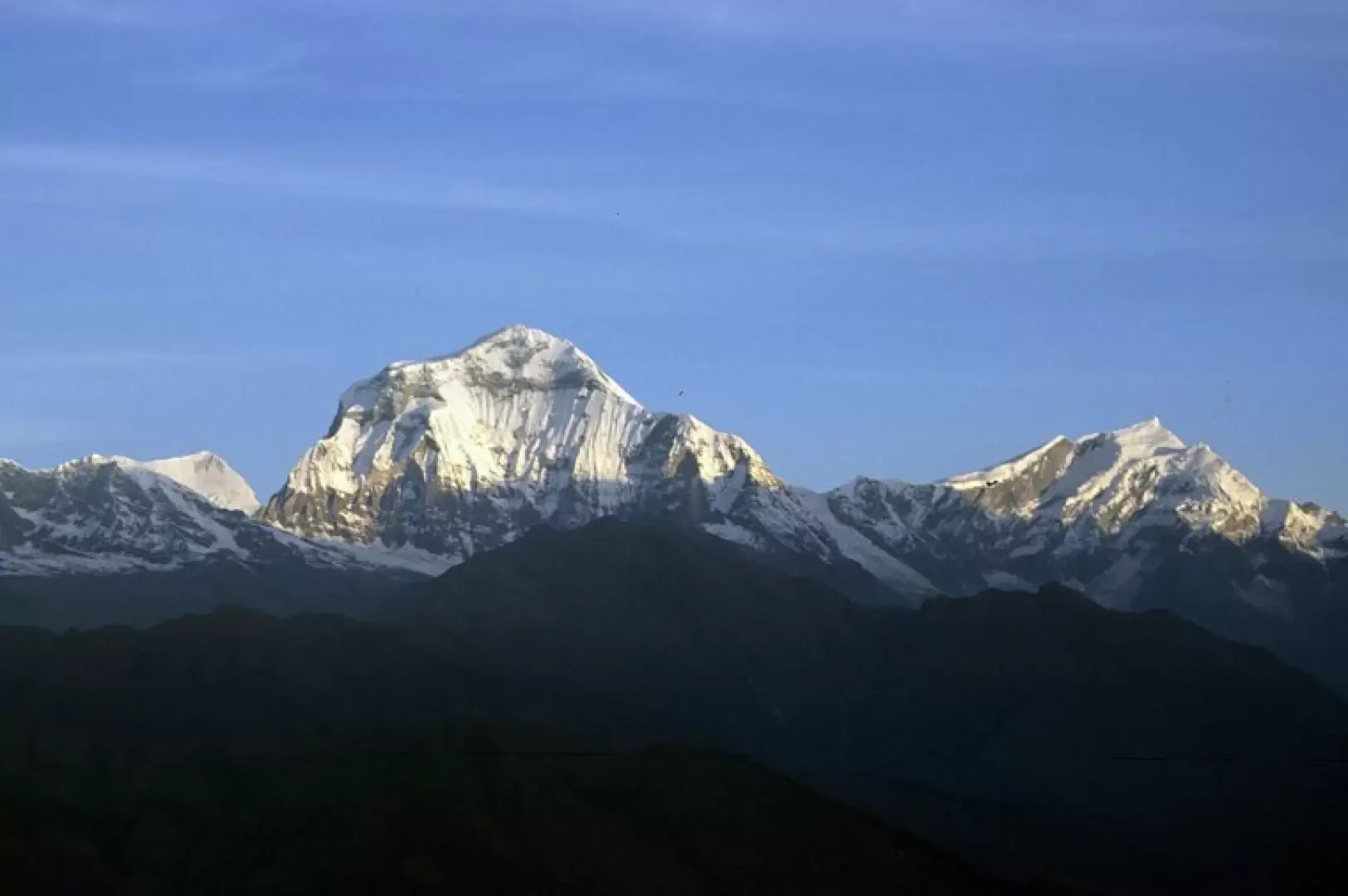
At 8,167 metres, Dhaulagiri I is the seventh highest mountain on Earth and the main peak of a vast massif that stretches over 120 kilometres in north-central Nepal, in the province of Gandaki Pradesh, bordered by the Kali Gandaki Gorge to the east and the Bheri River to the west. The name is derived from Sanskrit and means "white mountain" or "shining mountain" - a reference to its snowy walls that seem to glow against the background of the blue Himalayan sky. Discovered and measured in 1808 during the British Great Trigonometrical Survey, Dhaulagiri was considered the highest mountain on Earth for some thirty years, until 1838, when Kangchenjunga took its place; then Everest would finally put an end to this supremacy. The first ascent was made on 13 May 1960 by a Swiss-Austrian expedition led by Max Eiselin, with an attacking rope team consisting of Austrian Kurt Diemberger, German Peter Diener, Swiss Ernst Forrer and Albin Schelbert and Sherpas Nyima Dorji and Nawang Dorji, all without supplementary oxygen. It was the first Himalayan expedition to use a small aircraft - a Pilatus PC-6 nicknamed "Yeti" - to transport material to the north-east col; the aircraft crashed during a return manoeuvre, with no injuries among the crew. The first winter ascent was carried out on 21 January 1985 by Jerzy Kukuczka and Andrzej Czok, as part of an extraordinary winter season in which Kukuczka would climb Cho Oyu less than a month later, on 12 February 1985: two eight-thousandth winter ascents in the same season, a record that is still unbeaten.
.Description
Geographical Background
Dhaulagiri I dominates north-central Nepal from within a massif that has ten peaks over 7,000 metres, including Dhaulagiri II (7,751m), Dhaulagiri III (7,715m) and Putha Hiunchuli (7,246m). To the east, separated from the massif by the Kali Gandaki gorge, rises Annapurna I (8,091m): the two eight-thousanders are only 34 kilometres apart as the crow flies, but are separated by the Kali Gandaki valley, considered the deepest gorge on earth. The Kali Gandaki River flows at an altitude of 2,520 metres between the two mountains, creating an elevation difference of about 5,571 metres from the summit of Annapurna - a difference in altitude that exceeds that of any other canyon on the planet. This gorge has been traversed for centuries by trade caravans between Nepal and Tibet and holds important deposits of ammonite fossils - so-called shaligrams - revered in Hindu tradition as forms of the god Vishnu.
Geologically speaking, the Dhaulagiri massif belongs to the Great Himalayan Sequence, the crystalline middle zone of the range, with predominantly high-grade metamorphic rocks - gneisses, migmatites and micaschists - uplifted and deformed by the collision of the Indian and Eurasian plates. The upper walls of the mountain expose the sedimentary sequences of the Tethyan Himalayan Sequence, with marine limestones and pelites of Palaeozoic origin, evidence of the ancient Tethys Ocean. The structure of the Kali Gandaki provides one of the most readable geological sections in the entire Himalayan chain, crossing perpendicularly all the major tectonic units from the Lesser Himalayas to the Tethys. The mountain is infamous for its heavy snowfall and the frequency of ice avalanches discharging from the upper slopes: this feature has made Dhaulagiri one of the most dangerous eight-thousanders and one of the last to be conquered.
The fauna and flora in the lower parts of the massif reflect the climatic transition between the monsoonal southern slope and the drier northern slope. Rhododendron, fir and birch forests extend up to about 4,000 metres on the southern slope; snow leopard (Panthera uncia) and Himalayan tahr (Hemitragus jemlahicus) frequent the slopes at intermediate altitudes.
Mountaineering History
Dhaulagiri attracted mountaineering interest as early as 1950, when the French expedition led by Maurice Herzog - who would later conquer Annapurna - carried out a reconnaissance without finding viable routes. Between 1953 and 1958, five expeditions attempted the difficult north buttress called "Pear Buttress" all without success. In 1959, an Austrian expedition led by Fritz Moravec explored the north-east ridge, finding what was to become the route of the first ascent.
In the spring of 1960, Max Eiselin's Swiss-Austrian expedition took an innovative approach, bringing a small Pilatus PC-6 cargo plane, renamed "Yeti", to the north-east col of the mountain to speed up the transport of material. The aircraft managed to land on the Diemberger and Forrer col, but during a re-entry manoeuvre it crashed into the flanks of the mountain; the pilots emerged unharmed, but the vehicle was abandoned on the mountain. On 13 May, taking advantage of an exceptionally favourable weather window - the usual afternoon storm deserted the event - Kurt Diemberger, Peter Diener, Ernst Forrer, Albin Schelbert, Nyima Dorji and Nawang Dorji reached the summit without supplementary oxygen. Ten days later, Hugo Weber and Michel Vaucher from the same expedition also reached the summit. For Diemberger, it was the second first ascent of an eight-thousand metre peak, after Broad Peak in 1957: a record that would never be equalled again.
In the following decades, attempts on new faces multiplied, often with tragic results. In 1969, an American expedition on the south-east ridge lost seven members, including expedition leader Boyd Everett, in an avalanche: the worst Himalayan disaster in Nepal up to that time. In 1975, a Japanese expedition on the south-west face lost six climbers in an avalanche; in 1978, the same team returned to the south-west face and reached the summit with five climbers. In the same autumn, the Japanese team of Seiko Tanaka opened the south-east ridge with four deaths during the ascent. In 1981, the Japanese Hironobu Kamuro made the first solo ascent on the normal route; in 1982, the Belgian Lutgaarde Vivijs made the first female ascent. In 1984, the Czechs opened a new route on the east face, with Jan Simon dying during the descent.
The first winter ascent was made on 21 January 1985 by Jerzy Kukuczka and Andrzej Czok, as part of a Polish expedition led by Adam Bilczewski. The ascent took place under difficult weather conditions, with the route being prepared in the first weeks of December and the decisive attempt in January. Less than a month later, on 12 February 1985, Kukuczka reached the summit of Cho Oyu: two winter ascents of two separate eight-thousanders in the same season, a feat that no mountaineer has ever equalled.
In 1999, the Slovenian Tomaž Humar made a solo attempt on the gigantic south face of Dhaulagiri - some 4.4,000 metres high - in one of the most daring attempts of the turn of the millennium: after nine days of climbing, he reached some 7,300 metres before being forced to descend due to poor rock conditions. The south face remains untouched. In 1998, Chantal Mauduit, a French mountaineer who had already achieved numerous first ascents on eight-thousanders, lost her life in an avalanche on Dhaulagiri. In 2006 Nives Meroi and Romano Benet conquered the summit.
Cultural background
Dhaulagiri takes its name from Sanskrit and its white walls are visible from a great distance on a clear day, dominating the horizon of central Nepal. The Kali Gandaki gorge, which separates it from Annapurna, has been a major trans-Himalayan trade route for centuries and is home to historic villages such as Marpha, Kagbeni and Muktinath, the latter an important pilgrimage site for Hindus and Buddhists. Ammonite fossils collected in the Kali Gandaki riverbed, called shaligram, are revered as incarnations of the god Vishnu and traded in the major religious cities of the Indian subcontinent. The Dhaulagiri massif is the highest mountain to lie completely within a single nation - Nepal - without touching any international borders, a distinction that makes it symbolically significant to the country's geographical identity.
Trekking and frequentation
Dhaulagiri is less frequented than the eight-thousanders of the Khumbu due to its long approach and reputation as a fickle mountain in terms of weather. The approach trek from Beni takes about ten days. The ascent permit is issued by the government of Nepal. The normal route to the north-east ridge is the most frequented; the technical routes on the south, east and south-east slopes are only climbed by highly specialised expeditions.
Approaches
" North Base Camp (4.740m) - on the Northern Dhaulagiri Glacier
- First SE ridge made by the Japanese Noboru Yamada
- First SO pillar made by the French Pierre Béghin (alpine style)
- 1982 First NO ridge made by the Japanese Noboru Yamada
- First winter ascent of the normal (NE spur) by the Polish Kukuczka and Czok
- 1987 First women to reach the summit: Americans Calhoun and Grissom
Information
Height: 8.167m
Alternative name: Dhaulagiri = "white / shining mountain" (Sanskrit)
Mountain group: Dhaulagiri Himal - Nepalese Western Himalayas
Alpine chain: Himalayas
Typology: pyramid/main summit of massif
Protected area: none
First ascent: 13 May 1960
First climbers: Kurt Diemberger, Peter Diener, Ernst Forrer, Albin Schelbert, Nyima Dorji, Nawang Dorji
First winter ascent: 21 January 1985
First ascenders in winter: Jerzy Kukuczka, Andrzej Czok
Vice book: absent
Commune/s: Myagdi / Mustang (Nepal)
Valley/s: Myagdi Khola Valley; Kali Gandaki Gorge (E)
Mountaineering difficulty: AD (normal route); TD-ED (south and east slopes)
Average elevation: 3.427m (from Base Camp)
Recommended period: April-May; September-October
Prevalent exposure: N-E (normal route); S (unclimbed south face)
Presence of glaciers: yes
Presence of equipped sections: yes (fixed ropes on the normal route)