Columbia Icefield

Edited by:
Massimo Martini
Access
The Columbia Icefield, located in the province of Alberta, is a destination accessible mainly through a well-organised system of roads and regional transportation. The nearest airports to reach this area are Calgary International Airport (YYC) and Edmonton International Airport (YEG). Both offer direct connections to many international and Canadian cities, making them the most convenient starting points for those visiting the region.
From Calgary, the suggested route is to follow the Trans-Canada Highway (Highway 1) west to Lake Louise, from where it continues along the Icefields Parkway (Highway 93 North) to the Columbia Icefield. This well-marked and maintained route passes through some of the most iconic landscapes in the Rocky Mountains. From Edmonton International Airport, on the other hand, one can take the Yellowhead Highway (Highway 16) towards Jasper, and then take the Icefields Parkway south, which leads directly to the glacier area. Both routes guarantee a safe and pleasant journey, although it is advisable to pay attention to weather conditions, especially in winter.
For those who prefer the train, the main railway option is offered by VIA Rail, with stops in Jasper. However, direct public transport from downtown Jasper to the Columbia Icefield is limited, so hiring a car or using private bus services or organised tours is often necessary to complete the journey.
The road network in Alberta is modern and well developed, with major highways connecting major cities and important natural sites. The Icefields Parkway, which connects Jasper to Lake Louise, is considered one of the most scenic roads in Canada and offers direct access to the Columbia Icefield, as well as numerous opportunities to stop and explore points of interest along the way. Although this road is accessible year-round, it is essential to check driving conditions in advance, as snowfall and winter conditions may require snow tyres or chains.
In general, the car remains the most convenient means of getting to and around the Columbia Icefield area, providing the flexibility to explore its unique landscapes and the time to fully enjoy the journey.
Introduction
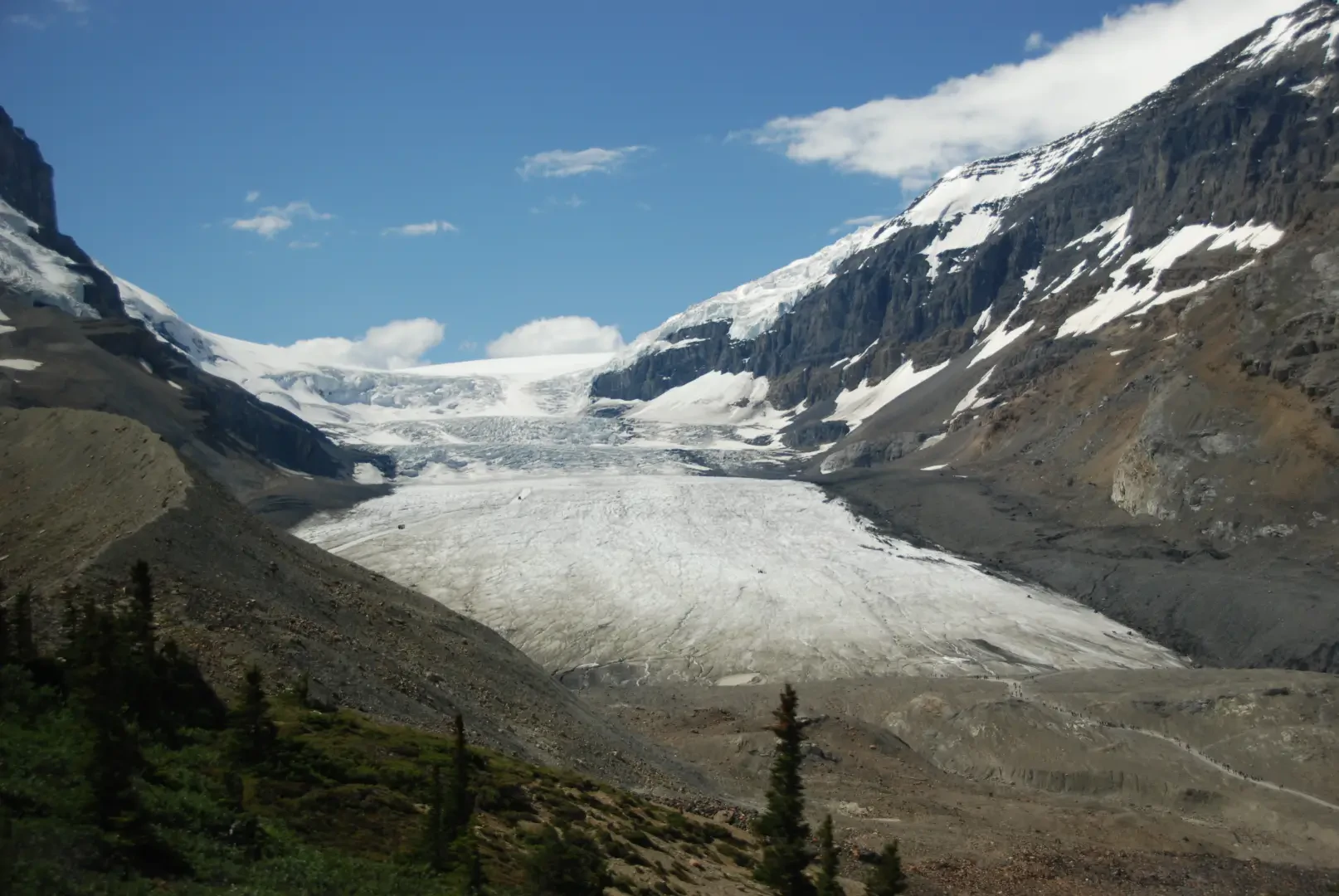
The Columbia Icefield, located in the heart of Jasper National Park, is one of the most spectacular wonders of the Canadian Rockies. This vast ice field, with an area of about 325 km², represents the largest ice reserve in the Rocky Mountains. Among its many glacial tongues, Athabasca Glacier is one of the most accessible and visited, offering a unique opportunity to get close to the beauty and power of millennial ice. This extraordinary site is not only a breathtaking panorama, but also a window into Earth's past. Formed during the last Ice Age some 10,000 years ago, the glacier continues to shape the surrounding landscape through the processes of erosion and deposition. The slow but steady descent of the Athabasca Glacier carries rocks and debris, creating lateral and terminal moraines that bear witness to the movement of the ice over time. Its presence provides a natural narrative that prompts reflection on how climate change is accelerating the retreat of these ice giants.
Description
The Columbia Icefield is also unique from a hydrological point of view: its melt waters feed three large river basins that flow into the Pacific, Atlantic and Arctic oceans respectively. This natural system underlines the vital importance of glaciers for local ecosystems and human communities, providing pure fresh water for multiple uses. The 6 km long Athabasca is one of the most visited glaciers in the world due to its exceptional accessibility. Visitors can explore its surface through guided tours on board 'Ice Explorers', vehicles designed to move on the ice. During these experiences, they can observe crevasses, moraines and icefalls, discovering the geological processes that have sculpted the Rocky Mountains.
The Columbia Icefield is also a tangible symbol of climate change. In recent decades, the Athabasca Glacier has undergone a marked retreat, a phenomenon attributed to global warming. Meltwater, which once took centuries to reach the valleys, now carries increasing traces of air pollutants. This situation is a reminder of the urgency of protecting these fragile landscapes for future generations. Visiting the Columbia Icefield means immersing oneself in a unique and delicate natural environment. It is essential to respect a few simple rules to preserve wildlife and the integrity of the landscape: keep a safe distance from animals, do not leave litter and do not pick up plants or rocks. Every gesture counts to ensure that these wonders remain untouched.
The Columbia Icefield and Athabasca Glacier are not just tourist destinations: they are places for reflection, adventure and learning. To explore them is to get in touch with the primordial power of nature, while discovering our role in its conservation.
Information
The Columbia Icefield, located in Jasper National Park, Alberta, is one of Canada's most fascinating natural attractions. The tourist season for 2025 is scheduled to run from 4 May to 14 October, barring adverse weather conditions.Main attractions include the Columbia Icefield Adventure, which offers the opportunity to explore the Athabasca Glacier in specialised vehicles called Ice Explorers, allowing visitors to walk on a thousand-year-old glacier. Another not-to-be-missed experience is the Columbia Icefield Skywalk, a glass walkway suspended 280 metres above the Sunwapta Valley, offering breathtaking panoramic views of the majestic surrounding mountains.
As far as events are concerned, there are no specific events organised directly at the Columbia Icefield. However, the region offers a variety of seasonal activities promoted by the national parks, including guided hikes and educational programmes dedicated to local geology and ecology. For up-to-date information on events and activities, please consult the official websites of Jasper and Banff National Parks.
It is important to bear in mind that weather conditions may affect opening hours and availability of activities. It is therefore recommended that you check the latest updates before planning your visit. Also, given the high influx of tourists, it is advisable to book in advance to ensure access to the desired experiences.