Broad Peak

Edited by:
Massimo Martini
Access
Summit routes
Broad Peak shares with K2 and the Gasherbrums the approach from the village of Askole across the Baltoro glacier, some 80 kilometres on foot over glacial terrain, with base camp set up at about 4,900 metres at the foot of the western spur. The normal route climbs this spur, identified by the 1957 Austrian expedition, and ascends to the summit ridge, which is long and articulated, with three main peaks: the main summit (8,051m), the central summit (8,011m) and the north summit (8,028m). The last section, along the summit ridge, is technically delicate due to exposure and orientation difficulties, as demonstrated by the 1957 attempt in which Diemberger and Wintersteller initially mistook the central summit for the main summit. The mountain is exposed to strong and sudden winds.
Summer ascent routes
" from Base Camp (4,900m), via western spur - AD - 5-7 weeks (including acclimatisation) - (normal route)
" from Base Camp, south-west face route (Urubko-Samoilov, 2005) - D - alpine style route
" from Chinese Base Camp, east face route (1992, Dalmau-Cadiach-Soncini) - AD+ - first ascent from Chinese face
Winter ascent routes
" western spur (4.900m) - AD - first winter ascent 5 March 2013 (mountaineering, Berbeka, Bielecki, Kowalski, Małek)
Introduction
At 8,051 metres, Broad Peak is the 12th highest mountain on earth. It rises in the central Karakorum, on the border between Pakistan and China, just 8 kilometres from K2, with which it shares the Baltoro glacier and the approach from Askole. The name "Broad Peak" was given in 1892 by the British explorer William Martin Conway after observing that the summit stretches for almost two kilometres; the original name of the Survey of India was K3, the third summit surveyed in the Karakoram; in Balti language it is known as Faichan Langri. The first ascent was carried out on 9 June 1957 by an Austrian Alpine Club expedition of four mountaineers - Marcus Schmuck, Fritz Wintersteller, Kurt Diemberger and Hermann Buhl - who chose to climb without supplementary oxygen and without high altitude porters, in what Buhl called the "Western Alpine style" the first documented application of what would later be called the Alpine style on an eight-thousand-meter peak. Eighteen days after the first ascent of Broad Peak, on 27 June 1957, Hermann Buhl died on Chogolisa (7,654m) due to the collapse of a snow frame during the descent; his body was never found. The first winter ascent was made on 5 March 2013 by four Polish mountaineers: Maciej Berbeka, Adam Bielecki, Tomasz Kowalski and Artur Małek. Berbeka and Kowalski disappeared on the descent.
Description
Geographical background
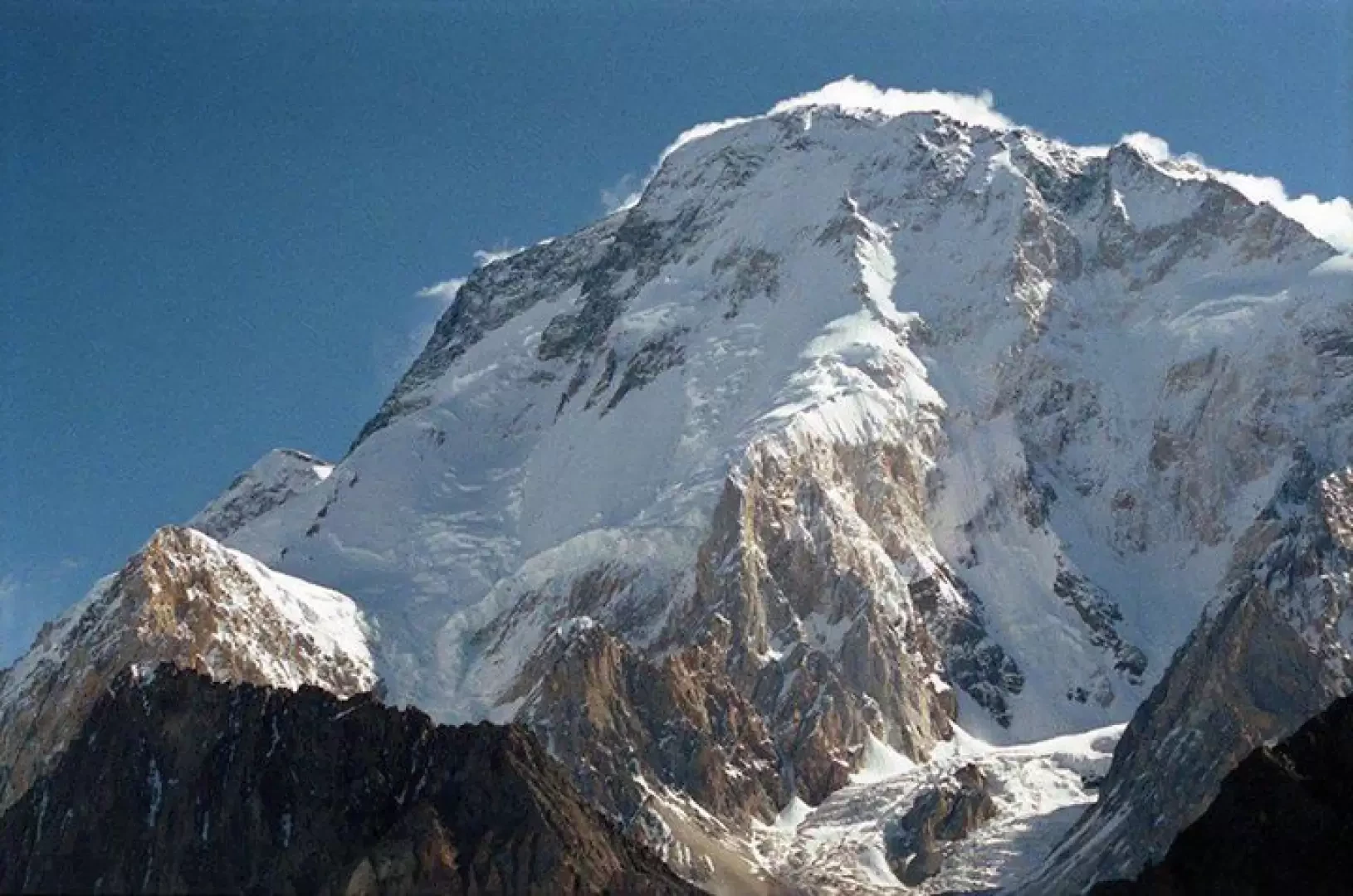
Broad Peak is part of the Gasherbrum massif, separated from K2 by just over 8 kilometres of glacier. From base camp, located on the Baltoro moraine, it is possible to simultaneously observe K2, Broad Peak, and the Gasherbrums: one of the most spectacular mountaineering panoramas on earth. The summit ridge, which stretches almost 2 kilometres in a north-south direction with its three main peaks, is the morphological feature that distinguishes Broad Peak from all other eight-thousanders: no other mountain above 8,000 metres has a summit line so extended horizontally. To the east, the mountain faces the Godwin-Austen glacier that descends towards K2; to the west, the Baltoro glacier. The south-west face, which plunges directly into the Baltoro, is one of the most visible and photographed faces in the entire Karakoram.
The geology of Broad Peak reflects that of the Gasherbrum massif: granitoids of the Karakoram batolite interspersed with metamorphic sequences of gneisses and mica schists. The upper slopes, particularly those facing China to the east, have sections of compact rock alternating with ice; the western slopes are characterised by broad snowy slopes that stiffen in the summit area. The very long ridge is prone to cornice formation in the winter and spring seasons - it was on the cornice of such a ridge that Hermann Buhl met his death on Chogolisa in 1957.
Mountaineering history
The first reconnaissance of Broad Peak dates back to 1909, when the Italian Duke of the Abruzzi expedition travelled the Baltoro Glacier and documented its shape. In 1934, Günter Dyhrenfurth's international expedition, which included the Italian Piero Ghiglione, explored the surroundings. In 1954, a German expedition led by Karl Herrligkoffer identified a possible route to the western spur, without attempting the summit.
The first ascent came in 1957 with an Austrian Alpine Club expedition of only four people: expedition leader Marcus Schmuck, Fritz Wintersteller, the very young Kurt Diemberger (25 years old, making his Himalayan debut) and Hermann Buhl, who had just returned from the legendary first solo ascent of Nanga Parbat in 1953. The expedition found itself without porters before base camp due to organisational difficulties, and Buhl took the opportunity to reset the entire logistics: no high altitude porters, no oxygen cylinders, light equipment, minimal camps. He called this approach the "Western Alps style" and it is conventionally considered the first application of the Alpine style on an eight-thousander - two years before Messner and Habeler's ascent of Gasherbrum I. The decisive attempt started on 7 June; on 9 June, in the early hours of the morning, the rope team was in motion towards the summit. Schmuck and Wintersteller were the first to reach the summit; Diemberger, who was following them, reached the summit and then descended to meet Buhl, who was having problems with his feet due to frostbite on Nanga Parbat. He waited for him and accompanied him back to the summit: a gesture of mountaineering friendship that Diemberger would remember for the rest of his life. It was night when Buhl reached the highest point. Eighteen days later, on 27 June 1957, Buhl died on the Chogolisa while attempting another first ascent with Diemberger: a snow frame collapsed under his feet. His body was never found. He was the second man to have climbed two eight-thousanders in a first ascent, after Kurt Diemberger himself - who, with Broad Peak and Dhaulagiri in 1960, would prove to be the only man still alive to hold this record.
In 1975, a Polish expedition opened the route to the central peak. In 1977, the Japanese made the second ascent of the main summit. In 1982, Renato Casarotto from Vicenza made the first ascent of Broad Peak North (7,600m) in pioneering solo style - one of the most challenging routes ever opened solo in the Karakorum. In 1983, the Swiss Erhard Loretan and Marcel Rüedi reached the summit of Broad Peak as the third summit in 15 days, after Gasherbrum II and Gasherbrum I. The first female ascent was made on 30 June 1983 by Polish climber Krystyna Palmowska. In 2005, Denis Urubko and Sergey Samoilov opened a new route on the south-west face in alpine style.
The first winter ascent, on 5 March 2013, was both a triumph and a tragedy. The four Poles - Berbeka, Bielecki, Kowalski and Małek - reached the summit in extreme conditions, with perceived temperatures of around -30°C. Bielecki and Małek returned to camp; Berbeka and Kowalski, who had bivouacked at 7,900 metres, did not return. From 6 March, radio contact was lost. It was Berbeka's third winter premiere on an eight-thousand metre peak, after Manaslu in 1984 and Cho Oyu in 1985, and the news of his death shook the international mountaineering community to its core.
Cultural context
Broad Peak is intimately linked to the history of post-war Austrian mountaineering and the figure of Hermann Buhl. His decision to climb "light" in 1957, at a time when the great Himalayan expeditions mobilised dozens of mountaineers, hundreds of porters and tons of equipment, was an almost revolutionary act that anticipated by twenty years the maturation of mountaineering style as an aesthetic and ethical approach to great altitudes. Buhl's death on the Chogolisa, a few days after the premiere of Broad Peak, gave this mountain an aura of tragedy that still accompanies it today. The story of the friendship between Buhl and Diemberger - the veteran who waits for the younger man on the night summit, the young man who goes back to accompany him - is one of the most beautiful and humane episodes in the entire mountaineering literature.
Fruition and attendance
Broad Peak is reached by a relatively small number of expeditions each year, due to its remote location and the approach over the Baltoro. The permit is issued by the Pakistani government. The base camp is shared with the Gasherbrum. The main season is the summer (June-August).
Traverses
" Broad Peak - Gasherbrum I - Gasherbrum II (Loretan-Rüedi, 1983: three eight-thousanders in 15 days)
Appositions
" Baltoro Base Camp (4,900m) - shared with the Gasherbrum expeditions
Information
Information
Quota: 8.051m
Alternative name: K3 (Survey of India), Faichan Langri (balti); Broad Peak = "broad peak"
Mountain group: Central Karakorum - Gasherbrum massif, Baltoro Muztagh sub-chain
Alpine chain: Karakorum
Typology: extended summit ridge / three main summits
Protected area: none
First ascent: 9 June 1957
First ascenders: Marcus Schmuck, Fritz Wintersteller, Kurt Diemberger, Hermann Buhl
First ascent in winter: 5 March 2013
First ascenders in winter: Maciej Berbeka, Adam Bielecki, Tomasz Kowalski, Artur Małek
Vice book: absent
Commune/s: Gilgit-Baltistan (Pakistan) / Xinjiang (China)
Valley/s: Baltoro Valley (Pakistan)
Mountaineering difficulty: AD (normal route); D (south-west face)
Average elevation gain: 3.151m (from Base Camp)
Recommended period: June-August
Prevalent exposure: W (western spur, normal route)
Presence of glaciers: yes (Baltoro, Godwin-Austen)
Presence of equipped sections: yes (fixed ropes on the normal route)