Annapurna I

Edited by:
Massimo Martini
Access
Summit routes
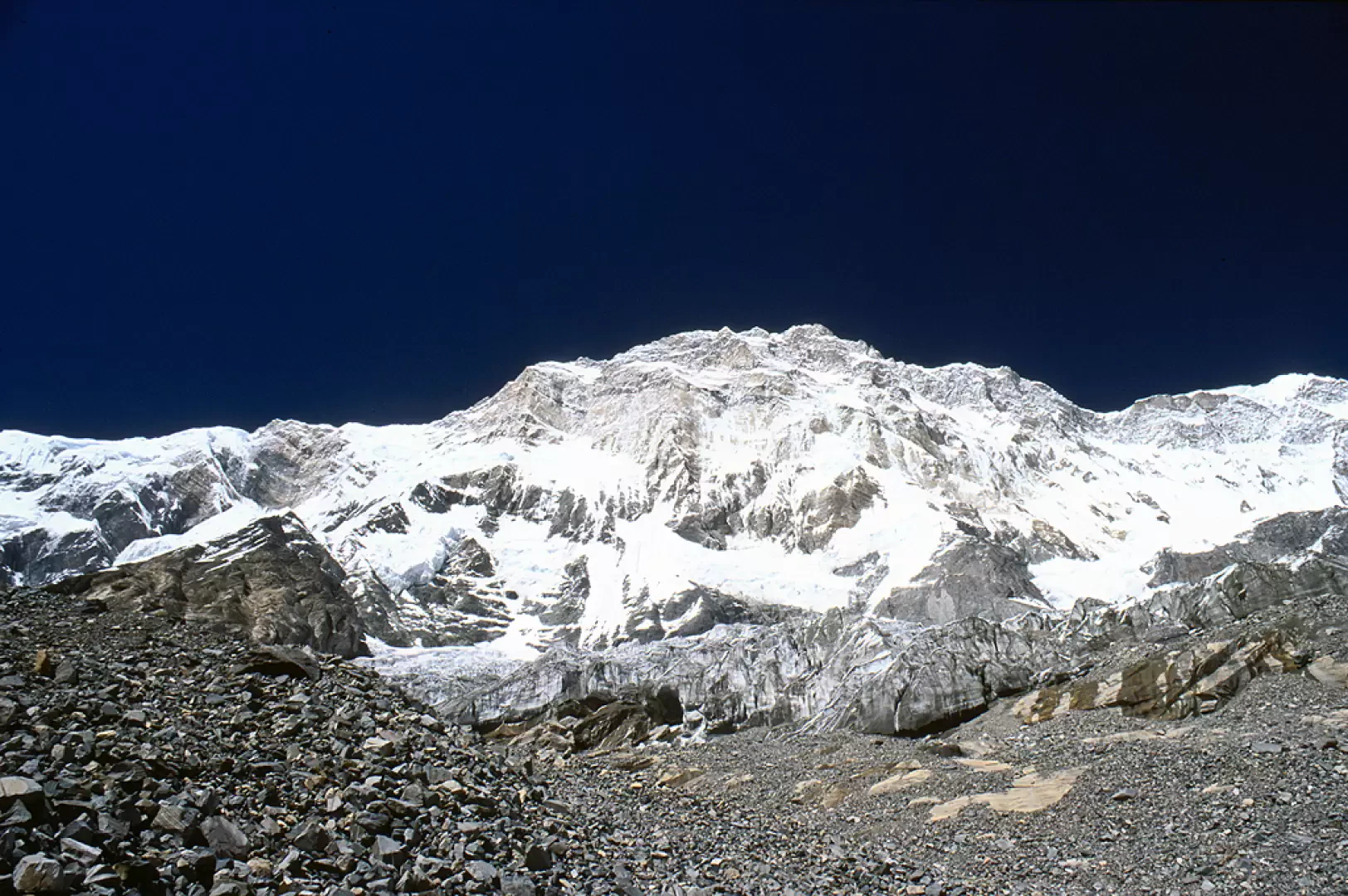
The Annapurna I can be reached mainly from the north face, following the route traced by the first climbers in 1950. Base camp is set up at around 4,200 metres, in the glacial basin at the foot of the north face. The route ascends the face through a system of glaciers and snowy channels, with the central section - known as the "Sickle" - at about 7,000 metres crossing a labyrinth of unstable seracs, the source of the most devastating avalanches in the history of the mountain. The normal route does not present extreme technical difficulties, but the combination of altitude, avalanche exposure and unpredictable weather conditions makes it one of the most dangerous climbs of all the eight-thousanders. The South Face - opened by Bonington's British expedition in 1970 with Haston and Whillans at the summit - is the most technically challenging and spectacular route, with over 3,000 metres of vertical drop.
Summer ascent routes
" from North Base Camp (4,200m), North Face route - AD - 5-7 weeks (including acclimatisation) - (normal route)
" from South Base Camp, South Face route - Bonington Spur (1970, Haston and Whillans) - ED - first deliberately difficult technical route on an eight-thousander
" from South Base Camp, Béghin-Lafaille route (1992, attempted; ascent by Steck 2013, disputed) - ED+ - very direct route on the south face
" from Base Camp, west-north-west face route (1985, Messner-Kammerlander) - D - untouched at the time of the first ascent
Winter ascent routes
" north face route (4.200m) - AD - first winter ascent 3 February 1987 (mountaineering, Kukuczka and Hajzer)
Introduction
At 8,091 metres, Annapurna I is the tenth highest mountain on earth, but it holds a very special place in the history of mountaineering: on 3 June 1950 it became the first peak above eight thousand metres to be climbed by man. The French expedition led by Maurice Herzog - made up of the elite of post-war transalpine mountaineering, with Louis Lachenal, Lionel Terray and Gaston Rébuffat among the protagonists - reached the summit without supplementary oxygen and without any previous attempts on the mountain, because Nepal had been closed to foreign mountaineers until 1946. The price of success was extremely high: the descent turned into an ordeal of avalanches, forced bivouacs and devastating frostbite that cost Herzog all his fingers and toes and Lachenal the amputation of his feet. The mountain is located in north-central Nepal, in the province of Gandaki Pradesh, separated from Dhaulagiri by the Kali Gandaki gorge to the west and bordered by Marsyangdi to the north. The name is derived from Sanskrit and means "goddess of abundance". Annapurna I holds the statistical record of the eight-thousandth mountain with the highest mortality rate: historically around one victim for every three mountaineers attempting the summit. The first winter ascent was made on 3 February 1987 by Jerzy Kukuczka and Artur Hajzer.
.Description
Geographical background
The Annapurna massif stretches about 55 kilometres in an east-west direction in north-central Nepal and comprises six main peaks: Annapurna I (8.091m), Annapurna II (7,937m), Annapurna III (7,555m), Annapurna IV (7,525m), Gangapurna (7,455m) and Annapurna South (7,219m). The main summit lies at the western end of the system, separated from Annapurna II by a wide ridge at over 7,000 metres. To the west, the Kali Gandaki gorge - considered the deepest in the world - separates the massif from Dhaulagiri (8,167m): the two eight-thousanders are less than 35 kilometres apart as the crow flies, but a river flows between them at an altitude of around 2,500 metres, creating a jump of more than 5,500 metres compared to Annapurna. To the north, the massif bounds the Annapurna Conservation Area, established in 1985 and covering 7,629 square kilometres, the first and largest protected area in Nepal.
The geology of the massif belongs to the Great Himalayan Sequence, with high-grade metamorphic rocks - gneisses, migmatites and marbles - uplifted by the collision of the Indian and Eurasian plates. The north face has a glacial profile with large areas of snow accumulation that feed unstable seracs in the Sickle section. The south face is a rock and ice structure of exceptional verticality, with channels and pillars that descend more than 3,000 metres towards the Modi Khola valley. The Annapurna Conservation Area is home to an extraordinary variety of ecosystems - from the subtropical forests of the Terai to the perennial snows - with species such as the snow leopard (Panthera uncia), Himalayan tahr (Hemitragus jemlahicus) and the red panda (Ailurus fulgens). The area is visited by tens of thousands of trekkers every year along the Annapurna Circuit and the Annapurna Shrine trek.
Mountaineering history
The Annapurna was the first major Himalayan peak to be attempted without any previous expedition. Nepal's closure to foreigners had prevented any exploration until 1946; when the Rana dynasty gradually opened the country to the outside world, the French were among the first to obtain a permit. The 1950 expedition, led by Maurice Herzog, initially reserved the choice between Dhaulagiri and Annapurna once on site; after a month of exploration and evaluation, they chose Annapurna as the main objective, identifying the access route along the north face only in mid-May. The speed of the assault was astonishing: in less than ten days, the climbers set up five camps and prepared the route. On 3 June, Maurice Herzog and Louis Lachenal started from camp 5 at about 7,400 metres and in eight hours reached the summit, without oxygen, on a mountain that no one had ever attempted before.
The descent was an ordeal. Herzog had lost his gloves on the summit and the frostbite in his hands and feet was already severe by the time he reached Camp 5, where Terray and Rébuffat were waiting for them. The next dawn brought a storm that temporarily blinded the four mountaineers; in the confusion the descent continued to a crevasse where they bivouacked, sharing just two sleeping bags between four of them. An avalanche partially buried them in snow, taking their shoes with it. At base camp, doctor Oudot was forced to perform amputations without anaesthesia. Herzog lost all his fingers and toes; Lachenal his feet. The return to France took place amidst national ovations: the feat had become a symbol of France's post-war redemption. Herzog's book, Annapurna, premier 8000, sold more than twenty million copies in sixty languages and remains one of the bestsellers in mountain literature.
Vent'years later, in 1970, Chris Bonington's British expedition opened a deliberately difficult and technical route on the south face - the first Himalayan expedition to explicitly approach difficulty, not the easiest route. Dougal Haston and Don Whillans reached the summit, without using the available oxygen; Ian Clough died in an avalanche during the descent. The feat marked the beginning of a new era in high-altitude mountaineering. In 1974, the Spaniards opened a route on the south face; in 1978, the first female ascent was carried out by the Americans Vera Komarkova and Irene Miller, as part of the American Women's Himalayan Expedition led by Arlene Blum; two companions - Alison Chadwick-Onyszkiewicz and Vera Watson - lost their lives during the same expedition. In 1985, Reinhold Messner and Hans Kammerlander opened a route on the unclimbed West-Northwest Face.
The first winter ascent was made on 3 February 1987 by Jerzy Kukuczka and Artur Hajzer, as part of a Polish expedition that also included Wanda Rutkiewicz and Krzysztof Wielicki. For Kukuczka, it was the fourth winter first ascent of an eight-thousandthousander.
The year 1992 brought one of the most dramatic episodes in the history of Annapurna: the Frenchman Pierre Béghin and the young Jean-Christophe Lafaille attempted in alpine style a direct line on the south face, which Béghin had already imagined as one of the great open problems of himalayering. The two stopped at 7,400 metres; on the descent, at 7,200 metres, a belay bolt on a double rope gave way and Béghin fell. Lafaille was left alone, with a broken arm and without equipment, and survived four days solo before managing to descend. On 25 December 1997, Anatoli Bukreev - one of the strongest Himalayan climbers of the post-Messner generation, who had already been involved in rescues during the 1996 Everest tragedy - died on Annapurna, swept away by an avalanche while attempting the north face route.
On 9 October 2013, Swiss climber Ueli Steck claimed to have opened solo, in 28 hours from the advanced base camp and back, the direct line on the south face already dreamt of by Béghin and attempted with Lafaille in 1992. The ascent was awarded the 2014 Piolet d'Or, but was later questioned by the international mountaineering community due to the absence of photographic evidence of the summit: the question remains open. The first certified ascent of the Béghin-Lafaille line was made in 2013 by French mountaineers Yannick Graziani and Stéphane Benoist.
Cultural context
The name Annapurna recalls one of the most revered deities in the Hindu pantheon: Annapurna is the goddess of abundance and food, depicted with a bowl of rice in her hand - an image of generosity in stark contrast to the reputation of a killer mountain that the peak has earned among mountaineers. For the Gurung and Magar communities living in the Marsyangdi valley bottom, the massif has always had a sacred and identity significance. The Annapurna Sanctuary - the glacial basin at the foot of the south face, reached by tens of thousands of trekkers every year - is one of the most photographed and visited Himalayan environments in Nepal. Herzog's book, published in France in 1951, was the world's first bestseller on the mountain and helped build the image of Nepal as a land of adventure and extreme challenge in the post-war European and American imagination.
Frequentation and fruition
Annapurna I remains one of the least visited of the eight-thousanders, despite the massif's notoriety in the trekking world. The northern base camp can be reached from Pokhara by trekking for about a week. The ascent permit is issued by the government of Nepal. The main seasons are spring (April-May) and autumn (October-November). The historical mortality rate - around one fatality for every three attempts - is the highest of all the eight-thousanders, although it has improved in recent decades due to better weather management.
Traverses
" Annapurna I - Annapurna III traverse
Appositions
" North Base Camp (4,200m) - in the glacial basin at the foot of the north face
Information
Quota: 8.091m
Alternative name: Annapurna = "goddess of'abundance" (Sanskrit)
Mountain group: Annapurna Himal - Central Nepalese Himalaya
Alpine chain: Himalaya
Typology: massif/main summit
Protected area: Annapurna Conservation Area (Nepal, 7.629 km²)
First ascent: 3 June 1950
First ascentionists: Maurice Herzog, Louis Lachenal
First winter ascent: 3 February 1987
First winter ascent: Jerzy Kukuczka, Artur Hajzer
Vice book: absent
Commune/s: Kaski / Myagdi (Nepal)
Valley/s: Marsyangdi Valley (N-E); Modi Khola Valley (S); Kali Gandaki Gorge (O)
Mountaineering difficulty: AD (north face normal route); ED (south face)
Average elevation: 3.891m (from Base Camp)
Recommended period: April-May; October-November
Prevalent exposure: N (normal route); S (south face)
Presence of glaciers: yes
Presence of equipped sections: yes (fixed ropes on the normal route)