Ancona

Edited by:
Massimo Martini
Access
The municipality can be reached from the Bologna-Taranto motorway via two dedicated toll stations: Ancona Nord, serving the northern side of the city and connections to Vallesina via the state road , and Ancona Sud, serving the port and southern districts. The state road Adriatica runs along the coast, connecting the territory northwards towards Senigallia-Pesaro and southwards towards Civitanova Marche. Provincial roads and provide connections with municipalities in the immediate hinterland, including Osimo, Camerano and Agugliano. The Ancona railway station is a junction on the Bologna-Pescara-Bari line operated by Trenitalia (TI) and Intercity; the same station is served by Marche regional trains. The Marche Airport of Falconara Marittima, about 15 km from the centre, can be reached by urban and extra-urban bus service. Local public transport is managed by Conerobus with urban and suburban lines that reach the main hamlets. There are no seasonal criticalities in ordinary road accessibility.
.Introduction
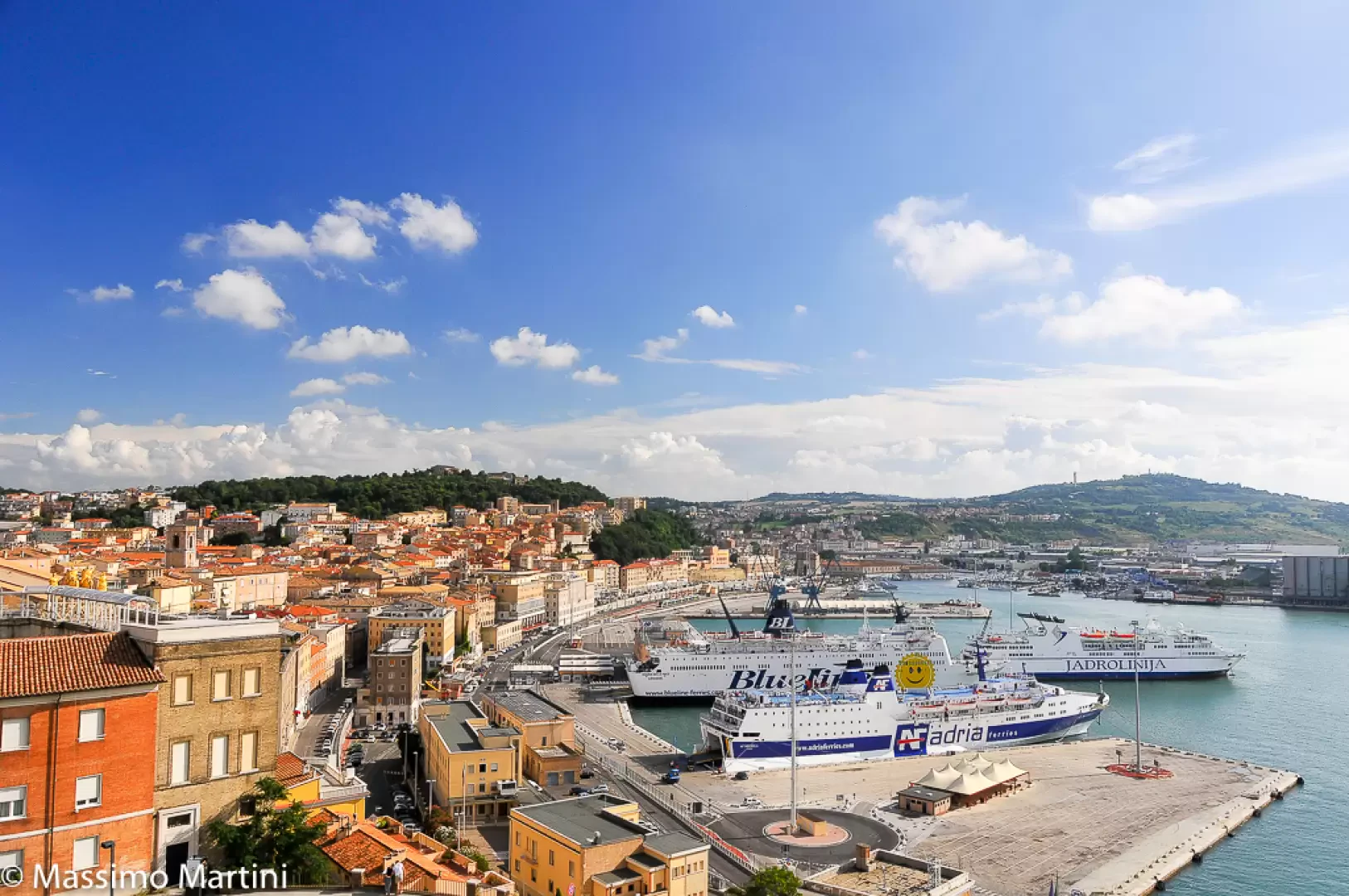
Ancona is the capital of the Marche region and the province of the same name, located on the central Adriatic coast, on the northern foothills of the Monte Conero promontory. The municipal territory is arranged on a system of hills that descend towards the sea, with the historic centre located on Guasco Hill, which forms the northern summit of the promontory and dominates the natural harbour. The shape of the coastline, angled towards the Adriatic, is the origin of the place name: the Greek name Ankón literally means "elbow" or "corner". The settlement history of the site dates back to at least the Bronze Age, with continuity through the Greek, Roman, medieval and modern periods. The foundation of the Greek colony of Syracuse in the 4th century BC marked the start of a port activity that remained structural for the entire history of the city. The municipality is bordered to the north and west by Falconara Marittima, Camerata Picena, Agugliano, Polverigi, Offagna and Osimo, and to the south by Camerano and Sirolo, municipalities that share with Ancona the Conero Regional Park strip.
.Description
The territory of Ancona lies on a promontory of almost triangular shape, formed by the northern slopes of Monte Conero, which reaches its maximum altitude of 572 m towards the southern sector of the municipality. The promontory is bordered to the west by the Gulf of Ancona, where the natural harbour is located, and to the east by a high coastline with cliffs reaching 300m in height in the Portonovo area. The morphological peculiarity of the site means that the promontory is washed by the Adriatic Sea on both the eastern and western sides, making it possible to watch the sunrise and sunset over the sea. The inland hill system is furrowed by a series of parallel valleys; among these, the Valli di Pietralacroce (Pietralacroce Valleys) descend from the town centre towards the edge of the southern cliffs. The area also has two coastal lakes in the Portonovo area: the Grande and the Profondo, which serve as resting places for migratory birdlife.
The first traces of settlement on the site date back to the Lower Palaeolithic, with flint artefacts found in the summit area of Monte Conero. The port was frequented by Greek navigators even before the founding of the colony, taking the form of a Greek-Picene maritime emporium. In 387 B.C., Syracusans of Doric stock founded the colony of Ankón, from which derives both the name of the city and the nickname "dorica" given to the people of Ancona. In Roman times Ancona became a municipium and then a colony, with the port assuming a strategic role for the Adriatic trade: the Archus of Trajan, built in the 2nd century AD on the docks, bears witness to the imperial investment in the city. In the mediaeval period Ancona was a free commune and then a seignory, before finally becoming part of the Papal States in the 16th century. To the medieval heritage belong the Cathedral of San Ciriaco, of Romanesque-Byzantine layout on Guasco hill, and the church of Santa Maria della Piazza, with its façade with arches and portal with symbolic figures. The works of Dalmatian sculptor and architect Giorgio da Sebenico date back to the 15th century: the portals of the church of San Francesco alle Scale, that of the former church of Sant'Agostino and the façade of the Loggia dei Mercanti. Between the bombings of World War II and the earthquake of 1972, the city suffered significant losses in building and demographic heritage during the 20th century.
A large part of the southern municipal territory falls within the Conero Regional Park, established in 1987 over an area of approximately 6,000 hectares. The vegetation of the park is characterised by Mediterranean maquis with holm oak (Quercus ilex), strawberry tree (Arbutus unedo), mastic tree (Pistacia lentiscus) and laurel (Viburnum tinus); On the coastal cliffs, there are red juniper (Juniperus oxycedrus), tree spurge (Euphorbia dendroides) and the Hellenic reed (Arundo pliniana). The Aleppo pine (Pinus halepensis), on the other hand, is the result of reforestation conducted in the early decades of the 20th century. The limestone caves of Monte Conero were already used in Roman times for the extraction of white stone used in the construction of the Trajan Arch and the Duomo. The city economy has historically been based on the port, still one of the main Adriatic ports for international passenger traffic, flanked by sectors such as shipbuilding, logistics and fishing. On the agricultural side, the southern area produces extra virgin olive oil and DOC wines, including Rosso Conero. On the excursion side, the Conero Park offers a network of marked trails both on the coastal side, which is steeper and steeper, and inland, which is more accessible; some of the beaches of the Conero Riviera within the municipal territory, such as Portonovo, Mezzavalle and the Vela beach, can be reached by footpaths.
Information
General Data
Area: 124.84 km²
Main town elevation: 16m
Main elevation: 572m - Monte Conero
Number of inhabitants: 100.230 (as of 01.01.2025, ISTAT)
Name of inhabitants: anconetani (or anconitani)
Patron saint: San Ciriaco
Border municipalities: Agugliano - Camerano - Camerata Picena - Falconara Marittima - Offagna - Osimo - Polverigi - Sirolo
Province of origin: Ancona
Region of origin: Marche
Nationality: Italy
Institutional site: www.comune.ancona.gov.it