Allein

Edited by:
Massimo Martini
Access
Allein is accessible from the motorway Turin–Aosta, exiting at the Aosta Est tollgate. From the tollgate, continue along the national road of the Great Saint Bernard heading north, passing through Gignod, then turn onto the regional road which climbs the hillside towards Le Plan-de-Clavel and the hamlets of the municipality. The road network is fully paved with steep sections and numerous hairpin bends; in winter, snow and ice conditions are possible, requiring appropriate tyres or snow chains. The nearest railway service is at Aosta station, on the Chivasso–Aosta line, operated by Trenitalia (TI) with connections towards Turin. The nearest airport is Turin-Caselle; Milan Malpensa is the higher-capacity alternative. Local public transport is provided by regional bus lines connecting Aosta with the municipalities of the Great Saint Bernard valley, with reduced frequencies on public holidays and in winter months.
Introduction
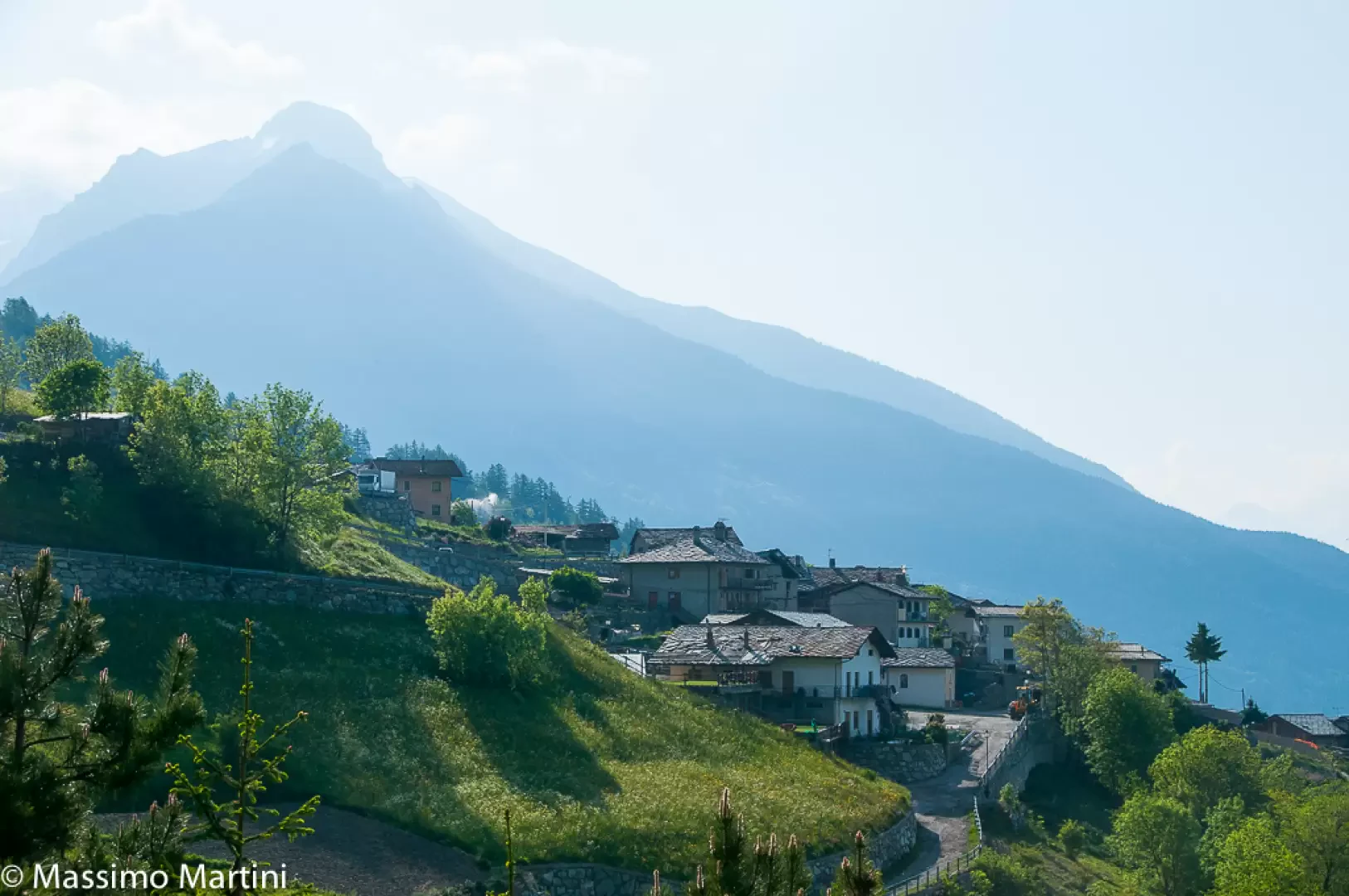
Allein is a municipality in the Aosta Valley, situated on the left orographic side of the Great Saint Bernard valley, along the corridor that rises from the Aosta plain towards the Great Saint Bernard Pass and tunnel. The administrative centre, Le Plan-de-Clavel, stands at 1,190 metres above sea level; the territory extends towards the upper ridges reaching Mont Saron, which rises above 2,600 metres. The elevated position above the road axis of national road gave the municipality a role in controlling valley traffic as far back as Roman times, when this route was used by the Salassi people heading towards Octodurus, present-day Martigny. The municipality borders Gignod, Doues and Étroubles, within an Alpine settlement system of numerous villages and rural hamlets distributed along the hillside. The municipality's identity is rooted in cattle farming, dairy production and, historically, woodworking — an activity that some etymological interpretations connect to the place name itself.
Description
The municipal territory occupies a broad, sun-facing slope cut through by the Artanavaz torrent, a tributary of the Dora Baltea. The morphology is alpine, with terraced slopes, hay meadows at lower altitudes, intermediate pasture areas and high-altitude grasslands above 2,000 metres, where the landscape opens onto scree and rocky terrain. Forest belts, composed mainly of conifers, cover the mid-slope zones and contribute to slope stability. Settlement is organised in a number of hamlets — including Ayez, Allamanaz, Bruson, Chez-Norat, Clavel, Daillon, Frein, Les Godioz and La Ville — distributed along the local road network, showing the typical constructive features of Valdostan rural architecture: stone structures, timber barns and slate roofing.
The area was crossed in Roman times by the road of the Salassi, which climbed the valley towards the Great Saint Bernard Pass to reach Octodurus. Roman presence is documented by the discovery in 1856 of a group of silver coins from the Republican period, preserved in part at the museum of the Académie Saint-Anselme in Aosta. The place name is the subject of differing interpretations: historians P. Äbischer and Dante Olivieri derive it from the Latin personal name Allius, yielding the form Allianus; historian Carla Mercato highlighted the traditional etymology ad lignum, pointing to the village's position on the edge of a wooded area and its inhabitants' traditional craft skills; a further hypothesis links the name to the presence of a community of Alans, a Sarmatian tribe documented in the western Alps in the fifth century. In the Middle Ages the municipality belonged to the Lordship of Gignod; in 1242 jurisdiction passed to the lords of Quart, who returned it to the House of Savoy in 1378. In 1543, Charles III of Savoy separated Allein and Doues from the Lordship of Gignod, selling them to Nicolas de la Crête; in 1574 the territory passed to François de la Crête, Secretary of State to Charles Emmanuel I, who obtained the title of Baron of Gignod. Having no heirs, his possessions were inherited by the Pallavicino-La Crête family, which held the territory until the final decades of the eighteenth century. In 1939, the name was Italianised to Alleno by royal decree; the form Allain was restored in 1946, while the current spelling Allein has been fixed since 1976.
The built heritage contains elements of note. In the hamlet of Ayez stands a fifteenth-century fortified house, an example of late-Gothic rural architecture in dressed stone with carved windows and a characteristic inverted keel motif; the building houses the Museum of the Carnival of the Coumba Freida. In the hamlet of Allamanaz, a sixteenth-century medieval house is documented. At La Ville, on the site of the original church, a wall fragment bears the inscription Maria anno MVII leprosis laboravit, considered the oldest document attesting to the presence of leprosy in the Aosta Valley. The parish church of Saint Stephen, consecrated in 1841, has a façade with four pilasters ending in a pediment and a spire bell tower; the parish is first mentioned in the synodal constitutions of Blessed Emeric of Quart at the beginning of the fourteenth century.
The economy has traditionally been based on cattle farming and dairy production, with Fontina PDO as the main product. Woodworking is a historically documented craft activity. Recurring events include the Fëta di Trifolle, a festival dedicated to mountain potatoes featuring the preparation of the Sorsa d'Allein, held on the last weekend of August, and the Carnival of the Coumba Freida, which involves the entire valley area. The Allein carnival is distinguished by the dominant use of red in the landzette costumes, inspired by the jackets of the Napoleonic army that passed through the area in 1800, decorated with mirrors, feathers and fringes. The municipality is part of the Unité des Communes valdôtaines Grand-Combin.
The territory is crossed by a network of trails connecting the hamlets to the upper alpine pastures and the ridges towards Mont Saron (2,681m). The routes also allow connections with the neighbouring municipalities of Doues and Gignod, passing through pastoral environments and viewpoints over the main valley. In winter, the upper slopes are used for snowshoeing and ski touring on unmarked routes.
Information
General data
Area: 7.96 km²
Altitude of main village: 1,190m
Highest point: 2,681m – Mont Saron
Population: 201 (as of 31 October 2025)
Dialect name: Alèn
Name of inhabitants: allençois
Patron saint: Saint Stephen (26 December) [to be verified: Wikipedia also mentions Saint Andrew]
Neighbouring municipalities: Doues – Étroubles – Gignod
Region: Aosta Valley
Country: Italy
Official website: https://www.comune.allein.ao.it