Aconcagua

Edited by:
Massimo Martini
Access
The Aconcagua can be climbed to different degrees of difficulty depending on the route chosen. The normal route, on the north-eastern slope, does not present any technical mountaineering difficulties - it does not require the use of ice axes and crampons in standard summer conditions - but the altitude, cold and sudden weather variations are the main risks. The approach to the base camp at Plaza de Mulas (4,370m) requires two days of trekking from the Horcones Valley; from there, the intermediate camps are climbed progressively, with obligatory acclimatisation stops. On the other hand, the technical routes - particularly the south face, which is almost 3,000m high - require consolidated mountaineering experience, mixed ice-rock skills and high altitude management. Access to the park is subject to the purchase of a permit issued by the Dirección de Recursos Naturales Renovables of the province of Mendoza; the cost varies depending on the season and type of activity. The mountaineering season is concentrated between December and March (austral summer).
Summer ascent routes
" from Plaza de Mulas (4,370m) - normal route NE side - F - approx. 8-12 days from the park entrance - (approx. 2,600mD+ from base camp) (normal route)
" from Plaza Argentina (4.200m) - Glacier of the Poles NE slope - PD - approx. 10-14 days - (approx. 2,800mD+ from base camp)
" from Plaza Francia (4,200m) - south face, route of the French - D/TD - approx. 7-10 days on the wall - (approx. 2,800mD+ from base camp)
Introduction
Aconcagua (6,962m), also known as Cerro Aconcagua, is the highest peak in the Americas, the southern hemisphere and the entire American continent. It is located in the Andes Mountains on Argentine territory, in the Las Heras department of the province of Mendoza, near the border with Chile, within the Parque Provincial Aconcagua. With a prominence of around 6,962m - second only to Everest - it is the highest non-Asian peak on the planet and is included in the rankings of the Seven Summits, the mountaineering project that involves climbing the highest peak on each continent. The mountain is an extinct palaeo-volcano whose genesis dates back to the Tertiary Andean orogeny; its appearance, dominated by ridges and slopes with no permanent snow on the north-west side, is that of a rocky pyramid of considerable grandeur. The first ascent was carried out on 14 January 1897 by Matthias Zurbriggen, a Swiss mountain guide from Macugnaga, as part of a British expedition organised by Edward Fitzgerald: Zurbriggen reached the summit alone from the north-west face, following what was to become the reference route for all subsequent expeditions. The etymology of the name is controversial: according to R.J. Secor could derive from the Quechua Anco Cahuac ("white sentinel") or Ackon Cahuak ("stone sentinel"), while in the Aymara language kon kawa means a "snow-capped mountain" and in the Mapudungun language of the Mapuche people Aconca Hue means "coming from the other side". The mountain is touched by the Aconcagua Ultra Trail and the South American High Peaks circuit.
Description
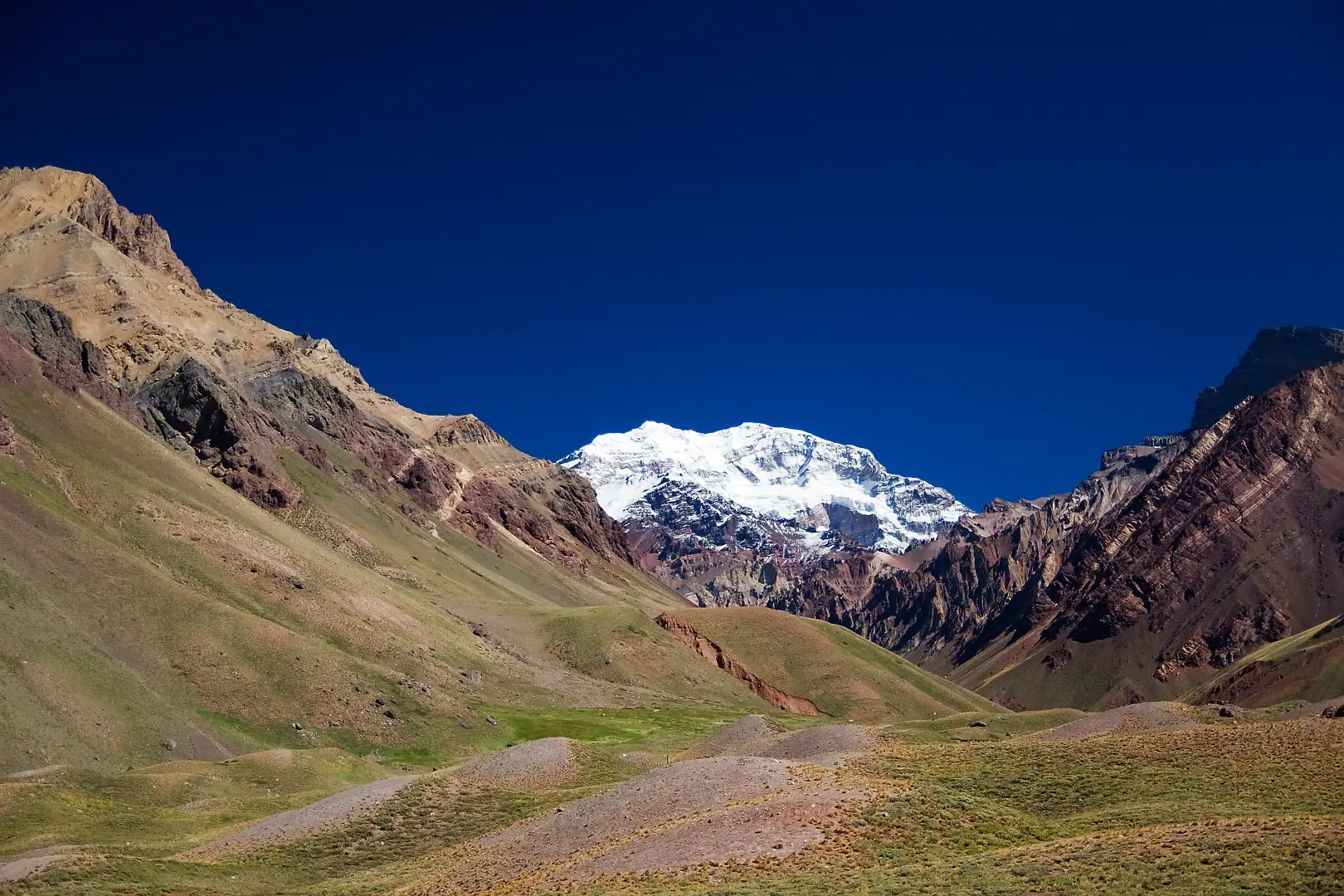
The Aconcagua is located in the Central Andes, in the sector of the Argentine-Chilean Cordillera Principal, at 32° south latitude, at the crossroads of Mendoza and Santiago de Chile. The mountain dominates an articulated valley system: to the west, the valley of the Río de las Cuevas, traversed by the Ruta Nacional 7 and the former Trans-Andean Railway; to the north-east, the Valle de las Vacas, the approach route to the east face; and to the south, the Valle de Horcones Inferior, which leads to the foot of the south face. From this position, Aconcagua rises sharply in relation to the surrounding peaks, which also exceed 5,000m in numerous cases, reaching 6,000m at Cerro Almacenes (5,345m) and Cerro de los Dedos (5,150m). Geologically speaking, the mountain is a now inactive paleo-volcano, whose structure consists of marine sedimentary rocks from the Upper Jurassic and Lower Cretaceous at the base - with marine fossils at relatively high altitudes, evidence of Andean uplift - and andesites and volcanic rocks at the summit. The genesis of Aconcagua is linked to the subduction of the Nazca plate under the South American plate, a still active process that makes the region seismically unstable. The slopes have very different characters: the north-west side is arid, with no permanent snow, and a perennial snowline of around 5,000 m due to the prevailing westerly winds; the south and east sides, which are more protected, are home to the two main glaciers - the north-eastern glacier, known as the Polish Glacier, and the eastern glacier, known as the English Glacier. The park's flora is adapted to the arid conditions and extreme altitude, with buffer species such as yareta (Azorella compacta), shrubs of the Asteraceae family and coirón grasslands (Festuca pallescens) in the lower areas, while the fauna includes the guanaco (Lama guanicoe), the puma (Puma concolor), the Andean fox (Lycalopex culpaeus), the Andean condor (Vultur gryphus) and several species of birds of prey.
The mountaineering history of Aconcagua began with a documented European attempt in 1883, when German geologist Paul Güssfeldt led an expedition that climbed the north-west spur to about 6,500m, effectively opening up the route that would become the normal route. The summit was first reached on 14 January 1897 by Matthias Zurbriggen, a mountain guide born in Saas Fee (Switzerland) and living in Macugnaga, as part of the British expedition organised by Edward Fitzgerald. Fitzgerald himself had to give up at around 6,800m due to the altitude, leaving Zurbriggen to climb solo. On 13 February of the same year, Stuart Vines and Nicola Lanti completed the second ascent. The first woman to reach the summit was Frenchwoman Adriana Bance, on 7 March 1940, accompanied by members of the Club Andinista de Mendoza. In 1934, two new routes were opened: in March, the Polish expedition formed by Daszinski and Osiecki opened the route on the north-eastern glacier, which still bears the name "Glacier of the Poles" in August, Lieutenant Nicolás Plantamura led the first Argentinean ascent, with a team that included the Italian mountaineers P. Ceresa, P. Ghigliole and R. Chabod. The first winter ascent was carried out between 11 and 15 September 1953 by the Argentinians E. Huerta, H. Vasalla and F. Godoy on the normal route. The following year, on 25 February 1954, a French expedition led by René Ferlet completed the first ascent of the south face, considered one of the most important mountaineering feats in the entire history of the Andes: Pierre Lesueuer, Adrien Dagory, Edmond Denis, Robert Paragot, Lucien Berardini and Guy Poulet spent seven days on the wall, overcoming ice walls, unstable rock slabs and sections of artificial climbing at altitudes of over 6000m, with bivouacs on makeshift terraces. Almost all the members of the expedition suffered frostbite in their limbs. In 1982, a team from the Club Andinista de Mendoza, during an attempt on a variant of the south face, found the mummy of a seven-year-old boy at an altitude of 5,200m, referable to the Inca culture, with semicircular wall structures and a ceremonial site at the summit: the discovery confirmed that Aconcagua had played a ritual role in the Inca Andean road system, the Qhapac Ñan, declared a UNESCO World Heritage Site. The mountain has had a prolific series of speed records: in 2014, Kílian Jornet covered the Horcones-peak-Horcones route in 12h49' a record that was later lowered in 2015 by Karl Egloff to 11h52'
The name Aconcagua has several unresolved etymological hypotheses: the main derivations proposed are Quechua, Aymara and Mapudungun. The name of the Aconcagua people - mentioned as early as the 18th century by the geographer Giandomenico Coleti - also designated the Chilean valley to the west of the mountain, from which the name would extend to the summit. The Inca presence on the mountain, documented by the discovery of the mummy in 1982 and the remains of wall structures at 5,200m, places Aconcagua within the sacred and commercial network of the Inca Empire, which used the high peaks of the Andes as places of sacrifice and communication with the deities. The mountain has since taken on a symbolic role in contemporary Argentine identity, with frequent national expeditions and a strong trekking and organised mountaineering industry centred on the city of Mendoza.
Aconcagua is one of the most visited non-Himalayan peaks on the planet: the mountaineering season records several thousand attempts each year, with a success rate on the normal route of around 30-40% due to weather conditions and altitude sickness. Access to the Parque Provincial Aconcagua is from the Horcones junction on Ruta Nacional 7, about 185km from Mendoza; the park entrance is at an altitude of 2,850m. All activities within the protected area require prior permission. The optimal season is from December to March, with the most stable conditions typically concentrated between the second half of January and the first half of February.
Shelters
No managed shelters present along the main routes. Expeditions set up their own camps at altitude. Service facilities (toilets, park doctor) are present at Plaza de Mulas (4,370m).
Information
General Data
Height: 6.962m
Alternative name: Cerro Aconcagua
Mountain group: Central Andes - Cordillera Principal
Chain: Cordillera de los Andes
Typology: extinct paleo-volcano / rock pyramid
Protected area: Parque Provincial Aconcagua (Mendoza province, Argentina)
First ascent: 14 January 1897
First climber: Matthias Zurbriggen (Swiss mountain guide, res. Macugnaga; British expedition dir. Edward Fitzgerald)
First winter ascent: September 1953
First winter climbers: E. Huerta, H. Vasalla, F. Godoy (Argentina)
First female ascent: 7 March 1940 - Adriana Bance (France)
First south face: 25 February 1954 - French expedition dir. René Ferlet
Summit book: present
Municipality(s): Las Heras department, Mendoza province (Argentina)
Mountaineering difficulty: F (normal route) - D/TD (south face)
Mountaineering grade: approx. 2,600m from base camp Plaza de Mulas (4,370m)
Recommended period: December-March
Prevalent exposure: NE (normal route) - S (south face)
Presence of glaciers: yes (Polish Glacier, English Glacier)
Presence of equipped sections: no (normal route) - yes (technical south face routes)