Abriès-Ristolas

Edited by:
Massimo Martini
Access
The commune of Abriès-Ristolas can be reached by taking the departmental road , which runs up the entire Guil Valley from Guillestre to the high-altitude villages. There are no direct motorway links to the area: access is exclusively via the network of departmental roads, some of which are narrow and subject to seasonal snow closures. The reference railway station is Guillestre-Mont-Dauphin, operated by the SNCF on the Briançon-Gap line, with local bus services connecting the valley floor to inland villages. The nearest airports are Turin Caselle and Grenoble, both of which can be used depending on where you are coming from. The Colle dell'Agnello, the border pass with Italy, can be crossed by the departmental road and is subject to winter closure for several months, generally from November to April.
.Introduction
Abriès-Ristolas is a commune in the Hautes-Alpes département, in the Provence-Alpes-Côte d'Azur region, located in the Haut-Valley du Guil, on the slopes of the Cottian Alps, a few kilometres from the Italian border. The territory, entirely mountainous, stretches between 1,500 and 3,300 metres above sea level and includes the two historical nuclei of Abriès and Ristolas, merged into a single municipality in 2016. The entire area falls within the Queyras Regional Natural Park, which defines its environmental structure and guides its local development policies. The municipality borders Italian territory to the east through the Colle dell'Agnello pass, an ancient alpine passage along the route between the Dauphiné and Piedmont. The traditional economy, based on livestock breeding and transhumance, has given way over time to a mixed model in which seasonal mountain tourism is the main component.
Description
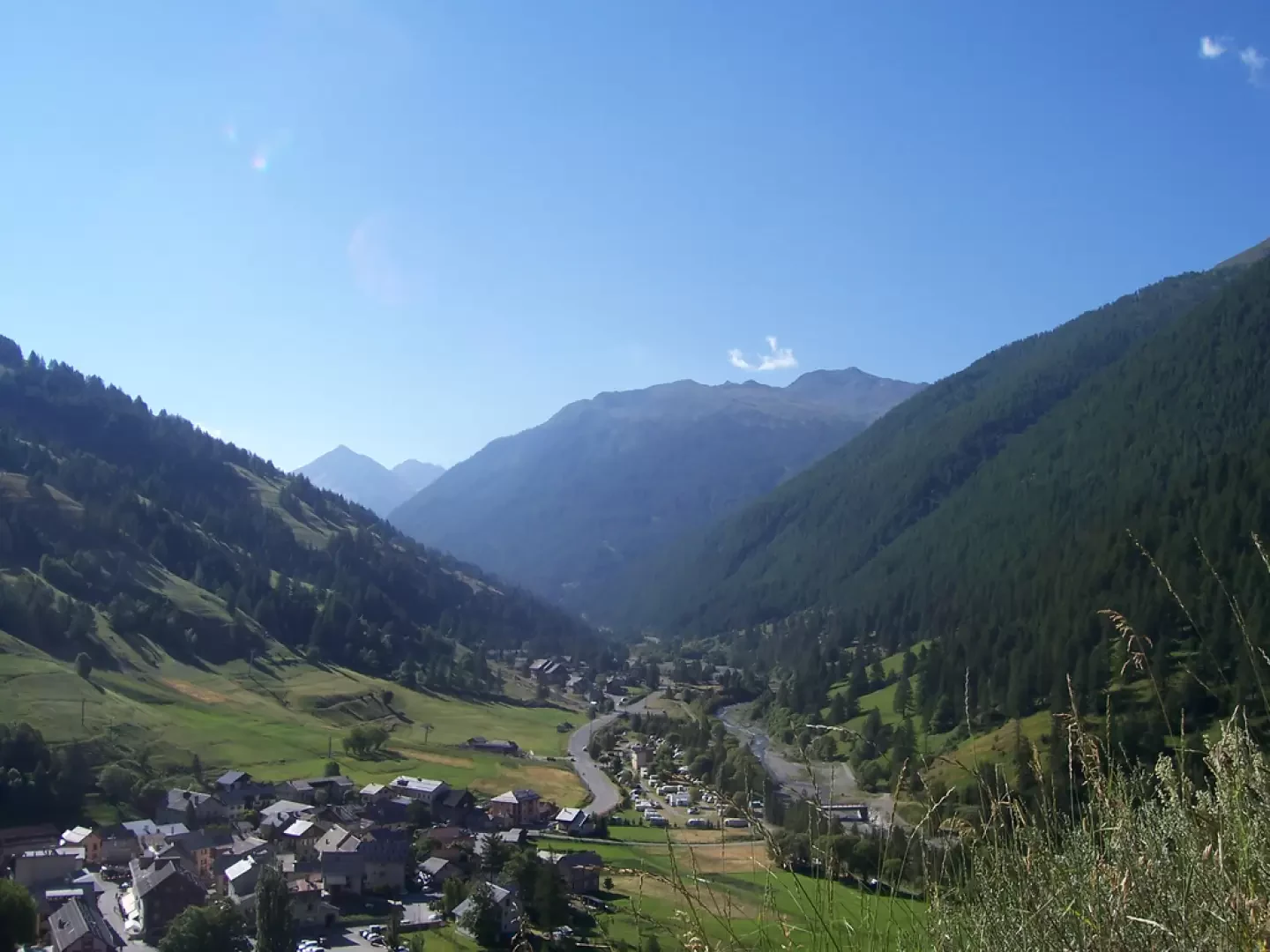
The territory of Abriès-Ristolas is defined by the morphology of the Alta Valle del Guil, a deep furrow oriented in an east-west direction that progressively opens up towards the border relief with Piedmont. The Guil stream runs through the entire valley, fed by a series of lateral tributaries from the glacial cirques at higher altitudes. The slopes are occupied by extensive forests of larch (Larix decidua) and stone pine (Pinus uncinata), which gradually thin out above 2,200 metres, leaving room for high-altitude pastures and rocky ridges. The highest point of the municipal territory is marked by Punta Ramière - Bric Froid at 3,302 metres. High-altitude lake basins include Lake Egorgéou and Lake Barical, both in a glacial environment.
The earliest evidence of settlements dates back to the medieval period, when the border strip between the Dauphiné and Piedmont played a strategic role in transalpine traffic. The building fabric of the two villages retains elements of rural Occitan architecture, with stone houses, carved portals and votive chapels located along the communication routes. The Colle dell'Agnello pass was already frequented in the Middle Ages as a commercial and military passage between the two Alpine sides. The administrative confluence of Abriès and Ristolas, which took place in 2016, gave rise to the current unified municipality without changing the identities of the respective nuclei.
The Queyras community belongs to the Occitan linguistic area, and Abriès-Ristolas preserves some of its traits in its oral traditions, patronal festivals and local place names. The rural economy has historically been based on sheep and cattle breeding and the production of alpine cheeses, a practice that remains active in the summer months thanks to the network of high-altitude mountain pastures. Mountain tourism, both summer and winter, now constitutes the municipality's main economic activity, with offerings concentrated on hiking, ski mountaineering and snowshoeing.
The municipality's trail network is among the most articulated in the Queyras Regional Nature Park. The main routes of interest include the traverse to the Colle dell'Agnello, itineraries to the high altitude glacial lakes and tracks along the Guil Valley, where the presence of chamois (Rupicapra rupicapra) and golden eagle (Aquila chrysaetos) is documented. A structure dedicated to environmental education operates at Ristolas, a reference point for nature activities in the eastern sector of the park.
.Information
General Data
Area: 159.31 km²
Main town elevation: 1,513m
Maximum elevation: 3,302m - Punta Ramière - Bric Froid
Number of inhabitants: 379 (as at 31.12.2022)
Name in dialect: Abrìas-Ristòlas (Occitan)
Name of the inhabitants: Abriessois
Patron saint: St. Peter (Abriès, 29 June) - St. Michael (Ristolas, 29 September)
Neighbouring municipalities: Aiguilles - Bobbio Pellice - Cervières - Cesana Torinese - Prali - Sauze di Cesana
Department of affiliation: Hautes-Alpes
Region of affiliation: Hautes-Alpes-Côte d'Azur
Nationality: France
Institutional site: https://www.abries-ristolas.fr