Challand-Saint-Anselme

Edited by:
redazione
Access
Challand-Saint-Anselme, situated at an altitude of 734 metres in the Val d'Ayas, can be reached by various means of transport.
For those travelling by air, the nearest airport is Turin Caselle, approximately 115 km away. Other options include Milan Malpensa (180 km), Milan Linate (200 km) and Geneva Airport (140 km).
As for rail travel, the nearest station is Verrès, on the Chivasso–Ivrea–Aosta line, about 5 km from the town. From there, you can continue by regular bus services serving the Val d’Ayas, with stops at Challand-Saint-Victor, Challand-Saint-Anselme, Brusson and other towns as far as Saint-Jacques.
By car, you can take the A5 Turin–Aosta motorway to the Verrès exit, situated about 4 km from Challand-Saint-Anselme. From there, continue along the Val d’Ayas Regional Road 45, which runs through the municipal area. The provincial road network is well developed and connects the valley’s main towns, facilitating access to the municipality.
For those who prefer public transport, there are bus services from Verrès railway station to the Val d’Ayas, with stops at Challand-Saint-Anselme. Furthermore, during the winter season, transfer services operate from Turin Caselle and Milan Malpensa airports to the main resorts in the Aosta Valley.
In summary, Challand-Saint-Anselme is easily accessible by both private and public transport, thanks to an efficient transport network linking the region to the main cities and transport hubs of northern Italy and neighbouring areas.
Introduction
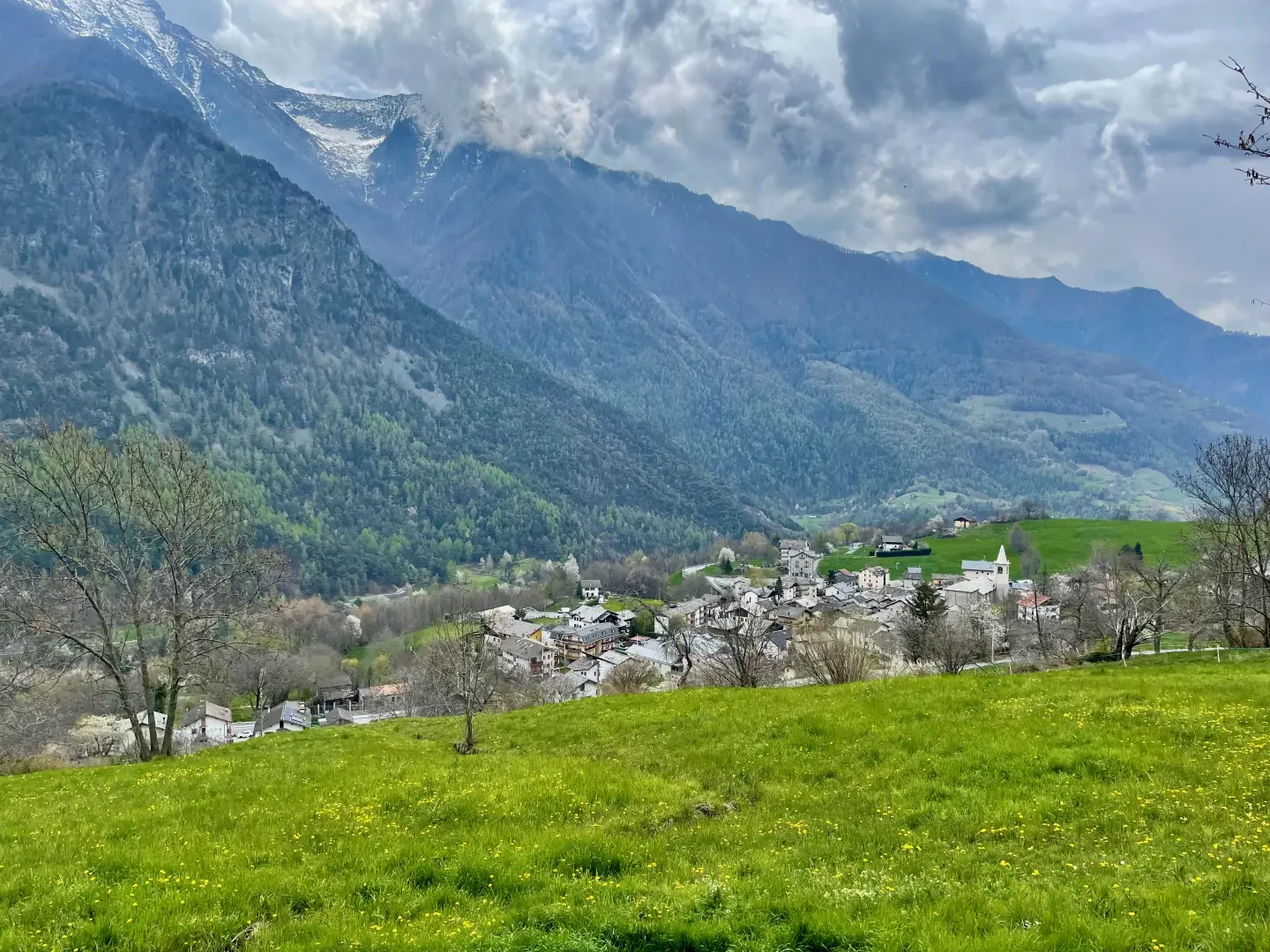
Challand-Saint-Anselme is a charming village situated in the Val d’Ayas, in the Aosta Valley, at an altitude of 1,036 metres. Surrounded by chestnut and walnut woods, this small village offers an unspoilt natural environment steeped in history.
The territory of Challand-Saint-Anselme covers approximately 28 km², situated between the municipalities of Challand-Saint-Victor downstream and Brusson upstream. The landscape is characterised by dense woods, meadows and pastures alternating with mountainous peaks such as Corno Bussola and Becca Torché, offering breathtaking views and a wealth of biodiversity.
Description
The origins of the municipality date back to the time of the Salassi, an ancient people who exploited the area’s mineral resources. Later, during the Middle Ages, the territory became part of the fiefdom of the noble Challant family, an influential house from the Aosta Valley. In 1746, the parish was established under the jurisdiction of the Bishop of Aosta and dedicated to Saint Anselm. Over the centuries, the municipality has undergone various administrative changes, including its merger with Challand-Saint-Victor during the Fascist period, before regaining its autonomy in 1946.
The local economy is based mainly on agriculture, livestock farming and crafts. Woodworking is particularly significant, with the production of traditional items such as ‘sabots’, the typical wooden clogs. In recent years, tourism has taken on an increasingly important role, thanks to the numerous opportunities the area offers for lovers of nature and outdoor activities.
The culture of Challand-Saint-Anselme is rich in traditions. Among the most significant events is the ‘Fehta da tchivra’ (Goat Festival), which takes place on the first weekend of July in the hamlet of Quinçod, celebrating local pastoral traditions. During this event, visitors can watch demonstrations of traditional crafts, sample local specialities and take part in celebrations involving the whole community.
For hiking enthusiasts, Challand-Saint-Anselme offers numerous trails winding through woods and mountains. One of the most picturesque routes is the one along the Ru d’Arlaz, an ancient irrigation channel that crosses the Arlaz forest, offering panoramic views and the chance to admire the waterfall of the same name. Furthermore, peaks such as the Corno Bussola and the Becca Torché provide opportunities for more challenging hikes, with spectacular views over the valley. In winter, the nearby towns of Brusson and Champoluc offer facilities for cross-country and downhill skiing, making Challand-Saint-Anselme an ideal base for winter sports enthusiasts.
In short, Challand-Saint-Anselme is an ideal destination for those wishing to immerse themselves in the tranquillity of the mountains, whilst discovering the rich history and traditions of the Aosta Valley. The combination of natural beauty, cultural heritage and recreational opportunities makes this town a fascinating place to visit in every season.
Information
Area: 27.99 km²
Altitude: 1,030 m
Highest point: 3,032 m - Becca di Vlou
Population: 740 (as at 1 January 2024)
Name in dialect: Tchallan
Name of inhabitants: Challandins
Patron saint: St Anselm of Aosta (7 September)
Neighbouring municipalities: Brusson, Challand-Saint-Victor, Emarèse, Issime
Website: www.comune.challand-st-anselme.ao.it
Places of interest
- mountain pastures - map
- villages - map
- hills - map
- peaks - map
- cultural heritage - map
- places of worship - map