
Edited by:
redazione
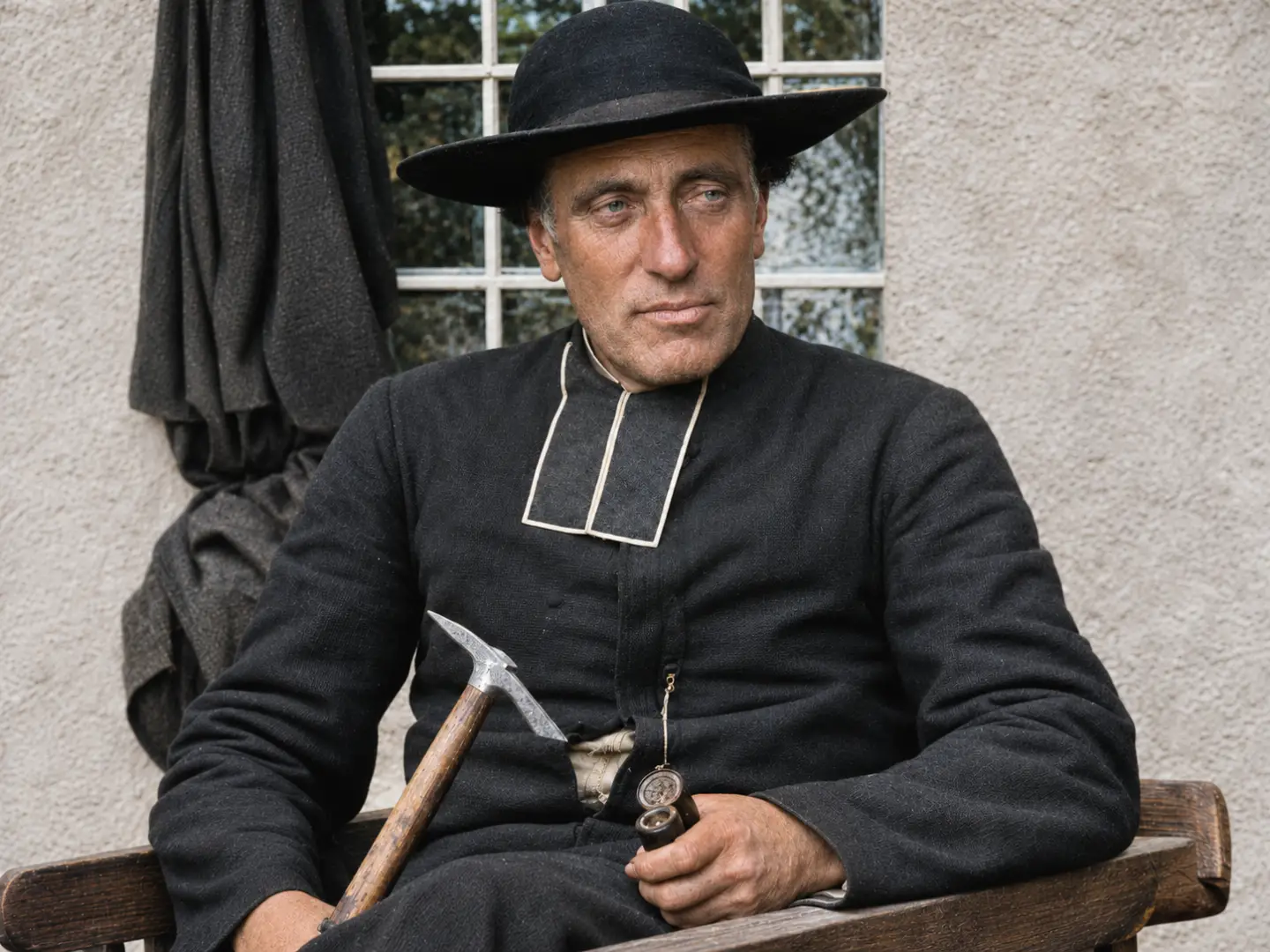
A priest and mountaineer from Valtournenche; in 1865, he was part of the climbing party that pioneered the Italian route up the Matterhorn and signed his writings as ‘l’Ours de la Montagne’.
Personal details
Name: Amé Gorret (also Aimé)
Date of birth: 25 October 1836 - Valtournenche
Died: 4 November 1907 - Saint-Pierre
Nationality: Italian
Occupation: priest, mountaineer, writer
Pseudonym / nickname: l'Ours de la Montagne; le Grand Gorret; l'Ermite de Saint-Jacques
Biography
Amé Gorret was born in Valtournenche on 25 October 1836, then part of the Kingdom of Sardinia, to Jean-Antoine Gorret, a mountain guide, and Marie-Véronique Carrel. He spent his childhood in the Cheneil valley, which at the time was an area of pastures and farmland. He belongs to the generation of priests from the Aosta Valley who, in the nineteenth century, combined their ministry with mountaineering and writing – the same generation that produced figures such as theAbbé Joseph-Marie Henry.
He studied under the parish priest and the curate of the village, then at the seminary in Aosta, and was ordained a priest on 25 May 1861. As a seminarian, in 1857, he took part with Jean-Antoine Carrel and Jean-Jacques Carrel in the first attempt on the Matterhorn, setting off from Breuil, during which they climbed the Testa del Leone.
His name remains associated above all with July 1865. Following the first ascent of the Matterhorn from the Swiss side, achieved on 14 July by the party led by Edward Whymper, Carrel sought companions to complete the Italian route, but the guides from Valtournenche proved reluctant. Gorret offered to accompany him; at the last moment, Jean-Baptiste Bich and Jean-Augustin Meynet joined them. The party set off from Breuil on 16 July. Just below the summit, Gorret – the heaviest of the four – and Meynet stopped to lower their companions down the couloir separating them from the final ridge and to secure their return; Carrel and Bich reached the summit on 17 July, three days after Whymper. Gorret reported the ascent in an account published in the *Feuille d’Aoste*.
His life as a priest was marked by a series of transfers. His first parish was Champorcher, from August 1861; on 1 August of that year, he met King Victor Emmanuel II there, with whom he forged a bond based on their shared love of the mountains. This was followed by Saint-Pierre in 1864, Cogne in 1865 and Valgrisenche in 1866; between 1869 and 1880 he changed posts frequently and taught at the seminary in Aosta. From 1881, he served three parishes in the Dauphiné, in France, until, in 1884, a decree by the French government required the repatriation of foreign priests. On his return to the Aosta Valley, he was appointed rector of Saint-Jacques, at the head of the Ayas Valley, at the foot of Monte Rosa, where he remained for twenty-one years, living in poverty, alleviated by a grant from Queen Margherita.
He wrote in French, the cultured language of the Aosta Valley in his day. Together with Baron Claude-Nicolas Bich, he published a guide to the Aosta Valley in 1876Aosta, describing the transport routes and accommodation facilities of the time, and a few years later a book on the hunting expeditions and Alpine stays of Victor Emmanuel II. He published accounts of his climbs in the bulletins of mountaineering clubs in Italy, France and Switzerland, signing his writings as theOurs de la Montagne. The historian Alexis Bétemps has also highlighted his work observing popular culture, interpreting it as that of one of the first ethnographers from the Aosta Valley.
His reputation as a man who did not quite conform to the standards of the clergy followed him throughout his life and is regarded by biographers as the reason for his frequent transfers to isolated parishes. The anecdotes that have been passed down concern his build, which earned him the nickname ‘Grand Gorret’, and his promise to always ‘carry’ his cassock, a promise he kept by keeping it in his rucksack.
From 1902 his eyesight deteriorated and in 1903 he underwent eye surgery in Turin. In 1905, he left Saint-Jacques for the priory of Saint-Pierre, a retirement home for elderly priests, where he lived with other priests from the Aosta Valley, including Abbé Cerlogne. In 1907, he climbed to the Little St Bernard Pass for the last time. He died in Saint-Pierre on 4 November 1907.
Mountaineering exploits
Testa del Leone (3,715 m) – July 1857 – first ascent, with Jean-Antoine Carrel and Jean-Jacques Carrel, during the first attempt on the Matterhorn from Breuil
Matterhorn (4,478 m), Cresta del Leone – 16–17 July 1865 – first ascent from the Italian side, with Jean-Antoine Carrel, Jean-Baptiste Bich and Jean-Augustin Meynet; Gorret and Meynet stopped just below the summit, which was reached by Carrel and Bich
Places and names
Pointe Aimé Gorret (3,191 m) - Valtournenche, the range between the Fiorio and the Clapier
Works
Guide de la Vallée d'Aosta, with Claude-Nicolas Bich, Turin, Casanova, 1876
Victor-Emmanuel sur les Alpes, Turin, Casanova, 1879
Autobiography and Miscellaneous Writings, Valtournenche, Municipal Council, 1998 (posthumous collection)
Bibliography
As a writer
Alexis Bétemps, From the Last Bear to the First Ethnographer: Abbé Aimé Gorret, *Le Monde alpin et rhodanien*, vol. 31, 2003, pp. 149–159
As a key reference
Edward Whymper, Scrambles amongst the Alps in the years 1860–69, London, John Murray, 1871 (appendix on the Italian ascent of 1865)
Xavier Favre, L’Ermite de Saint-Jacques, Musumeci, 2007
Alexis Bétemps, Aimé Gorret, Omega, 2007